

436
S. Schiele et al.
Commonly, crystals are still described with only few size parameters (such as
a diameter or other characteristic lengths). Such descriptions neglect the complex
shape that crystals may express. It is not uncommon that crystals have e.g. needlelike shapes or form even more complex structures through agglomeration that are
impossible to describe with only one or even a few size parameters.
Today, morphology of crystals is gaining increasing attention not only as a quality
criterion, but also as process parameter. Therefore, it is of great interest to describe
the morphology of crystals correctly in order to be able to model crystallization with
correct consideration of crystal morphology.
The aim of this article is to summarize the efforts that was made in context
of a collaborative research project (DFG SPP 1679) towards correct description of
crystals and crystallization modeling [1–9]. Such models could then be used in future
to optimize and control crystallization processes with respect to downstream process
performance and product quality.
2 Mathematical Description of Crystals
This section summarizes the basic mathematical crystal representation used in Reinhold et al. [9] and Kovaˇ cevi´ c et al. [1, 2, 4], which all used potash alum as an
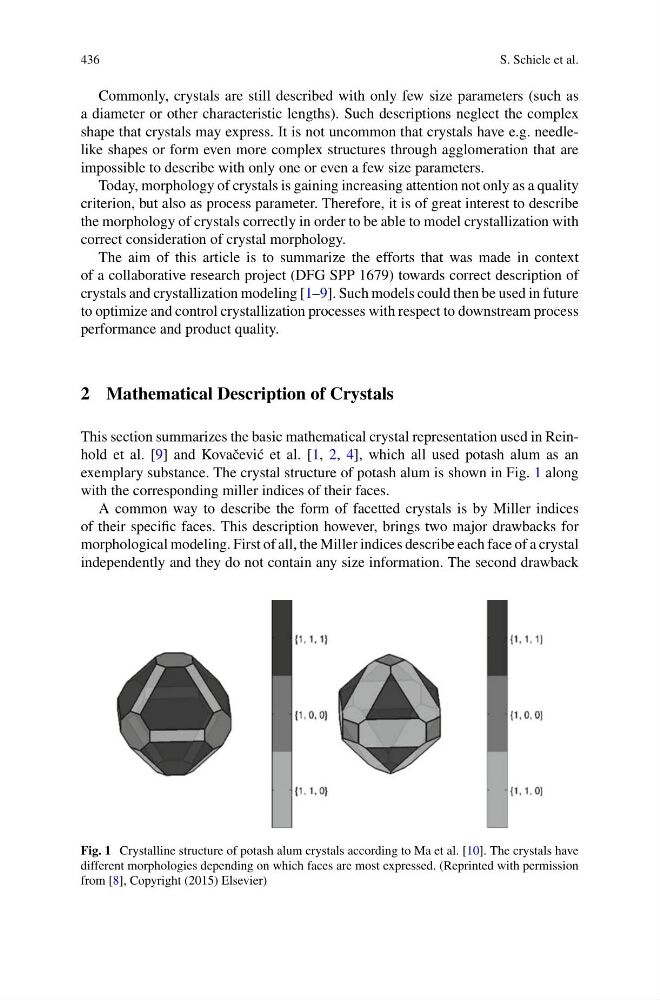
exemplary substance. The crystal structure of potash alum is shown in Fig. 1 along
with the corresponding miller indices of their faces.
A common way to describe the form of facetted crystals is by Miller indices
of their specific faces. This description however, brings two major drawbacks for
morphological modeling. First of all, the Miller indices describe each face of a crystal
independently and they do not contain any size information. The second drawback
Fig. 1 Crystalline structure of potash alum crystals according to Ma et al. [10]. The crystals have
different morphologies depending on which faces are most expressed. (Reprinted with permission
from [8], Copyright (2015) Elsevier)
S. Schiele et al.
Commonly, crystals are still described with only few size parameters (such as
a diameter or other characteristic lengths). Such descriptions neglect the complex
shape that crystals may express. It is not uncommon that crystals have e.g. needlelike shapes or form even more complex structures through agglomeration that are
impossible to describe with only one or even a few size parameters.
Today, morphology of crystals is gaining increasing attention not only as a quality
criterion, but also as process parameter. Therefore, it is of great interest to describe
the morphology of crystals correctly in order to be able to model crystallization with
correct consideration of crystal morphology.
The aim of this article is to summarize the efforts that was made in context
of a collaborative research project (DFG SPP 1679) towards correct description of
crystals and crystallization modeling [1–9]. Such models could then be used in future
to optimize and control crystallization processes with respect to downstream process
performance and product quality.
2 Mathematical Description of Crystals
This section summarizes the basic mathematical crystal representation used in Reinhold et al. [9] and Kovaˇ cevi´ c et al. [1, 2, 4], which all used potash alum as an
exemplary substance. The crystal structure of potash alum is shown in Fig. 1 along
with the corresponding miller indices of their faces.
A common way to describe the form of facetted crystals is by Miller indices
of their specific faces. This description however, brings two major drawbacks for
morphological modeling. First of all, the Miller indices describe each face of a crystal
independently and they do not contain any size information. The second drawback
Fig. 1 Crystalline structure of potash alum crystals according to Ma et al. [10]. The crystals have
different morphologies depending on which faces are most expressed. (Reprinted with permission
from [8], Copyright (2015) Elsevier)