

426
K. Vaupel et al.
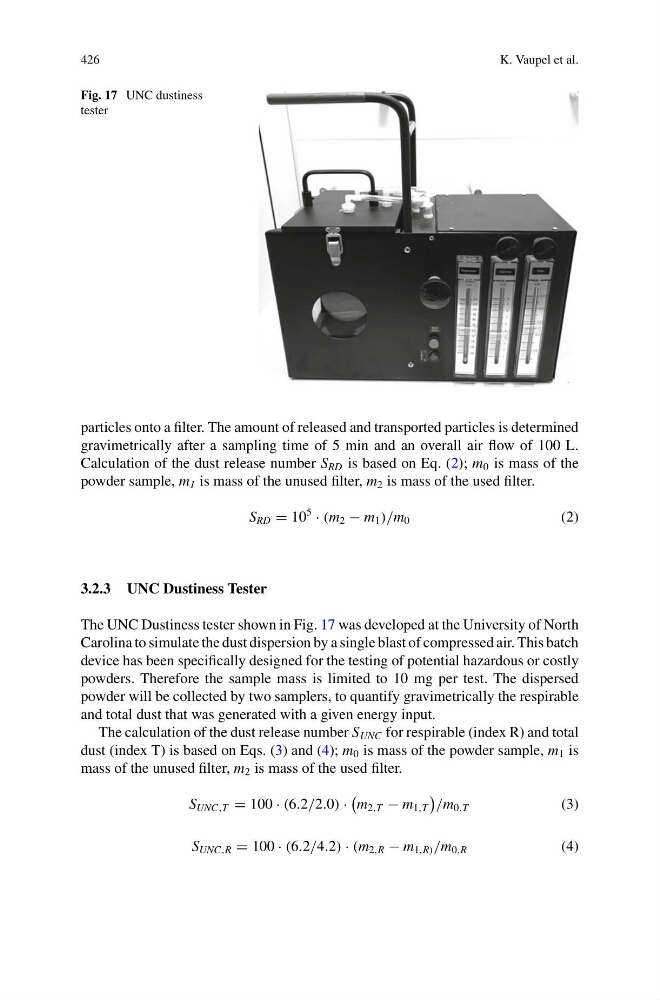
Fig. 17 UNC dustiness
tester
particles onto a filter. The amount of released and transported particles is determined
gravimetrically after a sampling time of 5 min and an overall air flow of 100 L.
Calculation of the dust release number S RD is based on Eq. (2); m 0 is mass of the
powder sample, m 1 is mass of the unused filter, m 2 is mass of the used filter.
S RD = 10
5
· (m 2 − m 1 )/m 0
(2)
3.2.3 UNC Dustiness Tester
The UNC Dustiness tester shown in Fig. 17 was developed at the University of North
Carolina to simulate the dust dispersion by a single blast of compressed air. This batch
device has been specifically designed for the testing of potential hazardous or costly
powders. Therefore the sample mass is limited to 10 mg per test. The dispersed
powder will be collected by two samplers, to quantify gravimetrically the respirable
and total dust that was generated with a given energy input.
The calculation of the dust release number S UNC for respirable (index R) and total
dust (index T) is based on Eqs. (3) and (4); m 0 is mass of the powder sample, m 1 is
mass of the unused filter, m 2 is mass of the used filter.
S UNC,T = 100 · (6.2/2.0) ·
m 2,T − m 1,T
/m 0,T
(3)
S UNC,R = 100 · (6.2/4.2) · (m 2,R − m 1,R) /m 0,R
(4)
K. Vaupel et al.
Fig. 17 UNC dustiness
tester
particles onto a filter. The amount of released and transported particles is determined
gravimetrically after a sampling time of 5 min and an overall air flow of 100 L.
Calculation of the dust release number S RD is based on Eq. (2); m 0 is mass of the
powder sample, m 1 is mass of the unused filter, m 2 is mass of the used filter.
S RD = 10
5
· (m 2 − m 1 )/m 0
(2)
3.2.3 UNC Dustiness Tester
The UNC Dustiness tester shown in Fig. 17 was developed at the University of North
Carolina to simulate the dust dispersion by a single blast of compressed air. This batch
device has been specifically designed for the testing of potential hazardous or costly
powders. Therefore the sample mass is limited to 10 mg per test. The dispersed
powder will be collected by two samplers, to quantify gravimetrically the respirable
and total dust that was generated with a given energy input.
The calculation of the dust release number S UNC for respirable (index R) and total
dust (index T) is based on Eqs. (3) and (4); m 0 is mass of the powder sample, m 1 is
mass of the unused filter, m 2 is mass of the used filter.
S UNC,T = 100 · (6.2/2.0) ·
m 2,T − m 1,T
/m 0,T
(3)
S UNC,R = 100 · (6.2/4.2) · (m 2,R − m 1,R) /m 0,R
(4)