

422
K. Vaupel et al.
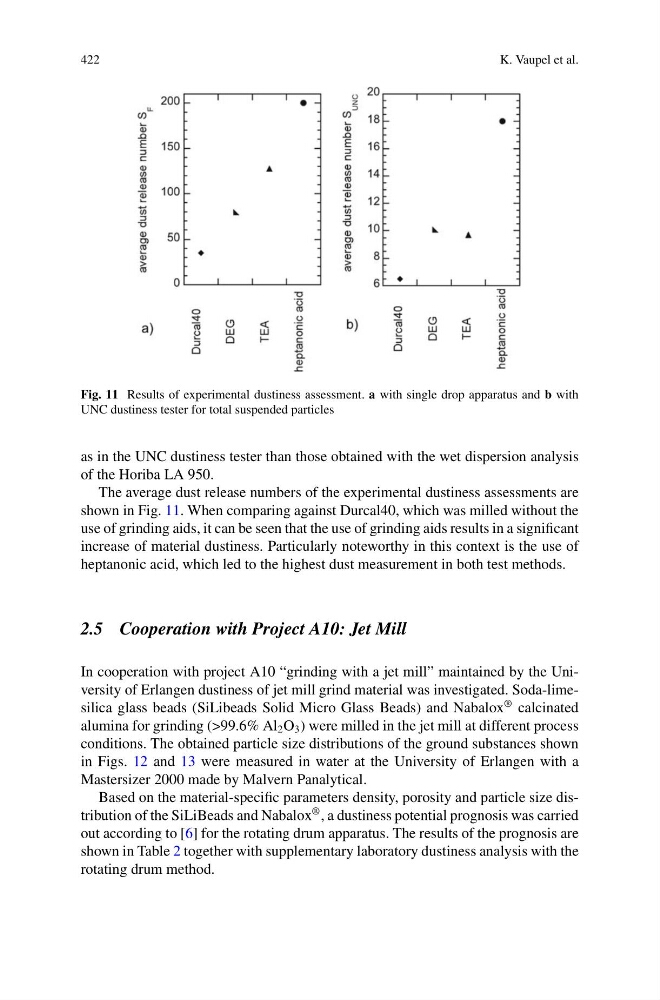
Fig. 11 Results of experimental dustiness assessment. a with single drop apparatus and b with
UNC dustiness tester for total suspended particles
as in the UNC dustiness tester than those obtained with the wet dispersion analysis
of the Horiba LA 950.
The average dust release numbers of the experimental dustiness assessments are
shown in Fig. 11. When comparing against Durcal40, which was milled without the
use of grinding aids, it can be seen that the use of grinding aids results in a significant
increase of material dustiness. Particularly noteworthy in this context is the use of
heptanonic acid, which led to the highest dust measurement in both test methods.
2.5 Cooperation with Project A10: Jet Mill
In cooperation with project A10 “grinding with a jet mill” maintained by the University of Erlangen dustiness of jet mill grind material was investigated. Soda-limesilica glass beads (SiLibeads Solid Micro Glass Beads) and Nabalox
® calcinated
alumina for grinding (>99.6% Al 2 O 3 ) were milled in the jet mill at different process
conditions. The obtained particle size distributions of the ground substances shown
in Figs. 12 and 13 were measured in water at the University of Erlangen with a
Mastersizer 2000 made by Malvern Panalytical.
Based on the material-specific parameters density, porosity and particle size distribution of the SiLiBeads and Nabalox
® , a dustiness potential prognosis was carried
out according to [6] for the rotating drum apparatus. The results of the prognosis are
shown in Table 2 together with supplementary laboratory dustiness analysis with the
rotating drum method.
K. Vaupel et al.
Fig. 11 Results of experimental dustiness assessment. a with single drop apparatus and b with
UNC dustiness tester for total suspended particles
as in the UNC dustiness tester than those obtained with the wet dispersion analysis
of the Horiba LA 950.
The average dust release numbers of the experimental dustiness assessments are
shown in Fig. 11. When comparing against Durcal40, which was milled without the
use of grinding aids, it can be seen that the use of grinding aids results in a significant
increase of material dustiness. Particularly noteworthy in this context is the use of
heptanonic acid, which led to the highest dust measurement in both test methods.
2.5 Cooperation with Project A10: Jet Mill
In cooperation with project A10 “grinding with a jet mill” maintained by the University of Erlangen dustiness of jet mill grind material was investigated. Soda-limesilica glass beads (SiLibeads Solid Micro Glass Beads) and Nabalox
® calcinated
alumina for grinding (>99.6% Al 2 O 3 ) were milled in the jet mill at different process
conditions. The obtained particle size distributions of the ground substances shown
in Figs. 12 and 13 were measured in water at the University of Erlangen with a
Mastersizer 2000 made by Malvern Panalytical.
Based on the material-specific parameters density, porosity and particle size distribution of the SiLiBeads and Nabalox
® , a dustiness potential prognosis was carried
out according to [6] for the rotating drum apparatus. The results of the prognosis are
shown in Table 2 together with supplementary laboratory dustiness analysis with the
rotating drum method.