

11 Experimental Study and Modelling of Particle …
407
Mann, “Experimentelle Untersuchung, Modellierung und dynamische Simulation
der mehrstufigen turbulenten Partikel-Querstromklassierung” (Otto-von-GuerickeUniv. Magdeburg, 2016). In principle, it amounts to a discretisation of the zigzag
channel in a (possibly large) number of compartments exchanging mass fluxes of particles with specific properties through their boundaries. Using an iterative approach,
steady-state conditions can be reached.
Unsteady predictions are in principle possible as well. Though this model is attractive and could deliver a high accuracy, it requires a good knowledge of many parameters and is not well suited for an integration into the central simulation software
DYSSOL. For this reason, alternatives are needed.
4.2 Improving Classical Models
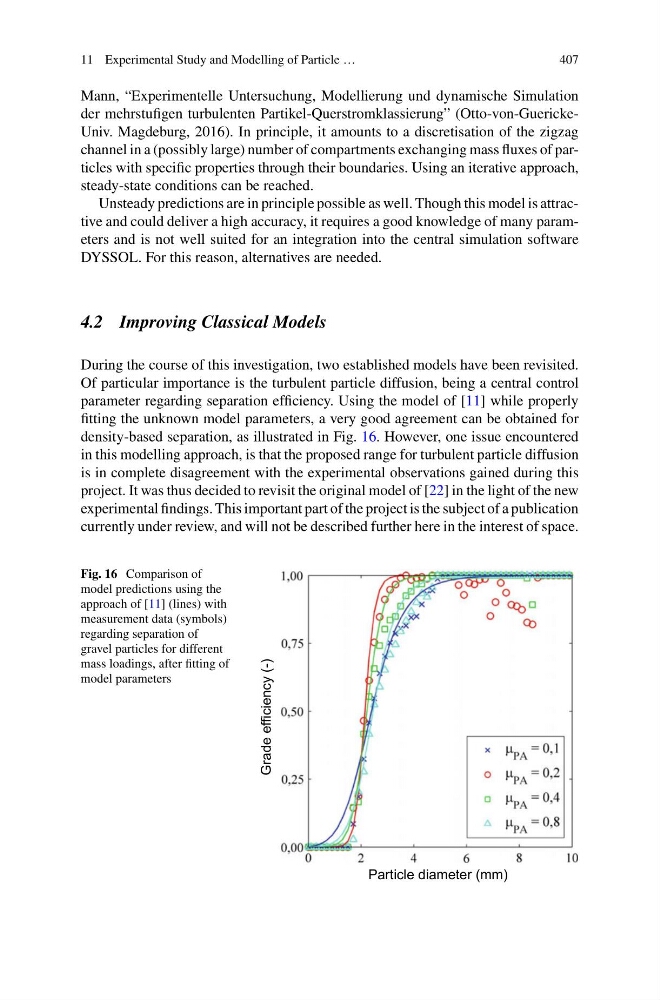
During the course of this investigation, two established models have been revisited.
Of particular importance is the turbulent particle diffusion, being a central control
parameter regarding separation efficiency. Using the model of [11] while properly
fitting the unknown model parameters, a very good agreement can be obtained for
density-based separation, as illustrated in Fig. 16. However, one issue encountered
in this modelling approach, is that the proposed range for turbulent particle diffusion
is in complete disagreement with the experimental observations gained during this
project. It was thus decided to revisit the original model of [22] in the light of the new
experimental findings. This important part of the project is the subject of a publication
currently under review, and will not be described further here in the interest of space.
Fig. 16 Comparison of
model predictions using the
approach of [11] (lines) with
measurement data (symbols)
regarding separation of
gravel particles for different
mass loadings, after fitting of
model parameters
Particle diameter (mm)
Grade efficiency (-)
407
Mann, “Experimentelle Untersuchung, Modellierung und dynamische Simulation
der mehrstufigen turbulenten Partikel-Querstromklassierung” (Otto-von-GuerickeUniv. Magdeburg, 2016). In principle, it amounts to a discretisation of the zigzag
channel in a (possibly large) number of compartments exchanging mass fluxes of particles with specific properties through their boundaries. Using an iterative approach,
steady-state conditions can be reached.
Unsteady predictions are in principle possible as well. Though this model is attractive and could deliver a high accuracy, it requires a good knowledge of many parameters and is not well suited for an integration into the central simulation software
DYSSOL. For this reason, alternatives are needed.
4.2 Improving Classical Models
During the course of this investigation, two established models have been revisited.
Of particular importance is the turbulent particle diffusion, being a central control
parameter regarding separation efficiency. Using the model of [11] while properly
fitting the unknown model parameters, a very good agreement can be obtained for
density-based separation, as illustrated in Fig. 16. However, one issue encountered
in this modelling approach, is that the proposed range for turbulent particle diffusion
is in complete disagreement with the experimental observations gained during this
project. It was thus decided to revisit the original model of [22] in the light of the new
experimental findings. This important part of the project is the subject of a publication
currently under review, and will not be described further here in the interest of space.
Fig. 16 Comparison of
model predictions using the
approach of [11] (lines) with
measurement data (symbols)
regarding separation of
gravel particles for different
mass loadings, after fitting of
model parameters
Particle diameter (mm)
Grade efficiency (-)