

394
E. Lukas et al.
1
2
3
4
5
6
7
8
9
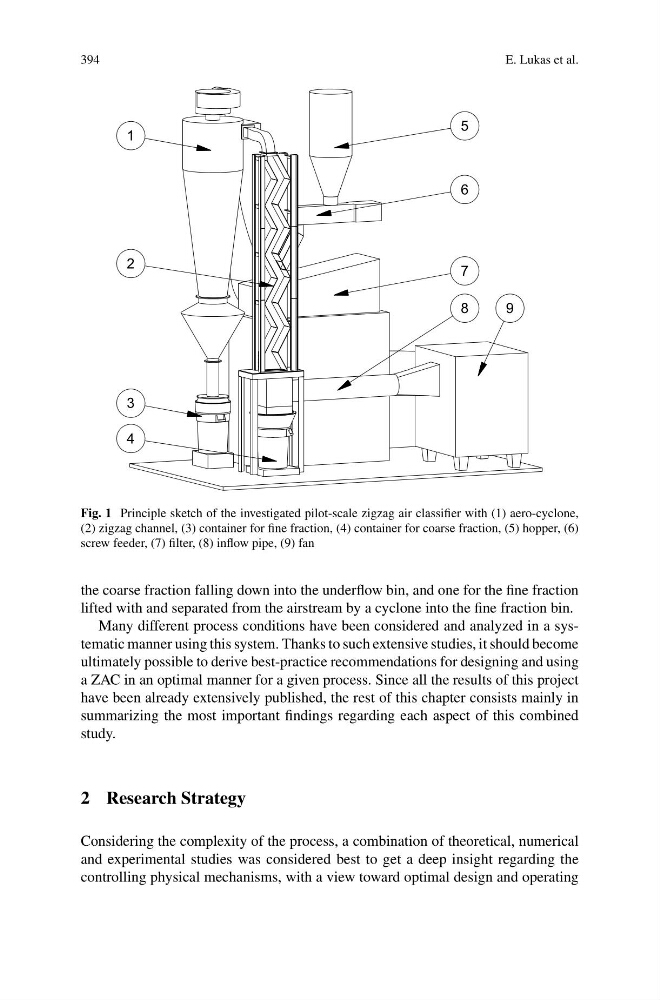
Fig. 1 Principle sketch of the investigated pilot-scale zigzag air classifier with (1) aero-cyclone,
(2) zigzag channel, (3) container for fine fraction, (4) container for coarse fraction, (5) hopper, (6)
screw feeder, (7) filter, (8) inflow pipe, (9) fan
the coarse fraction falling down into the underflow bin, and one for the fine fraction
lifted with and separated from the airstream by a cyclone into the fine fraction bin.
Many different process conditions have been considered and analyzed in a systematic manner using this system. Thanks to such extensive studies, it should become
ultimately possible to derive best-practice recommendations for designing and using
a ZAC in an optimal manner for a given process. Since all the results of this project
have been already extensively published, the rest of this chapter consists mainly in
summarizing the most important findings regarding each aspect of this combined
study.
2 Research Strategy
Considering the complexity of the process, a combination of theoretical, numerical
and experimental studies was considered best to get a deep insight regarding the
controlling physical mechanisms, with a view toward optimal design and operating
E. Lukas et al.
1
2
3
4
5
6
7
8
9
Fig. 1 Principle sketch of the investigated pilot-scale zigzag air classifier with (1) aero-cyclone,
(2) zigzag channel, (3) container for fine fraction, (4) container for coarse fraction, (5) hopper, (6)
screw feeder, (7) filter, (8) inflow pipe, (9) fan
the coarse fraction falling down into the underflow bin, and one for the fine fraction
lifted with and separated from the airstream by a cyclone into the fine fraction bin.
Many different process conditions have been considered and analyzed in a systematic manner using this system. Thanks to such extensive studies, it should become
ultimately possible to derive best-practice recommendations for designing and using
a ZAC in an optimal manner for a given process. Since all the results of this project
have been already extensively published, the rest of this chapter consists mainly in
summarizing the most important findings regarding each aspect of this combined
study.
2 Research Strategy
Considering the complexity of the process, a combination of theoretical, numerical
and experimental studies was considered best to get a deep insight regarding the
controlling physical mechanisms, with a view toward optimal design and operating