

9 Impact Comminution in Jet Mills
323
mean particle size, a stationary product flow rate is reached. Typically, the product
fineness and output is sensitive to decreasing particle sizes. However, size-dependent
particle pre-separation in the transport zone could minimize that effect on the classifier [49]. Since the various holdups result in different product mass flow rates, a
crucial role must be attributed to the load at the classifier and, thus, to the whole
process.
Since there is no perfect separation in technical applications, always a certain
amount of product-sized particles remains in the coarse fraction. According to Altun
and Benzer [50], the effect of fine particles by-passing the classifier and re-entering
the circulation system is influenced by the solid concentration. In comparison to
stand-alone classifiers, where the rejected material is entering the coarse fraction, the
fines are recirculated until they leave the classifier mill. Thus, the product particles
re-enter the transport and classification section, before approaching the classifier
again. The classifier is therefore exposed to a continuous stream consisting of fresh,
crushed and rejected material. Hence, product-sized particles are accumulated inside
the milling chamber. The relative amount of product-sized particles which remain
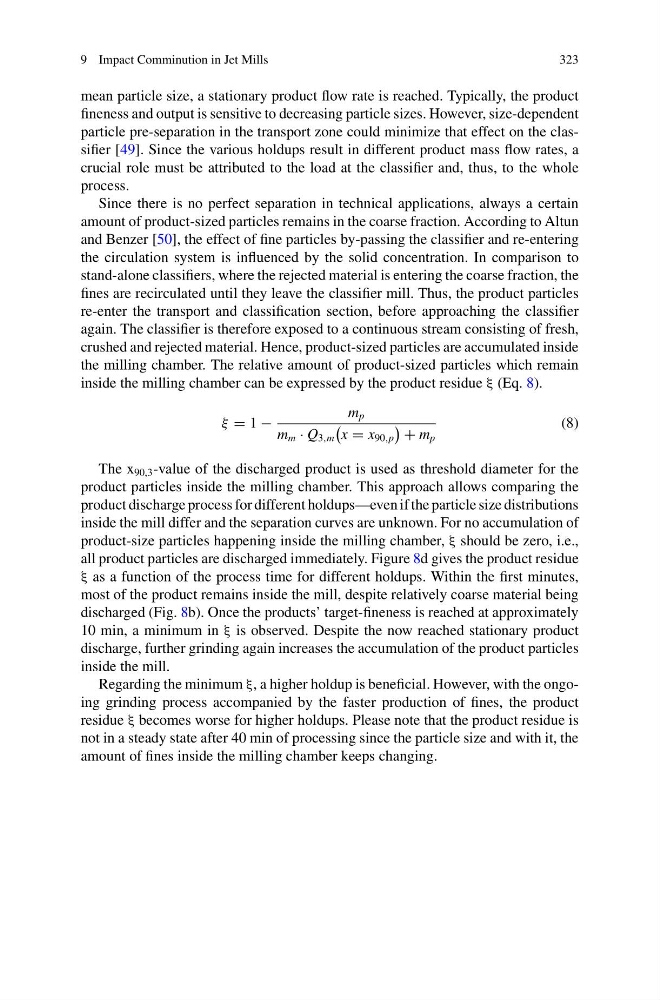
inside the milling chamber can be expressed by the product residue ξ (Eq. 8).
ξ = 1 −
m p
m m · Q 3,m
x = x 90,p
+ m p
(8)
The x 90,3 -value of the discharged product is used as threshold diameter for the
product particles inside the milling chamber. This approach allows comparing the
product discharge process for different holdups—even if the particle size distributions
inside the mill differ and the separation curves are unknown. For no accumulation of
product-size particles happening inside the milling chamber, ξ should be zero, i.e.,
all product particles are discharged immediately. Figure 8d gives the product residue
ξ as a function of the process time for different holdups. Within the first minutes,
most of the product remains inside the mill, despite relatively coarse material being
discharged (Fig. 8b). Once the products’ target-fineness is reached at approximately
10 min, a minimum in ξ is observed. Despite the now reached stationary product
discharge, further grinding again increases the accumulation of the product particles
inside the mill.
Regarding the minimum ξ, a higher holdup is beneficial. However, with the ongoing grinding process accompanied by the faster production of fines, the product
residue ξ becomes worse for higher holdups. Please note that the product residue is
not in a steady state after 40 min of processing since the particle size and with it, the
amount of fines inside the milling chamber keeps changing.
323
mean particle size, a stationary product flow rate is reached. Typically, the product
fineness and output is sensitive to decreasing particle sizes. However, size-dependent
particle pre-separation in the transport zone could minimize that effect on the classifier [49]. Since the various holdups result in different product mass flow rates, a
crucial role must be attributed to the load at the classifier and, thus, to the whole
process.
Since there is no perfect separation in technical applications, always a certain
amount of product-sized particles remains in the coarse fraction. According to Altun
and Benzer [50], the effect of fine particles by-passing the classifier and re-entering
the circulation system is influenced by the solid concentration. In comparison to
stand-alone classifiers, where the rejected material is entering the coarse fraction, the
fines are recirculated until they leave the classifier mill. Thus, the product particles
re-enter the transport and classification section, before approaching the classifier
again. The classifier is therefore exposed to a continuous stream consisting of fresh,
crushed and rejected material. Hence, product-sized particles are accumulated inside
the milling chamber. The relative amount of product-sized particles which remain
inside the milling chamber can be expressed by the product residue ξ (Eq. 8).
ξ = 1 −
m p
m m · Q 3,m
x = x 90,p
+ m p
(8)
The x 90,3 -value of the discharged product is used as threshold diameter for the
product particles inside the milling chamber. This approach allows comparing the
product discharge process for different holdups—even if the particle size distributions
inside the mill differ and the separation curves are unknown. For no accumulation of
product-size particles happening inside the milling chamber, ξ should be zero, i.e.,
all product particles are discharged immediately. Figure 8d gives the product residue
ξ as a function of the process time for different holdups. Within the first minutes,
most of the product remains inside the mill, despite relatively coarse material being
discharged (Fig. 8b). Once the products’ target-fineness is reached at approximately
10 min, a minimum in ξ is observed. Despite the now reached stationary product
discharge, further grinding again increases the accumulation of the product particles
inside the mill.
Regarding the minimum ξ, a higher holdup is beneficial. However, with the ongoing grinding process accompanied by the faster production of fines, the product
residue ξ becomes worse for higher holdups. Please note that the product residue is
not in a steady state after 40 min of processing since the particle size and with it, the
amount of fines inside the milling chamber keeps changing.