

310
A. Strobel et al.
(1 − ε) =
R
r=0 (1 − ε) r · A r
A
(1)
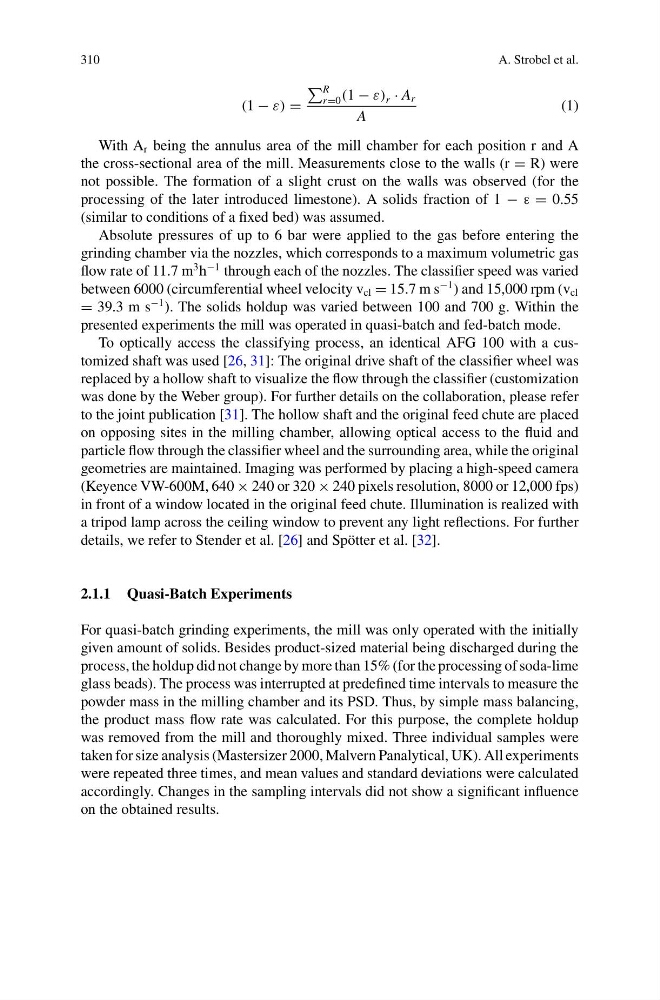
With A r being the annulus area of the mill chamber for each position r and A
the cross-sectional area of the mill. Measurements close to the walls (r = R) were
not possible. The formation of a slight crust on the walls was observed (for the
processing of the later introduced limestone). A solids fraction of 1 − ε = 0.55
(similar to conditions of a fixed bed) was assumed.
Absolute pressures of up to 6 bar were applied to the gas before entering the
grinding chamber via the nozzles, which corresponds to a maximum volumetric gas
flow rate of 11.7 m
3 h
−1 through each of the nozzles. The classifier speed was varied
between 6000 (circumferential wheel velocity v cl = 15.7 m s
−1 ) and 15,000 rpm (v cl
= 39.3 m s
−1 ). The solids holdup was varied between 100 and 700 g. Within the
presented experiments the mill was operated in quasi-batch and fed-batch mode.
To optically access the classifying process, an identical AFG 100 with a customized shaft was used [26, 31]: The original drive shaft of the classifier wheel was
replaced by a hollow shaft to visualize the flow through the classifier (customization
was done by the Weber group). For further details on the collaboration, please refer
to the joint publication [31]. The hollow shaft and the original feed chute are placed
on opposing sites in the milling chamber, allowing optical access to the fluid and
particle flow through the classifier wheel and the surrounding area, while the original
geometries are maintained. Imaging was performed by placing a high-speed camera
(Keyence VW-600M, 640 × 240 or 320 × 240 pixels resolution, 8000 or 12,000 fps)
in front of a window located in the original feed chute. Illumination is realized with
a tripod lamp across the ceiling window to prevent any light reflections. For further
details, we refer to Stender et al. [26] and Spötter et al. [32].
2.1.1 Quasi-Batch Experiments
For quasi-batch grinding experiments, the mill was only operated with the initially
given amount of solids. Besides product-sized material being discharged during the
process, the holdup did not change by more than 15% (for the processing of soda-lime
glass beads). The process was interrupted at predefined time intervals to measure the
powder mass in the milling chamber and its PSD. Thus, by simple mass balancing,
the product mass flow rate was calculated. For this purpose, the complete holdup
was removed from the mill and thoroughly mixed. Three individual samples were
taken for size analysis (Mastersizer 2000, Malvern Panalytical, UK). All experiments
were repeated three times, and mean values and standard deviations were calculated
accordingly. Changes in the sampling intervals did not show a significant influence
on the obtained results.
A. Strobel et al.
(1 − ε) =
R
r=0 (1 − ε) r · A r
A
(1)
With A r being the annulus area of the mill chamber for each position r and A
the cross-sectional area of the mill. Measurements close to the walls (r = R) were
not possible. The formation of a slight crust on the walls was observed (for the
processing of the later introduced limestone). A solids fraction of 1 − ε = 0.55
(similar to conditions of a fixed bed) was assumed.
Absolute pressures of up to 6 bar were applied to the gas before entering the
grinding chamber via the nozzles, which corresponds to a maximum volumetric gas
flow rate of 11.7 m
3 h
−1 through each of the nozzles. The classifier speed was varied
between 6000 (circumferential wheel velocity v cl = 15.7 m s
−1 ) and 15,000 rpm (v cl
= 39.3 m s
−1 ). The solids holdup was varied between 100 and 700 g. Within the
presented experiments the mill was operated in quasi-batch and fed-batch mode.
To optically access the classifying process, an identical AFG 100 with a customized shaft was used [26, 31]: The original drive shaft of the classifier wheel was
replaced by a hollow shaft to visualize the flow through the classifier (customization
was done by the Weber group). For further details on the collaboration, please refer
to the joint publication [31]. The hollow shaft and the original feed chute are placed
on opposing sites in the milling chamber, allowing optical access to the fluid and
particle flow through the classifier wheel and the surrounding area, while the original
geometries are maintained. Imaging was performed by placing a high-speed camera
(Keyence VW-600M, 640 × 240 or 320 × 240 pixels resolution, 8000 or 12,000 fps)
in front of a window located in the original feed chute. Illumination is realized with
a tripod lamp across the ceiling window to prevent any light reflections. For further
details, we refer to Stender et al. [26] and Spötter et al. [32].
2.1.1 Quasi-Batch Experiments
For quasi-batch grinding experiments, the mill was only operated with the initially
given amount of solids. Besides product-sized material being discharged during the
process, the holdup did not change by more than 15% (for the processing of soda-lime
glass beads). The process was interrupted at predefined time intervals to measure the
powder mass in the milling chamber and its PSD. Thus, by simple mass balancing,
the product mass flow rate was calculated. For this purpose, the complete holdup
was removed from the mill and thoroughly mixed. Three individual samples were
taken for size analysis (Mastersizer 2000, Malvern Panalytical, UK). All experiments
were repeated three times, and mean values and standard deviations were calculated
accordingly. Changes in the sampling intervals did not show a significant influence
on the obtained results.