

306
A. Strobel et al.
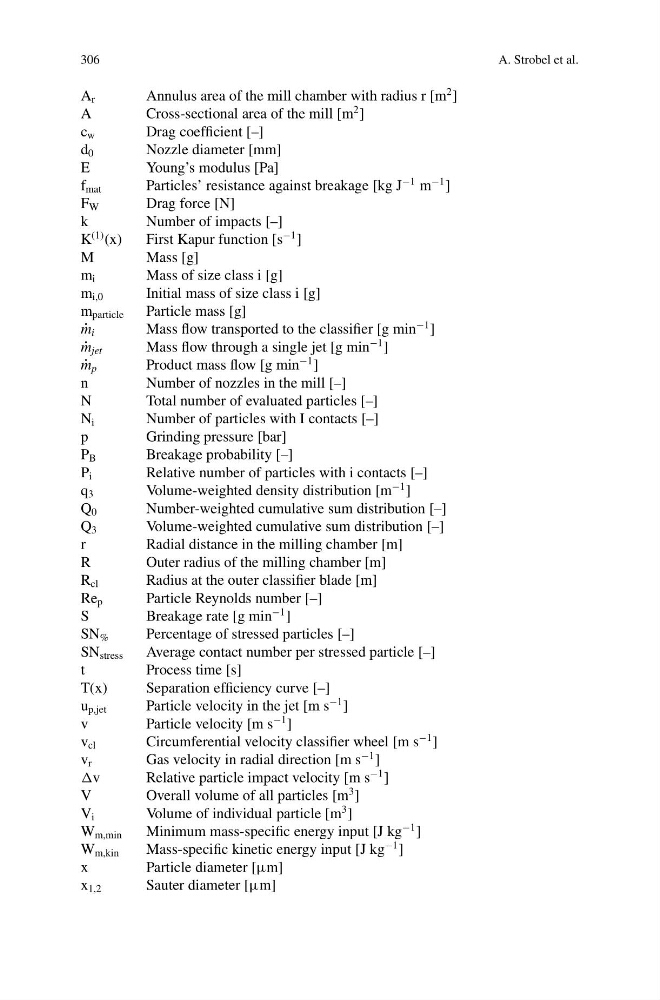
A r
Annulus area of the mill chamber with radius r [m
2 ]
A
Cross-sectional area of the mill [m
2 ]
c w
Drag coefficient [–]
d 0
Nozzle diameter [mm]
E
Young’s modulus [Pa]
f mat
Particles’ resistance against breakage [kg J
−1 m
−1 ]
F W
Drag force [N]
k
Number of impacts [–]
K
(1) (x)
First Kapur function [s
−1 ]
M
Mass [g]
m i
Mass of size class i [g]
m i,0
Initial mass of size class i [g]
m particle Particle mass [g]
˙
m i
Mass flow transported to the classifier [g min
−1 ]
˙
m jet
Mass flow through a single jet [g min
−1 ]
˙
m p
Product mass flow [g min
−1 ]
n
Number of nozzles in the mill [–]
N
Total number of evaluated particles [–]
N i
Number of particles with I contacts [–]
p
Grinding pressure [bar]
P B
Breakage probability [–]
P i
Relative number of particles with i contacts [–]
q 3
Volume-weighted density distribution [m
−1 ]
Q 0
Number-weighted cumulative sum distribution [–]
Q 3
Volume-weighted cumulative sum distribution [–]
r
Radial distance in the milling chamber [m]
R
Outer radius of the milling chamber [m]
R cl
Radius at the outer classifier blade [m]
Re p
Particle Reynolds number [–]
S
Breakage rate [g min
−1 ]
SN %
Percentage of stressed particles [–]
SN stress
Average contact number per stressed particle [–]
t
Process time [s]
T(x)
Separation efficiency curve [–]
u p,jet
Particle velocity in the jet [m s
−1 ]
v
Particle velocity [m s
−1 ]
v cl
Circumferential velocity classifier wheel [m s
−1 ]
v r
Gas velocity in radial direction [m s
−1 ]
v
Relative particle impact velocity [m s
−1 ]
V
Overall volume of all particles [m
3 ]
V i
Volume of individual particle [m
3 ]
W m,min
Minimum mass-specific energy input [J kg
−1 ]
W m,kin
Mass-specific kinetic energy input [J kg
−1 ]
x
Particle diameter [μm]
x 1,2
Sauter diameter [μm]
A. Strobel et al.
A r
Annulus area of the mill chamber with radius r [m
2 ]
A
Cross-sectional area of the mill [m
2 ]
c w
Drag coefficient [–]
d 0
Nozzle diameter [mm]
E
Young’s modulus [Pa]
f mat
Particles’ resistance against breakage [kg J
−1 m
−1 ]
F W
Drag force [N]
k
Number of impacts [–]
K
(1) (x)
First Kapur function [s
−1 ]
M
Mass [g]
m i
Mass of size class i [g]
m i,0
Initial mass of size class i [g]
m particle Particle mass [g]
˙
m i
Mass flow transported to the classifier [g min
−1 ]
˙
m jet
Mass flow through a single jet [g min
−1 ]
˙
m p
Product mass flow [g min
−1 ]
n
Number of nozzles in the mill [–]
N
Total number of evaluated particles [–]
N i
Number of particles with I contacts [–]
p
Grinding pressure [bar]
P B
Breakage probability [–]
P i
Relative number of particles with i contacts [–]
q 3
Volume-weighted density distribution [m
−1 ]
Q 0
Number-weighted cumulative sum distribution [–]
Q 3
Volume-weighted cumulative sum distribution [–]
r
Radial distance in the milling chamber [m]
R
Outer radius of the milling chamber [m]
R cl
Radius at the outer classifier blade [m]
Re p
Particle Reynolds number [–]
S
Breakage rate [g min
−1 ]
SN %
Percentage of stressed particles [–]
SN stress
Average contact number per stressed particle [–]
t
Process time [s]
T(x)
Separation efficiency curve [–]
u p,jet
Particle velocity in the jet [m s
−1 ]
v
Particle velocity [m s
−1 ]
v cl
Circumferential velocity classifier wheel [m s
−1 ]
v r
Gas velocity in radial direction [m s
−1 ]
v
Relative particle impact velocity [m s
−1 ]
V
Overall volume of all particles [m
3 ]
V i
Volume of individual particle [m
3 ]
W m,min
Minimum mass-specific energy input [J kg
−1 ]
W m,kin
Mass-specific kinetic energy input [J kg
−1 ]
x
Particle diameter [μm]
x 1,2
Sauter diameter [μm]