

1 Process Modeling for Dynamic Disperse Particle Separation …
23
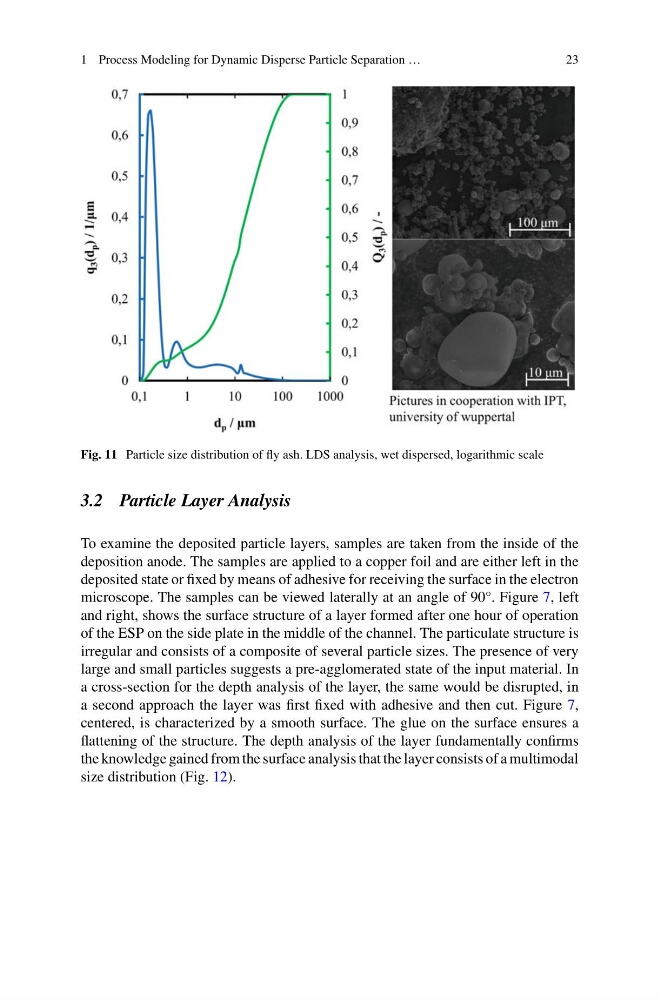
Fig. 11 Particle size distribution of fly ash. LDS analysis, wet dispersed, logarithmic scale
3.2 Particle Layer Analysis
To examine the deposited particle layers, samples are taken from the inside of the
deposition anode. The samples are applied to a copper foil and are either left in the
deposited state or fixed by means of adhesive for receiving the surface in the electron
microscope. The samples can be viewed laterally at an angle of 90°. Figure 7, left
and right, shows the surface structure of a layer formed after one hour of operation
of the ESP on the side plate in the middle of the channel. The particulate structure is
irregular and consists of a composite of several particle sizes. The presence of very
large and small particles suggests a pre-agglomerated state of the input material. In
a cross-section for the depth analysis of the layer, the same would be disrupted, in
a second approach the layer was first fixed with adhesive and then cut. Figure 7,
centered, is characterized by a smooth surface. The glue on the surface ensures a
flattening of the structure. The depth analysis of the layer fundamentally confirms
the knowledge gained from the surface analysis that the layer consists of a multimodal
size distribution (Fig. 12).
23
Fig. 11 Particle size distribution of fly ash. LDS analysis, wet dispersed, logarithmic scale
3.2 Particle Layer Analysis
To examine the deposited particle layers, samples are taken from the inside of the
deposition anode. The samples are applied to a copper foil and are either left in the
deposited state or fixed by means of adhesive for receiving the surface in the electron
microscope. The samples can be viewed laterally at an angle of 90°. Figure 7, left
and right, shows the surface structure of a layer formed after one hour of operation
of the ESP on the side plate in the middle of the channel. The particulate structure is
irregular and consists of a composite of several particle sizes. The presence of very
large and small particles suggests a pre-agglomerated state of the input material. In
a cross-section for the depth analysis of the layer, the same would be disrupted, in
a second approach the layer was first fixed with adhesive and then cut. Figure 7,
centered, is characterized by a smooth surface. The glue on the surface ensures a
flattening of the structure. The depth analysis of the layer fundamentally confirms
the knowledge gained from the surface analysis that the layer consists of a multimodal
size distribution (Fig. 12).