

266
M. Gleiss and H. Nirschl
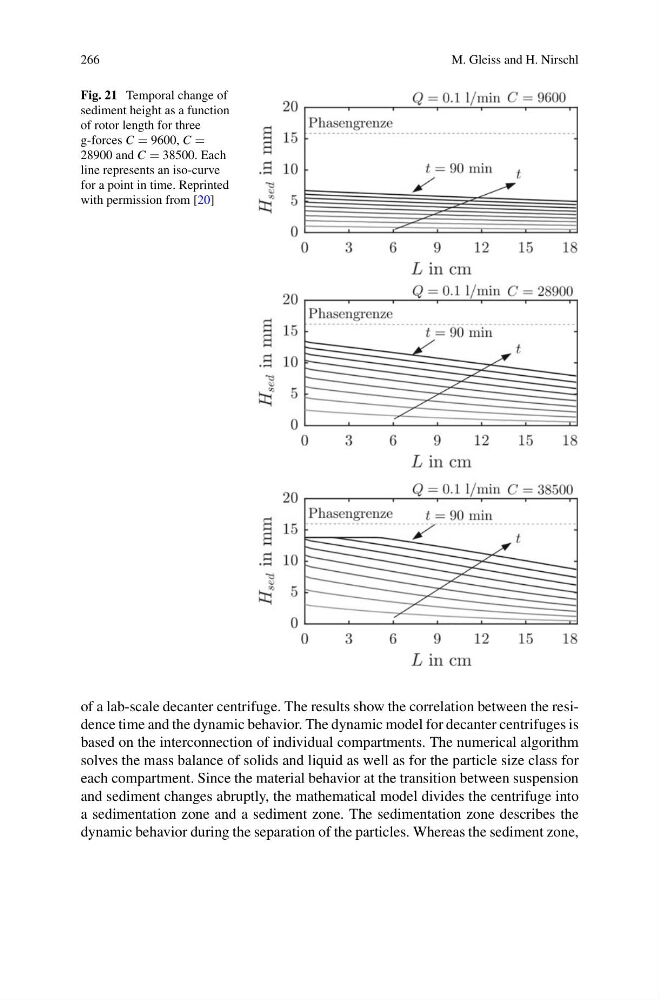
Fig. 21 Temporal change of
sediment height as a function
of rotor length for three
g-forces C = 9600, C =
28900 and C = 38500. Each
line represents an iso-curve
for a point in time. Reprinted
with permission from [20]
of a lab-scale decanter centrifuge. The results show the correlation between the residence time and the dynamic behavior. The dynamic model for decanter centrifuges is
based on the interconnection of individual compartments. The numerical algorithm
solves the mass balance of solids and liquid as well as for the particle size class for
each compartment. Since the material behavior at the transition between suspension
and sediment changes abruptly, the mathematical model divides the centrifuge into
a sedimentation zone and a sediment zone. The sedimentation zone describes the
dynamic behavior during the separation of the particles. Whereas the sediment zone,
M. Gleiss and H. Nirschl
Fig. 21 Temporal change of
sediment height as a function
of rotor length for three
g-forces C = 9600, C =
28900 and C = 38500. Each
line represents an iso-curve
for a point in time. Reprinted
with permission from [20]
of a lab-scale decanter centrifuge. The results show the correlation between the residence time and the dynamic behavior. The dynamic model for decanter centrifuges is
based on the interconnection of individual compartments. The numerical algorithm
solves the mass balance of solids and liquid as well as for the particle size class for
each compartment. Since the material behavior at the transition between suspension
and sediment changes abruptly, the mathematical model divides the centrifuge into
a sedimentation zone and a sediment zone. The sedimentation zone describes the
dynamic behavior during the separation of the particles. Whereas the sediment zone,