

6 Dynamic Process Models for Fine Grinding and Dispersing
217
material breakage behavior have already been applied to ball mills for estimating the
effect of operating parameters on the breakage rate [20–23].
In the following the influence of different operating and machine parameters on
the specific breakage rate in wet stirred media milling is discussed. On the one hand,
the stress conditions in a stirred media mill are determined by the semi-empirical,
mechanistic model of Kwade and on the other hand with two approaches based
on coupled CFD-DEM simulations. The results of the three procedures are compared with experimentally measured specific breakage rates of limestone, a material
frequently used to study the grinding process in stirred mills [24–26].
Stress energy approach: It can be shown that the breakage rate directly depends
on the product of stress energy and stress frequency (determined according to
Kwade’s stress model). The product of both, stress energy and frequency, can be
seen as a measure for the product volume specific power input acting on the product
particles during the grinding or dispersing process. This makes it possible to describe
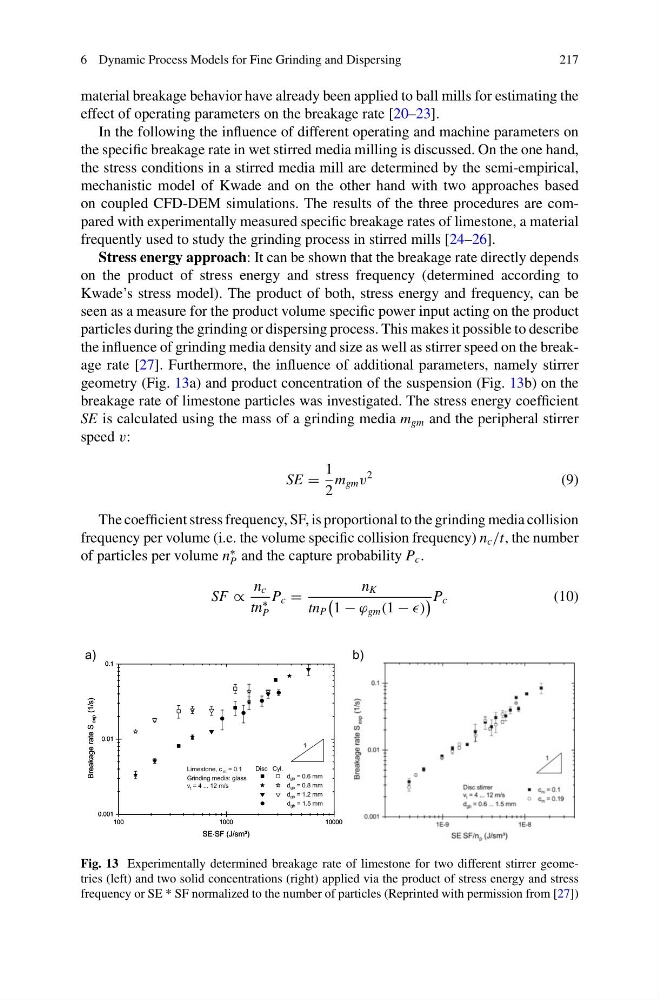
the influence of grinding media density and size as well as stirrer speed on the breakage rate [27]. Furthermore, the influence of additional parameters, namely stirrer
geometry (Fig. 13a) and product concentration of the suspension (Fig. 13b) on the
breakage rate of limestone particles was investigated. The stress energy coefficient
SE is calculated using the mass of a grinding media m gm and the peripheral stirrer
speed v:
SE =
1
2
m gm v
2
(9)
The coefficient stress frequency, SF, is proportional to the grinding media collision
frequency per volume (i.e. the volume specific collision frequency) n c /t, the number
of particles per volume n
∗
P and the capture probability P c .
SF ∝
n c
tn
∗
P
P c =
n K
tn P
1 − ϕ gm (1 − )
P c
(10)
a)
b)
Fig. 13 Experimentally determined breakage rate of limestone for two different stirrer geometries (left) and two solid concentrations (right) applied via the product of stress energy and stress
frequency or SE * SF normalized to the number of particles (Reprinted with permission from [27])
217
material breakage behavior have already been applied to ball mills for estimating the
effect of operating parameters on the breakage rate [20–23].
In the following the influence of different operating and machine parameters on
the specific breakage rate in wet stirred media milling is discussed. On the one hand,
the stress conditions in a stirred media mill are determined by the semi-empirical,
mechanistic model of Kwade and on the other hand with two approaches based
on coupled CFD-DEM simulations. The results of the three procedures are compared with experimentally measured specific breakage rates of limestone, a material
frequently used to study the grinding process in stirred mills [24–26].
Stress energy approach: It can be shown that the breakage rate directly depends
on the product of stress energy and stress frequency (determined according to
Kwade’s stress model). The product of both, stress energy and frequency, can be
seen as a measure for the product volume specific power input acting on the product
particles during the grinding or dispersing process. This makes it possible to describe
the influence of grinding media density and size as well as stirrer speed on the breakage rate [27]. Furthermore, the influence of additional parameters, namely stirrer
geometry (Fig. 13a) and product concentration of the suspension (Fig. 13b) on the
breakage rate of limestone particles was investigated. The stress energy coefficient
SE is calculated using the mass of a grinding media m gm and the peripheral stirrer
speed v:
SE =
1
2
m gm v
2
(9)
The coefficient stress frequency, SF, is proportional to the grinding media collision
frequency per volume (i.e. the volume specific collision frequency) n c /t, the number
of particles per volume n
∗
P and the capture probability P c .
SF ∝
n c
tn
∗
P
P c =
n K
tn P
1 − ϕ gm (1 − )
P c
(10)
a)
b)
Fig. 13 Experimentally determined breakage rate of limestone for two different stirrer geometries (left) and two solid concentrations (right) applied via the product of stress energy and stress
frequency or SE * SF normalized to the number of particles (Reprinted with permission from [27])