

6 Dynamic Process Models for Fine Grinding and Dispersing
215
feed size ratio. Therefore, the gap size was varied between 40 and 80 μm and the
feed particles have been sieved into four different fractions from 50 up to 110 μm
(Table 5).
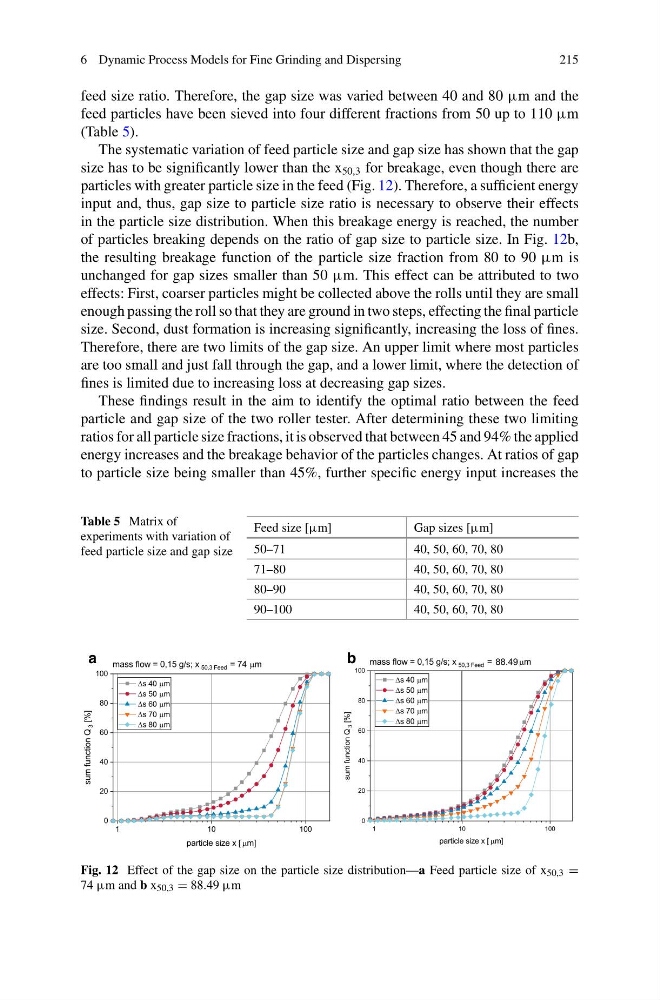
The systematic variation of feed particle size and gap size has shown that the gap
size has to be significantly lower than the x 50,3 for breakage, even though there are
particles with greater particle size in the feed (Fig. 12). Therefore, a sufficient energy
input and, thus, gap size to particle size ratio is necessary to observe their effects
in the particle size distribution. When this breakage energy is reached, the number
of particles breaking depends on the ratio of gap size to particle size. In Fig. 12b,
the resulting breakage function of the particle size fraction from 80 to 90 μm is
unchanged for gap sizes smaller than 50 μm. This effect can be attributed to two
effects: First, coarser particles might be collected above the rolls until they are small
enough passing the roll so that they are ground in two steps, effecting the final particle
size. Second, dust formation is increasing significantly, increasing the loss of fines.
Therefore, there are two limits of the gap size. An upper limit where most particles
are too small and just fall through the gap, and a lower limit, where the detection of
fines is limited due to increasing loss at decreasing gap sizes.
These findings result in the aim to identify the optimal ratio between the feed
particle and gap size of the two roller tester. After determining these two limiting
ratios for all particle size fractions, it is observed that between 45 and 94% the applied
energy increases and the breakage behavior of the particles changes. At ratios of gap
to particle size being smaller than 45%, further specific energy input increases the
Table 5 Matrix of
experiments with variation of
feed particle size and gap size
Feed size [μm]
Gap sizes [μm]
50–71
40, 50, 60, 70, 80
71–80
40, 50, 60, 70, 80
80–90
40, 50, 60, 70, 80
90–100
40, 50, 60, 70, 80
a
b
Fig. 12 Effect of the gap size on the particle size distribution—a Feed particle size of x 50,3 =
74 μm and b x 50,3 = 88.49 μm
215
feed size ratio. Therefore, the gap size was varied between 40 and 80 μm and the
feed particles have been sieved into four different fractions from 50 up to 110 μm
(Table 5).
The systematic variation of feed particle size and gap size has shown that the gap
size has to be significantly lower than the x 50,3 for breakage, even though there are
particles with greater particle size in the feed (Fig. 12). Therefore, a sufficient energy
input and, thus, gap size to particle size ratio is necessary to observe their effects
in the particle size distribution. When this breakage energy is reached, the number
of particles breaking depends on the ratio of gap size to particle size. In Fig. 12b,
the resulting breakage function of the particle size fraction from 80 to 90 μm is
unchanged for gap sizes smaller than 50 μm. This effect can be attributed to two
effects: First, coarser particles might be collected above the rolls until they are small
enough passing the roll so that they are ground in two steps, effecting the final particle
size. Second, dust formation is increasing significantly, increasing the loss of fines.
Therefore, there are two limits of the gap size. An upper limit where most particles
are too small and just fall through the gap, and a lower limit, where the detection of
fines is limited due to increasing loss at decreasing gap sizes.
These findings result in the aim to identify the optimal ratio between the feed
particle and gap size of the two roller tester. After determining these two limiting
ratios for all particle size fractions, it is observed that between 45 and 94% the applied
energy increases and the breakage behavior of the particles changes. At ratios of gap
to particle size being smaller than 45%, further specific energy input increases the
Table 5 Matrix of
experiments with variation of
feed particle size and gap size
Feed size [μm]
Gap sizes [μm]
50–71
40, 50, 60, 70, 80
71–80
40, 50, 60, 70, 80
80–90
40, 50, 60, 70, 80
90–100
40, 50, 60, 70, 80
a
b
Fig. 12 Effect of the gap size on the particle size distribution—a Feed particle size of x 50,3 =
74 μm and b x 50,3 = 88.49 μm