

176
D. Markauskas and H. Kruggel-Emden
4.2 Discontinuous Screening Without Moisture
As a second case screening of a polydisperse feed material is investigated by the
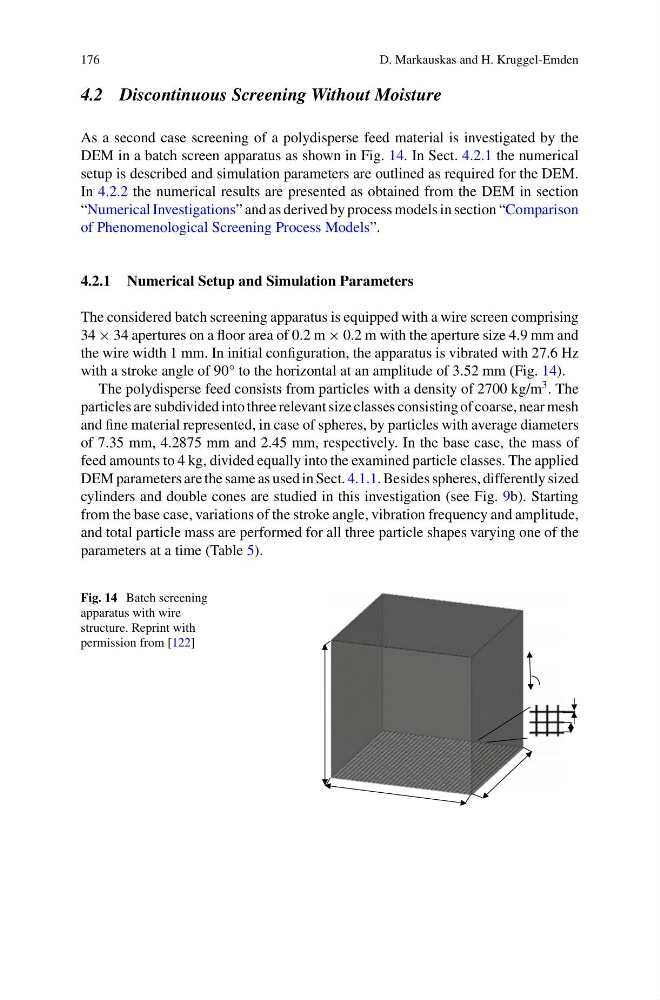
DEM in a batch screen apparatus as shown in Fig. 14. In Sect. 4.2.1 the numerical
setup is described and simulation parameters are outlined as required for the DEM.
In 4.2.2 the numerical results are presented as obtained from the DEM in section
“Numerical Investigations” and as derived by process models in section “Comparison
of Phenomenological Screening Process Models”.
4.2.1 Numerical Setup and Simulation Parameters
The considered batch screening apparatus is equipped with a wire screen comprising
34 × 34 apertures on a floor area of 0.2 m × 0.2 m with the aperture size 4.9 mm and
the wire width 1 mm. In initial configuration, the apparatus is vibrated with 27.6 Hz
with a stroke angle of 90° to the horizontal at an amplitude of 3.52 mm (Fig. 14).
The polydisperse feed consists from particles with a density of 2700 kg/m
3 . The
particles are subdivided into three relevant size classes consisting of coarse, near mesh
and fine material represented, in case of spheres, by particles with average diameters
of 7.35 mm, 4.2875 mm and 2.45 mm, respectively. In the base case, the mass of
feed amounts to 4 kg, divided equally into the examined particle classes. The applied
DEM parameters are the same as used in Sect. 4.1.1. Besides spheres, differently sized
cylinders and double cones are studied in this investigation (see Fig. 9b). Starting
from the base case, variations of the stroke angle, vibration frequency and amplitude,
and total particle mass are performed for all three particle shapes varying one of the
parameters at a time (Table 5).
Fig. 14 Batch screening
apparatus with wire
structure. Reprint with
permission from [122]
D. Markauskas and H. Kruggel-Emden
4.2 Discontinuous Screening Without Moisture
As a second case screening of a polydisperse feed material is investigated by the
DEM in a batch screen apparatus as shown in Fig. 14. In Sect. 4.2.1 the numerical
setup is described and simulation parameters are outlined as required for the DEM.
In 4.2.2 the numerical results are presented as obtained from the DEM in section
“Numerical Investigations” and as derived by process models in section “Comparison
of Phenomenological Screening Process Models”.
4.2.1 Numerical Setup and Simulation Parameters
The considered batch screening apparatus is equipped with a wire screen comprising
34 × 34 apertures on a floor area of 0.2 m × 0.2 m with the aperture size 4.9 mm and
the wire width 1 mm. In initial configuration, the apparatus is vibrated with 27.6 Hz
with a stroke angle of 90° to the horizontal at an amplitude of 3.52 mm (Fig. 14).
The polydisperse feed consists from particles with a density of 2700 kg/m
3 . The
particles are subdivided into three relevant size classes consisting of coarse, near mesh
and fine material represented, in case of spheres, by particles with average diameters
of 7.35 mm, 4.2875 mm and 2.45 mm, respectively. In the base case, the mass of
feed amounts to 4 kg, divided equally into the examined particle classes. The applied
DEM parameters are the same as used in Sect. 4.1.1. Besides spheres, differently sized
cylinders and double cones are studied in this investigation (see Fig. 9b). Starting
from the base case, variations of the stroke angle, vibration frequency and amplitude,
and total particle mass are performed for all three particle shapes varying one of the
parameters at a time (Table 5).
Fig. 14 Batch screening
apparatus with wire
structure. Reprint with
permission from [122]