

162
D. Markauskas and H. Kruggel-Emden
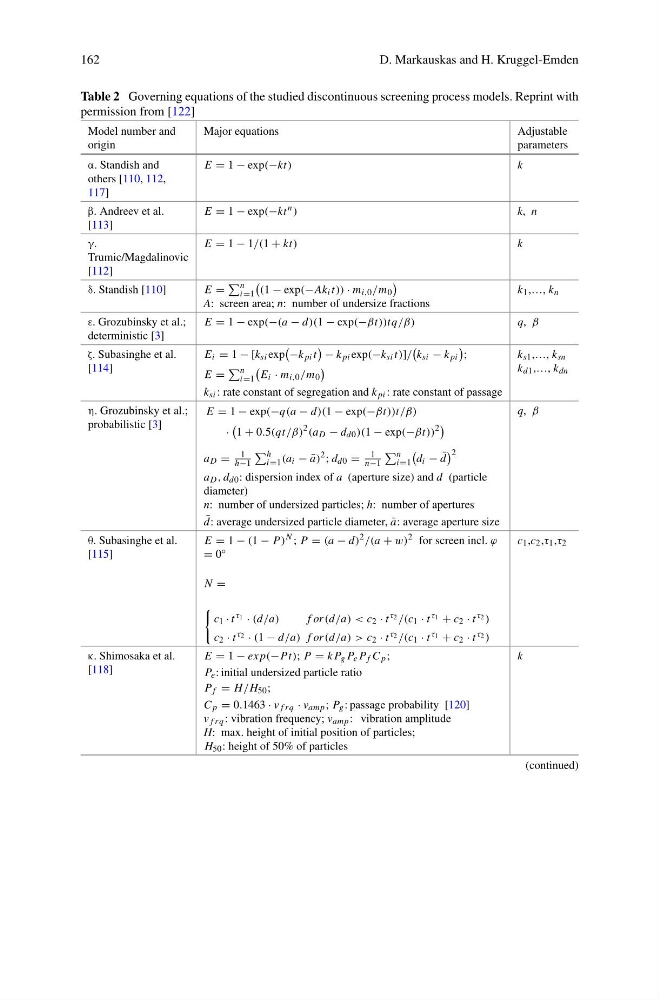
Table 2 Governing equations of the studied discontinuous screening process models. Reprint with
permission from [122]
Model number and
origin
Major equations
Adjustable
parameters
α. Standish and
others [110, 112,
117]
E = 1 − exp(−kt)
k
β. Andreev et al.
[113]
E = 1 − exp(−kt n )
k, n
γ.
Trumic/Magdalinovic
[112]
E = 1 − 1/(1 + kt)
k
δ. Standish [110]
E =
n
i=1
(1 − exp(−Ak i t)) · m i,0 /m 0
A: screen area; n: number of undersize fractions
k 1 ,…, k n
ε. Grozubinsky et al.;
deterministic [3]
E = 1 − exp(−(a − d)(1 − exp(−βt))tq/β)
q, β
ζ. Subasinghe et al.
[114]
E i = 1 − [k si exp
−k pi t
− k pi exp(−k si t)]/
k si − k pi
;
E =
n
i=1
E i · m i,0 /m 0
k si : rate constant of segregation and k pi : rate constant of passage
k s1 ,…, k sn
k d1 ,…, k dn
η. Grozubinsky et al.;
probabilistic [3]
E = 1 − exp(−q(a − d)(1 − exp(−βt))t/β)
·
1 + 0.5(qt/β)
2 (a D − d d0 )(1 − exp(−βt))
2
a D =
1
h−1
h
i=1 (a i − ¯
a)
2 ; d d0 =
1
n−1
n
i=1
d i − ¯
d
2
a D , d d0 : dispersion index of a (aperture size) and d (particle
diameter)
n: number of undersized particles; h: number of apertures
¯
d: average undersized particle diameter, ¯
a: average aperture size
q, β
θ. Subasinghe et al.
[115]
E = 1 − (1 − P)
N ; P = (a − d)
2 /(a + w)
2 for screen incl. ϕ
= 0°
N =
c 1 · t τ1 · (d/a)
f or(d/a) < c 2 · t τ2 /(c 1 · t τ1 + c 2 · t τ2 )
c 2 · t τ2 · (1 − d/a) f or(d/a) > c 2 · t τ2 /(c 1 · t τ1 + c 2 · t τ2 )
c 1 ,c 2 ,τ 1 ,τ 2
κ. Shimosaka et al.
[118]
E = 1 − ex p(−Pt); P = k P g P e P f C p ;
P e : initial undersized particle ratio
P f = H/H 50 ;
C p = 0.1463 · v f rq · v amp ; P g : passage probability [120]
v f rq : vibration frequency; v amp : vibration amplitude
H: max. height of initial position of particles;
H 50 : height of 50% of particles
k
(continued)
D. Markauskas and H. Kruggel-Emden
Table 2 Governing equations of the studied discontinuous screening process models. Reprint with
permission from [122]
Model number and
origin
Major equations
Adjustable
parameters
α. Standish and
others [110, 112,
117]
E = 1 − exp(−kt)
k
β. Andreev et al.
[113]
E = 1 − exp(−kt n )
k, n
γ.
Trumic/Magdalinovic
[112]
E = 1 − 1/(1 + kt)
k
δ. Standish [110]
E =
n
i=1
(1 − exp(−Ak i t)) · m i,0 /m 0
A: screen area; n: number of undersize fractions
k 1 ,…, k n
ε. Grozubinsky et al.;
deterministic [3]
E = 1 − exp(−(a − d)(1 − exp(−βt))tq/β)
q, β
ζ. Subasinghe et al.
[114]
E i = 1 − [k si exp
−k pi t
− k pi exp(−k si t)]/
k si − k pi
;
E =
n
i=1
E i · m i,0 /m 0
k si : rate constant of segregation and k pi : rate constant of passage
k s1 ,…, k sn
k d1 ,…, k dn
η. Grozubinsky et al.;
probabilistic [3]
E = 1 − exp(−q(a − d)(1 − exp(−βt))t/β)
·
1 + 0.5(qt/β)
2 (a D − d d0 )(1 − exp(−βt))
2
a D =
1
h−1
h
i=1 (a i − ¯
a)
2 ; d d0 =
1
n−1
n
i=1
d i − ¯
d
2
a D , d d0 : dispersion index of a (aperture size) and d (particle
diameter)
n: number of undersized particles; h: number of apertures
¯
d: average undersized particle diameter, ¯
a: average aperture size
q, β
θ. Subasinghe et al.
[115]
E = 1 − (1 − P)
N ; P = (a − d)
2 /(a + w)
2 for screen incl. ϕ
= 0°
N =
c 1 · t τ1 · (d/a)
f or(d/a) < c 2 · t τ2 /(c 1 · t τ1 + c 2 · t τ2 )
c 2 · t τ2 · (1 − d/a) f or(d/a) > c 2 · t τ2 /(c 1 · t τ1 + c 2 · t τ2 )
c 1 ,c 2 ,τ 1 ,τ 2
κ. Shimosaka et al.
[118]
E = 1 − ex p(−Pt); P = k P g P e P f C p ;
P e : initial undersized particle ratio
P f = H/H 50 ;
C p = 0.1463 · v f rq · v amp ; P g : passage probability [120]
v f rq : vibration frequency; v amp : vibration amplitude
H: max. height of initial position of particles;
H 50 : height of 50% of particles
k
(continued)