

5 Development of a Dynamic-Physical Process Model for Sieving
147
j
i
l
k
a
b
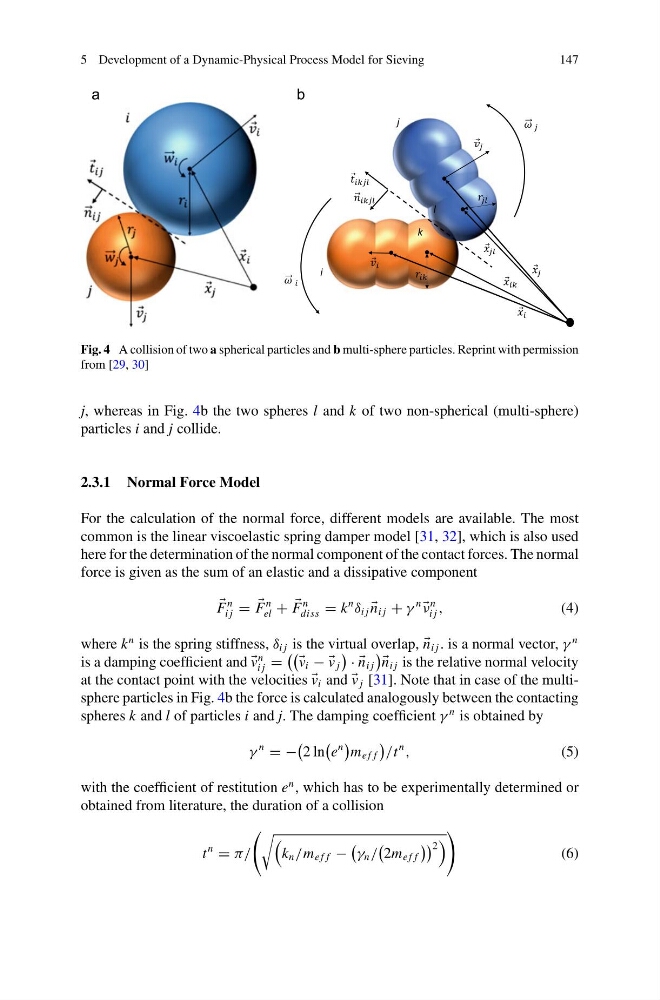
Fig. 4 A collision of two a spherical particles and b multi-sphere particles. Reprint with permission
from [29, 30]
j, whereas in Fig. 4b the two spheres l and k of two non-spherical (multi-sphere)
particles i and j collide.
2.3.1 Normal Force Model
For the calculation of the normal force, different models are available. The most
common is the linear viscoelastic spring damper model [31, 32], which is also used
here for the determination of the normal component of the contact forces. The normal
force is given as the sum of an elastic and a dissipative component
F
n
i j =
F
n
el +
F
n
diss = k
n
δ i j
n i j + γ
n
ν
n
i j ,
(4)
where k
n is the spring stiffness, δ i j is the virtual overlap,
n i j . is a normal vector, γ
n
is a damping coefficient and
v
n
i j =
v i − −
v j
· ·
n i j
n i j is the relative normal velocity
at the contact point with the velocities
v i and
v j [31]. Note that in case of the multisphere particles in Fig. 4b the force is calculated analogously between the contacting
spheres k and l of particles i and j. The damping coefficient γ
n is obtained by
γ
n
= −
2 ln
e
n
m e f f
/t
n
,
(5)
with the coefficient of restitution e
n , which has to be experimentally determined or
obtained from literature, the duration of a collision
t
n
= π/
k n /m e f f −
γ n /
2m e f f
2
(6)
147
j
i
l
k
a
b
Fig. 4 A collision of two a spherical particles and b multi-sphere particles. Reprint with permission
from [29, 30]
j, whereas in Fig. 4b the two spheres l and k of two non-spherical (multi-sphere)
particles i and j collide.
2.3.1 Normal Force Model
For the calculation of the normal force, different models are available. The most
common is the linear viscoelastic spring damper model [31, 32], which is also used
here for the determination of the normal component of the contact forces. The normal
force is given as the sum of an elastic and a dissipative component
F
n
i j =
F
n
el +
F
n
diss = k
n
δ i j
n i j + γ
n
ν
n
i j ,
(4)
where k
n is the spring stiffness, δ i j is the virtual overlap,
n i j . is a normal vector, γ
n
is a damping coefficient and
v
n
i j =
v i − −
v j
· ·
n i j
n i j is the relative normal velocity
at the contact point with the velocities
v i and
v j [31]. Note that in case of the multisphere particles in Fig. 4b the force is calculated analogously between the contacting
spheres k and l of particles i and j. The damping coefficient γ
n is obtained by
γ
n
= −
2 ln
e
n
m e f f
/t
n
,
(5)
with the coefficient of restitution e
n , which has to be experimentally determined or
obtained from literature, the duration of a collision
t
n
= π/
k n /m e f f −
γ n /
2m e f f
2
(6)