

5 Development of a Dynamic-Physical Process Model for Sieving
145
2.1 Particle Geometries in the DEM
Due to its simplicity, in particular with respect to the determination of the contacts, the
majority of studies in the field of DEM were using spherical particles [17]. In contrast,
non-spherical particles require a higher complexity for the contact determination
[18]. In most industrial processes, where bulk solids occur, including sieving, the
actual particle geometries, however, differ significantly from the spherical shape.
Therefore, methods for describing complex particle geometries within the DEM
have to be applied.
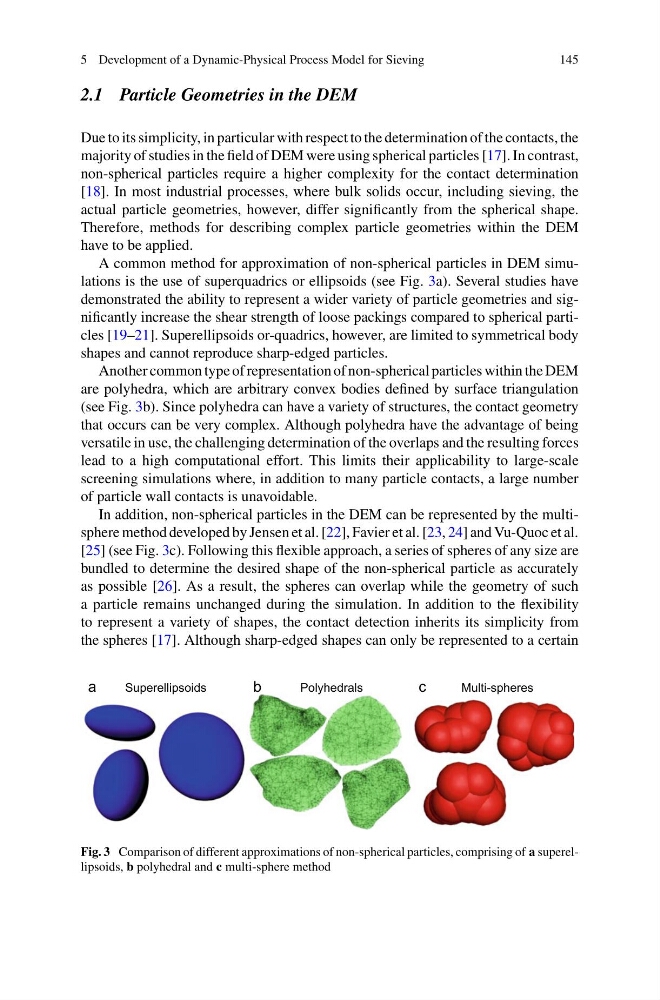
A common method for approximation of non-spherical particles in DEM simulations is the use of superquadrics or ellipsoids (see Fig. 3a). Several studies have
demonstrated the ability to represent a wider variety of particle geometries and significantly increase the shear strength of loose packings compared to spherical particles [19–21]. Superellipsoids or-quadrics, however, are limited to symmetrical body
shapes and cannot reproduce sharp-edged particles.
Another common type of representation of non-spherical particles within the DEM
are polyhedra, which are arbitrary convex bodies defined by surface triangulation
(see Fig. 3b). Since polyhedra can have a variety of structures, the contact geometry
that occurs can be very complex. Although polyhedra have the advantage of being
versatile in use, the challenging determination of the overlaps and the resulting forces
lead to a high computational effort. This limits their applicability to large-scale
screening simulations where, in addition to many particle contacts, a large number
of particle wall contacts is unavoidable.
In addition, non-spherical particles in the DEM can be represented by the multisphere method developed by Jensen et al. [22], Favier et al. [23, 24] and Vu-Quoc et al.
[25] (see Fig. 3c). Following this flexible approach, a series of spheres of any size are
bundled to determine the desired shape of the non-spherical particle as accurately
as possible [26]. As a result, the spheres can overlap while the geometry of such
a particle remains unchanged during the simulation. In addition to the flexibility
to represent a variety of shapes, the contact detection inherits its simplicity from
the spheres [17]. Although sharp-edged shapes can only be represented to a certain
a
Superellipsoids
b
Polyhedrals
c
Multi-spheres
Fig. 3 Comparison of different approximations of non-spherical particles, comprising of a superellipsoids, b polyhedral and c multi-sphere method
145
2.1 Particle Geometries in the DEM
Due to its simplicity, in particular with respect to the determination of the contacts, the
majority of studies in the field of DEM were using spherical particles [17]. In contrast,
non-spherical particles require a higher complexity for the contact determination
[18]. In most industrial processes, where bulk solids occur, including sieving, the
actual particle geometries, however, differ significantly from the spherical shape.
Therefore, methods for describing complex particle geometries within the DEM
have to be applied.
A common method for approximation of non-spherical particles in DEM simulations is the use of superquadrics or ellipsoids (see Fig. 3a). Several studies have
demonstrated the ability to represent a wider variety of particle geometries and significantly increase the shear strength of loose packings compared to spherical particles [19–21]. Superellipsoids or-quadrics, however, are limited to symmetrical body
shapes and cannot reproduce sharp-edged particles.
Another common type of representation of non-spherical particles within the DEM
are polyhedra, which are arbitrary convex bodies defined by surface triangulation
(see Fig. 3b). Since polyhedra can have a variety of structures, the contact geometry
that occurs can be very complex. Although polyhedra have the advantage of being
versatile in use, the challenging determination of the overlaps and the resulting forces
lead to a high computational effort. This limits their applicability to large-scale
screening simulations where, in addition to many particle contacts, a large number
of particle wall contacts is unavoidable.
In addition, non-spherical particles in the DEM can be represented by the multisphere method developed by Jensen et al. [22], Favier et al. [23, 24] and Vu-Quoc et al.
[25] (see Fig. 3c). Following this flexible approach, a series of spheres of any size are
bundled to determine the desired shape of the non-spherical particle as accurately
as possible [26]. As a result, the spheres can overlap while the geometry of such
a particle remains unchanged during the simulation. In addition to the flexibility
to represent a variety of shapes, the contact detection inherits its simplicity from
the spheres [17]. Although sharp-edged shapes can only be represented to a certain
a
Superellipsoids
b
Polyhedrals
c
Multi-spheres
Fig. 3 Comparison of different approximations of non-spherical particles, comprising of a superellipsoids, b polyhedral and c multi-sphere method