

16.6 Computer Program for Finite Element Free Vibration Analysis of Plates
603
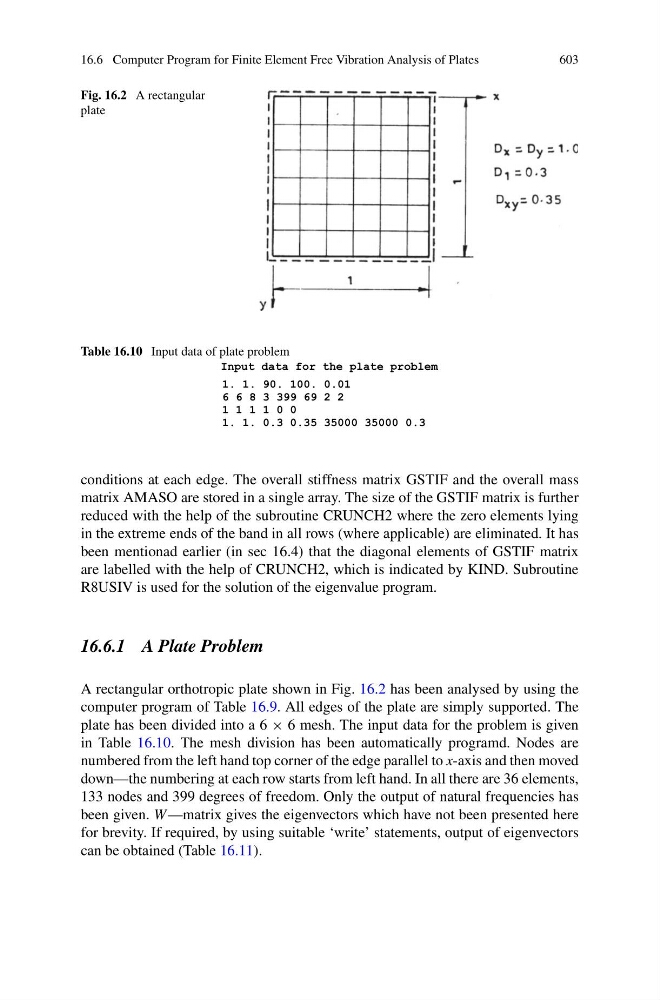
Fig. 16.2 A rectangular
plate
Table 16.10 Input data of plate problem
Input data for the plate problem
1. 1. 90. 100. 0.01
6 6 8 3 399 69 2 2
1 1 1 1 0 0
1. 1. 0.3 0.35 35000 35000 0.3
conditions at each edge. The overall stiffness matrix GSTIF and the overall mass
matrix AMASO are stored in a single array. The size of the GSTIF matrix is further
reduced with the help of the subroutine CRUNCH2 where the zero elements lying
in the extreme ends of the band in all rows (where applicable) are eliminated. It has
been mentionad earlier (in sec 16.4) that the diagonal elements of GSTIF matrix
are labelled with the help of CRUNCH2, which is indicated by KIND. Subroutine
R8USIV is used for the solution of the eigenvalue program.
16.6.1 A Plate Problem
A rectangular orthotropic plate shown in Fig. 16.2 has been analysed by using the
computer program of Table 16.9. All edges of the plate are simply supported. The
plate has been divided into a 6 × 6 mesh. The input data for the problem is given
in Table 16.10. The mesh division has been automatically programd. Nodes are
numbered from the left hand top corner of the edge parallel to x-axis and then moved
down—the numbering at each row starts from left hand. In all there are 36 elements,
133 nodes and 399 degrees of freedom. Only the output of natural frequencies has
been given. W —matrix gives the eigenvectors which have not been presented here
for brevity. If required, by using suitable ‘write’ statements, output of eigenvectors
can be obtained (Table 16.11).