

2.6 Energy Method and Free Torsional Vibration
41
=
32T 0
π d
4
1 G
L 1 +
L 2 d
4
1
d
4
2
=
32T 0
π d
4
1 G
L
where
L = L 1 + L 2
d
4
1
d
4
2
= equivalent length
k =
T 0
φ
=
π d
4
1 G
32L
I P =
W D
2
8g
Therefore, by definition
T = 2π
I P
k
= 2π
W D 2
8g
·
32
π d
4
1 G
L 1 + L 2
d
4
1
d
4
2
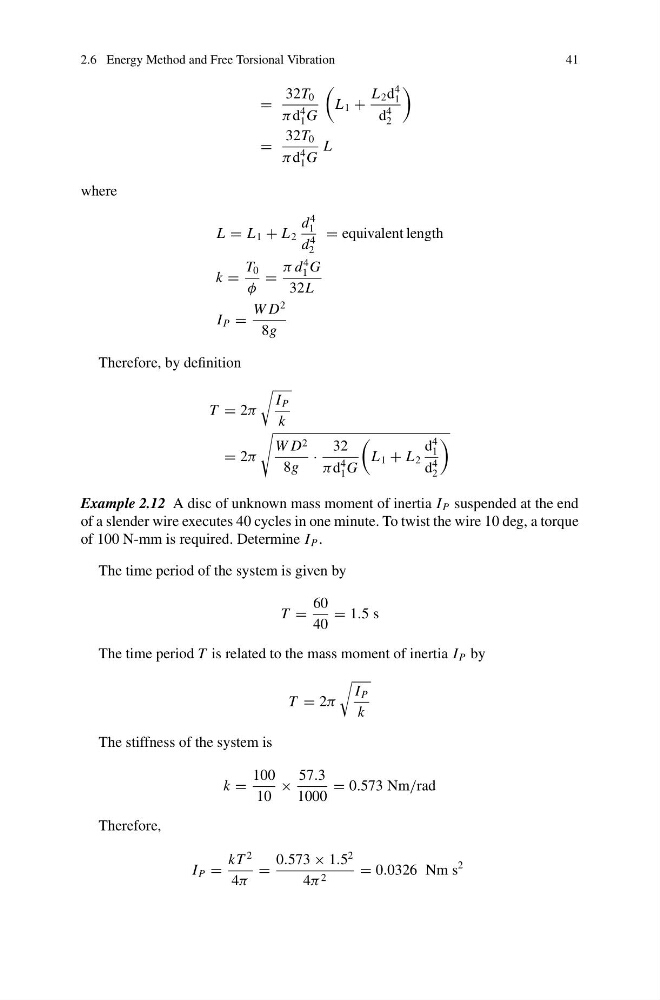
Example 2.12 A disc of unknown mass moment of inertia I P suspended at the end
of a slender wire executes 40 cycles in one minute. To twist the wire 10 deg, a torque
of 100 N-mm is required. Determine I P .
The time period of the system is given by
T =
60
40
= 1.5 s
The time period T is related to the mass moment of inertia I P by
T = 2π
I P
k
The stiffness of the system is
k =
100
10
×
57.3
1000
= 0.573 Nm/rad
Therefore,
I P =
kT
2
4π
=
0.573 × 1.5
2
4π 2
= 0.0326 Nm s
2
41
=
32T 0
π d
4
1 G
L 1 +
L 2 d
4
1
d
4
2
=
32T 0
π d
4
1 G
L
where
L = L 1 + L 2
d
4
1
d
4
2
= equivalent length
k =
T 0
φ
=
π d
4
1 G
32L
I P =
W D
2
8g
Therefore, by definition
T = 2π
I P
k
= 2π
W D 2
8g
·
32
π d
4
1 G
L 1 + L 2
d
4
1
d
4
2
Example 2.12 A disc of unknown mass moment of inertia I P suspended at the end
of a slender wire executes 40 cycles in one minute. To twist the wire 10 deg, a torque
of 100 N-mm is required. Determine I P .
The time period of the system is given by
T =
60
40
= 1.5 s
The time period T is related to the mass moment of inertia I P by
T = 2π
I P
k
The stiffness of the system is
k =
100
10
×
57.3
1000
= 0.573 Nm/rad
Therefore,
I P =
kT
2
4π
=
0.573 × 1.5
2
4π 2
= 0.0326 Nm s
2