

14.2 Perturbation Method
517
or
δ =
L 2 + y 2 − L
(b)
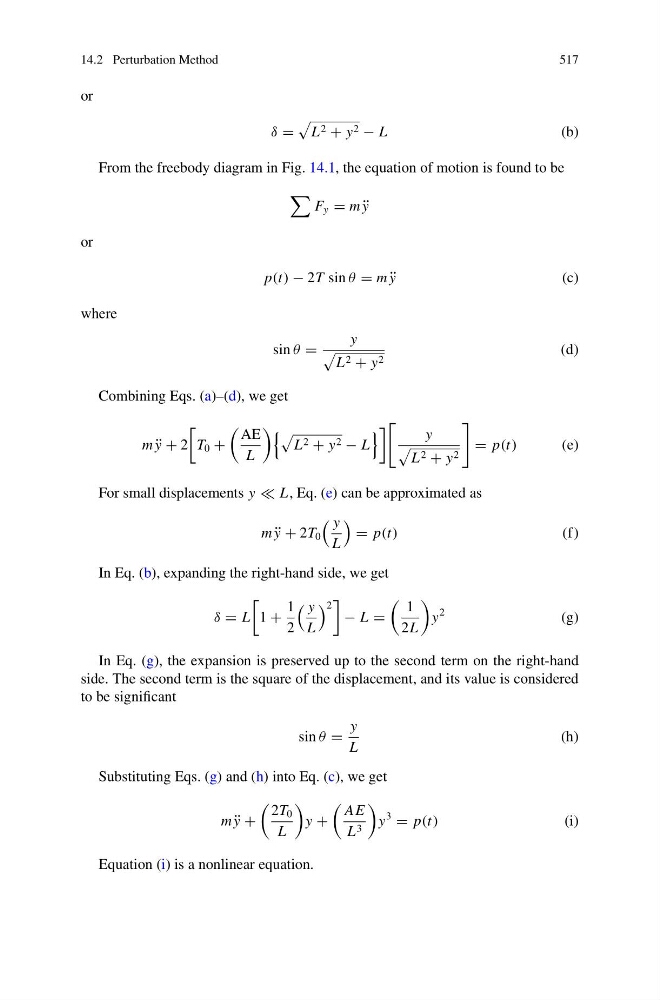
From the freebody diagram in Fig. 14.1, the equation of motion is found to be
F y = m ¨
y
or
p(t) − 2T sin θ = m ¨
y
(c)
where
sin θ =
y
L 2 + y 2
(d)
Combining Eqs. (a)–(d), we get
m ¨
y + 2
T 0 +
AE
L
L 2 + y 2 − L
y
L 2 + y 2
= p(t)
(e)
For small displacements y L, Eq. (e) can be approximated as
m ¨
y + 2T 0
y
L
= p(t)
(f)
In Eq. (b), expanding the right-hand side, we get
δ = L
1 +
1
2
y
L
2
− L =
1
2L
y
2
(g)
In Eq. (g), the expansion is preserved up to the second term on the right-hand
side. The second term is the square of the displacement, and its value is considered
to be significant
sin θ =
y
L
(h)
Substituting Eqs. (g) and (h) into Eq. (c), we get
m ¨
y +
2T 0
L
y +
AE
L 3
y
3
= p(t)
(i)
Equation (i) is a nonlinear equation.
517
or
δ =
L 2 + y 2 − L
(b)
From the freebody diagram in Fig. 14.1, the equation of motion is found to be
F y = m ¨
y
or
p(t) − 2T sin θ = m ¨
y
(c)
where
sin θ =
y
L 2 + y 2
(d)
Combining Eqs. (a)–(d), we get
m ¨
y + 2
T 0 +
AE
L
L 2 + y 2 − L
y
L 2 + y 2
= p(t)
(e)
For small displacements y L, Eq. (e) can be approximated as
m ¨
y + 2T 0
y
L
= p(t)
(f)
In Eq. (b), expanding the right-hand side, we get
δ = L
1 +
1
2
y
L
2
− L =
1
2L
y
2
(g)
In Eq. (g), the expansion is preserved up to the second term on the right-hand
side. The second term is the square of the displacement, and its value is considered
to be significant
sin θ =
y
L
(h)
Substituting Eqs. (g) and (h) into Eq. (c), we get
m ¨
y +
2T 0
L
y +
AE
L 3
y
3
= p(t)
(i)
Equation (i) is a nonlinear equation.