

12.8 Flexural Vibrations of Plates Using Isoparametric Elements
471
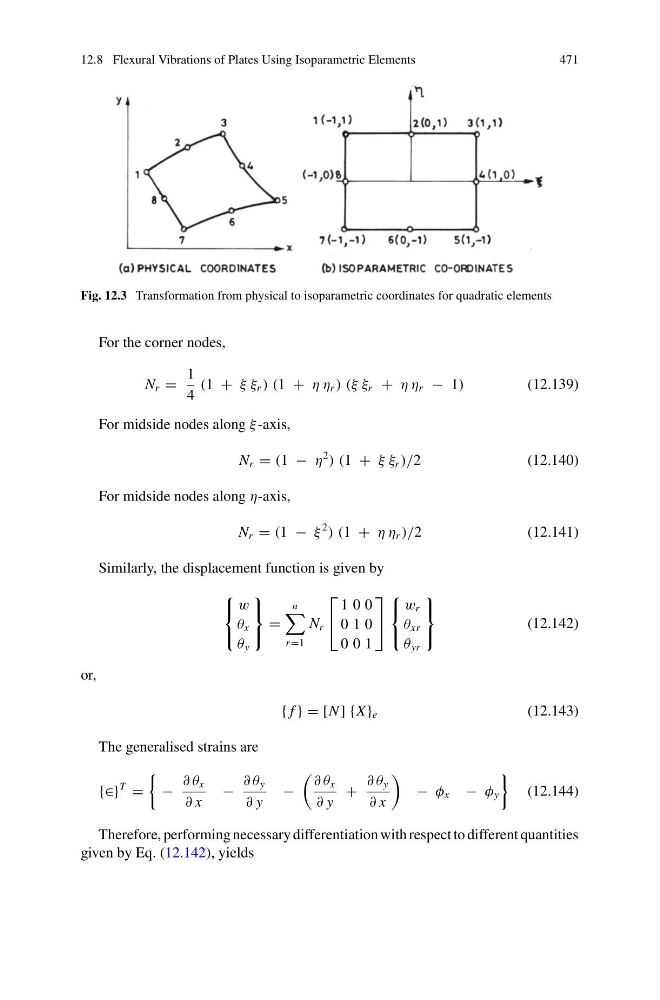
Fig. 12.3 Transformation from physical to isoparametric coordinates for quadratic elements
For the corner nodes,
N r =
1
4
(1 + ξ ξ r ) (1 + η η r ) (ξ ξ r + η η r − 1)
(12.139)
For midside nodes along ξ -axis,
N r = (1 − η
2
) (1 + ξ ξ r )/2
(12.140)
For midside nodes along η-axis,
N r = (1 − ξ
2
) (1 + η η r )/2
(12.141)
Similarly, the displacement function is given by
⎧
⎨
⎩
w
θ x
θ y
⎫
⎬
⎭
=
n
r =1
N r
⎡
⎣
1 0 0
0 1 0
0 0 1
⎤
⎦
⎧
⎨
⎩
w r
θ xr
θ yr
⎫
⎬
⎭
(12.142)
or,
{ f } = [N ] {X } e
(12.143)
The generalised strains are
{∈}
T
=
−
∂ θ x
∂ x
−
∂ θ y
∂ y
−
∂ θ x
∂ y
+
∂ θ y
∂ x
− φ x − φ y
(12.144)
Therefore, performing necessary differentiation with respect to different quantities
given by Eq. (12.142), yields
471
Fig. 12.3 Transformation from physical to isoparametric coordinates for quadratic elements
For the corner nodes,
N r =
1
4
(1 + ξ ξ r ) (1 + η η r ) (ξ ξ r + η η r − 1)
(12.139)
For midside nodes along ξ -axis,
N r = (1 − η
2
) (1 + ξ ξ r )/2
(12.140)
For midside nodes along η-axis,
N r = (1 − ξ
2
) (1 + η η r )/2
(12.141)
Similarly, the displacement function is given by
⎧
⎨
⎩
w
θ x
θ y
⎫
⎬
⎭
=
n
r =1
N r
⎡
⎣
1 0 0
0 1 0
0 0 1
⎤
⎦
⎧
⎨
⎩
w r
θ xr
θ yr
⎫
⎬
⎭
(12.142)
or,
{ f } = [N ] {X } e
(12.143)
The generalised strains are
{∈}
T
=
−
∂ θ x
∂ x
−
∂ θ y
∂ y
−
∂ θ x
∂ y
+
∂ θ y
∂ x
− φ x − φ y
(12.144)
Therefore, performing necessary differentiation with respect to different quantities
given by Eq. (12.142), yields