

414
10 Dynamic Direct Stiffness Method
where r
2
=
I
A
.
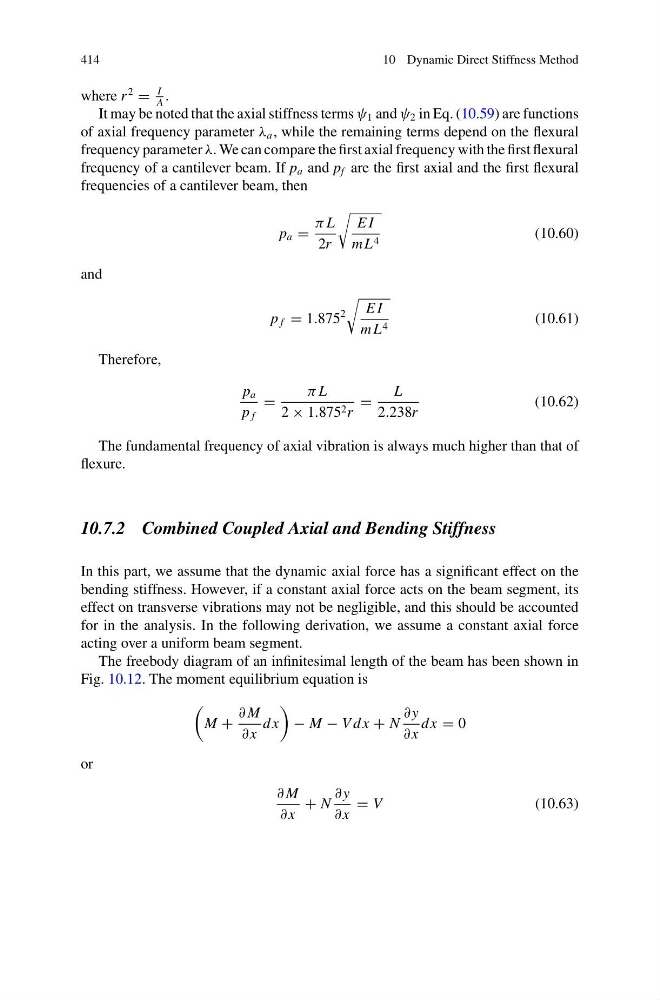
It may be noted that the axial stiffness terms ψ 1 and ψ 2 in Eq. (10.59) are functions
of axial frequency parameter λ a , while the remaining terms depend on the flexural
frequency parameter λ. We can compare the first axial frequency with the first flexural
frequency of a cantilever beam. If p a and p f are the first axial and the first flexural
frequencies of a cantilever beam, then
p a =
π L
2r
E I
m L 4
(10.60)
and
p f = 1.875
2
E I
m L 4
(10.61)
Therefore,
p a
p f
=
π L
2 × 1.875 2 r
=
L
2.238r
(10.62)
The fundamental frequency of axial vibration is always much higher than that of
flexure.
10.7.2 Combined Coupled Axial and Bending Stiffness
In this part, we assume that the dynamic axial force has a significant effect on the
bending stiffness. However, if a constant axial force acts on the beam segment, its
effect on transverse vibrations may not be negligible, and this should be accounted
for in the analysis. In the following derivation, we assume a constant axial force
acting over a uniform beam segment.
The freebody diagram of an infinitesimal length of the beam has been shown in
Fig. 10.12. The moment equilibrium equation is
M +
∂ M
∂ x
dx
− M − V dx + N
∂ y
∂ x
dx = 0
or
∂ M
∂ x
+ N
∂ y
∂ x
= V
(10.63)
10 Dynamic Direct Stiffness Method
where r
2
=
I
A
.
It may be noted that the axial stiffness terms ψ 1 and ψ 2 in Eq. (10.59) are functions
of axial frequency parameter λ a , while the remaining terms depend on the flexural
frequency parameter λ. We can compare the first axial frequency with the first flexural
frequency of a cantilever beam. If p a and p f are the first axial and the first flexural
frequencies of a cantilever beam, then
p a =
π L
2r
E I
m L 4
(10.60)
and
p f = 1.875
2
E I
m L 4
(10.61)
Therefore,
p a
p f
=
π L
2 × 1.875 2 r
=
L
2.238r
(10.62)
The fundamental frequency of axial vibration is always much higher than that of
flexure.
10.7.2 Combined Coupled Axial and Bending Stiffness
In this part, we assume that the dynamic axial force has a significant effect on the
bending stiffness. However, if a constant axial force acts on the beam segment, its
effect on transverse vibrations may not be negligible, and this should be accounted
for in the analysis. In the following derivation, we assume a constant axial force
acting over a uniform beam segment.
The freebody diagram of an infinitesimal length of the beam has been shown in
Fig. 10.12. The moment equilibrium equation is
M +
∂ M
∂ x
dx
− M − V dx + N
∂ y
∂ x
dx = 0
or
∂ M
∂ x
+ N
∂ y
∂ x
= V
(10.63)