

412
10 Dynamic Direct Stiffness Method
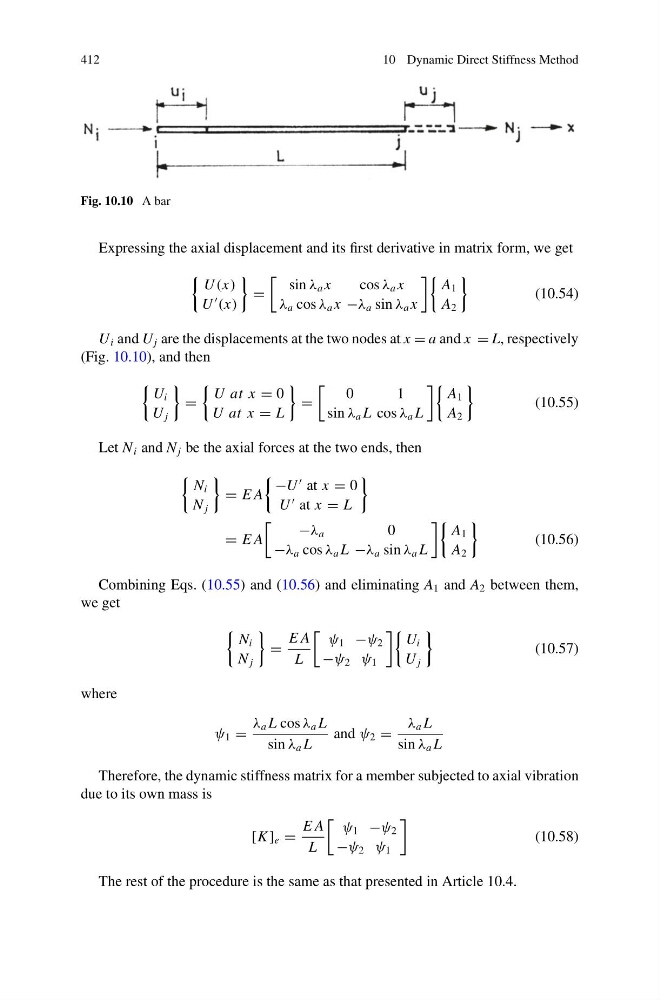
Fig. 10.10 A bar
Expressing the axial displacement and its first derivative in matrix form, we get
U (x)
U
(x)
=
sin λ a x
cos λ a x
λ a cos λ a x −λ a sin λ a x
A 1
A 2
(10.54)
U i and U j are the displacements at the two nodes at x = a and x = L, respectively
(Fig. 10.10), and then
U i
U j
=
U at x = 0
U at x = L
=
0
1
sin λ a L cos λ a L
A 1
A 2
(10.55)
Let N i and N j be the axial forces at the two ends, then
N i
N j
= E A
−U
at x = 0
U
at x = L
= E A
−λ a
0
−λ a cos λ a L −λ a sin λ a L
A 1
A 2
(10.56)
Combining Eqs. (10.55) and (10.56) and eliminating A 1 and A 2 between them,
we get
N i
N j
=
E A
L
ψ 1 −ψ 2
−ψ 2 ψ 1
U i
U j
(10.57)
where
ψ 1 =
λ a L cos λ a L
sin λ a L
and ψ 2 =
λ a L
sin λ a L
Therefore, the dynamic stiffness matrix for a member subjected to axial vibration
due to its own mass is
[K ] e =
E A
L
ψ 1 −ψ 2
−ψ 2 ψ 1
(10.58)
The rest of the procedure is the same as that presented in Article 10.4.
10 Dynamic Direct Stiffness Method
Fig. 10.10 A bar
Expressing the axial displacement and its first derivative in matrix form, we get
U (x)
U
(x)
=
sin λ a x
cos λ a x
λ a cos λ a x −λ a sin λ a x
A 1
A 2
(10.54)
U i and U j are the displacements at the two nodes at x = a and x = L, respectively
(Fig. 10.10), and then
U i
U j
=
U at x = 0
U at x = L
=
0
1
sin λ a L cos λ a L
A 1
A 2
(10.55)
Let N i and N j be the axial forces at the two ends, then
N i
N j
= E A
−U
at x = 0
U
at x = L
= E A
−λ a
0
−λ a cos λ a L −λ a sin λ a L
A 1
A 2
(10.56)
Combining Eqs. (10.55) and (10.56) and eliminating A 1 and A 2 between them,
we get
N i
N j
=
E A
L
ψ 1 −ψ 2
−ψ 2 ψ 1
U i
U j
(10.57)
where
ψ 1 =
λ a L cos λ a L
sin λ a L
and ψ 2 =
λ a L
sin λ a L
Therefore, the dynamic stiffness matrix for a member subjected to axial vibration
due to its own mass is
[K ] e =
E A
L
ψ 1 −ψ 2
−ψ 2 ψ 1
(10.58)
The rest of the procedure is the same as that presented in Article 10.4.