

2.3 Free Undamped Vibration of the Sdf System
27
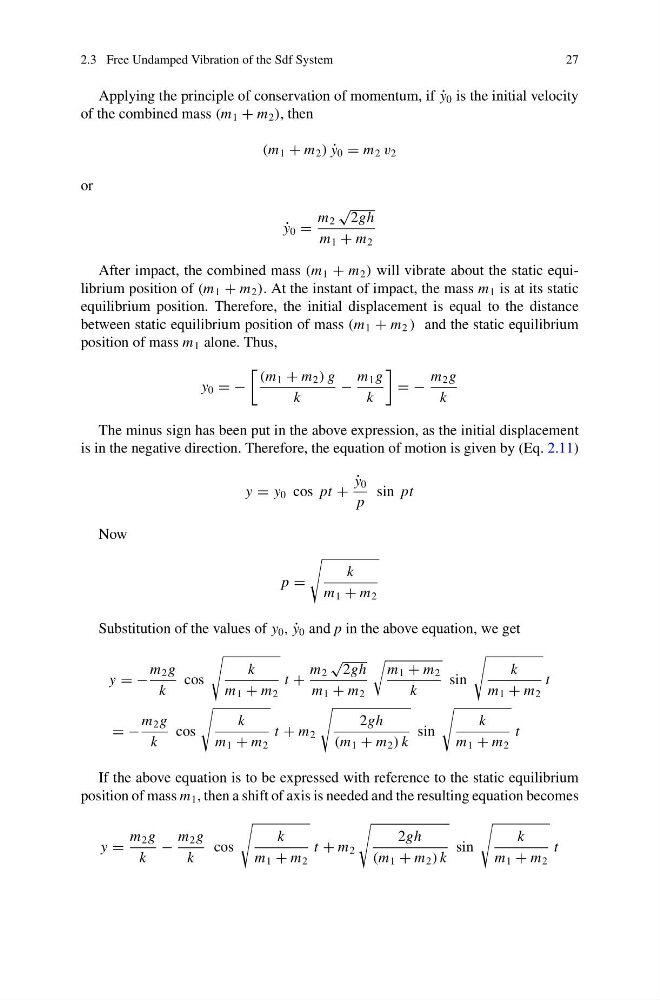
Applying the principle of conservation of momentum, if ˙
y 0 is the initial velocity
of the combined mass (m 1 + m 2 ), then
(m 1 + m 2 ) ˙
y 0 = m 2 v 2
or
˙
y 0 =
m 2
√
2gh
m 1 + m 2
After impact, the combined mass (m 1 + m 2 ) will vibrate about the static equilibrium position of (m 1 + m 2 ). At the instant of impact, the mass m 1 is at its static
equilibrium position. Therefore, the initial displacement is equal to the distance
between static equilibrium position of mass (m 1 + m 2 ) and the static equilibrium
position of mass m 1 alone. Thus,
y 0 = −
(m 1 + m 2 ) g
k
−
m 1 g
k
= −
m 2 g
k
The minus sign has been put in the above expression, as the initial displacement
is in the negative direction. Therefore, the equation of motion is given by (Eq. 2.11)
y = y 0 cos pt +
˙
y 0
p
sin pt
Now
p =
k
m 1 + m 2
Substitution of the values of y 0 , ˙
y 0 and p in the above equation, we get
y = −
m 2 g
k
cos
k
m 1 + m 2
t +
m 2
√
2gh
m 1 + m 2
m 1 + m 2
k
sin
k
m 1 + m 2
t
= −
m 2 g
k
cos
k
m 1 + m 2
t + m 2
2gh
(m 1 + m 2 ) k
sin
k
m 1 + m 2
t
If the above equation is to be expressed with reference to the static equilibrium
position of mass m 1 , then a shift of axis is needed and the resulting equation becomes
y =
m 2 g
k
−
m 2 g
k
cos
k
m 1 + m 2
t + m 2
2gh
(m 1 + m 2 ) k
sin
k
m 1 + m 2
t
27
Applying the principle of conservation of momentum, if ˙
y 0 is the initial velocity
of the combined mass (m 1 + m 2 ), then
(m 1 + m 2 ) ˙
y 0 = m 2 v 2
or
˙
y 0 =
m 2
√
2gh
m 1 + m 2
After impact, the combined mass (m 1 + m 2 ) will vibrate about the static equilibrium position of (m 1 + m 2 ). At the instant of impact, the mass m 1 is at its static
equilibrium position. Therefore, the initial displacement is equal to the distance
between static equilibrium position of mass (m 1 + m 2 ) and the static equilibrium
position of mass m 1 alone. Thus,
y 0 = −
(m 1 + m 2 ) g
k
−
m 1 g
k
= −
m 2 g
k
The minus sign has been put in the above expression, as the initial displacement
is in the negative direction. Therefore, the equation of motion is given by (Eq. 2.11)
y = y 0 cos pt +
˙
y 0
p
sin pt
Now
p =
k
m 1 + m 2
Substitution of the values of y 0 , ˙
y 0 and p in the above equation, we get
y = −
m 2 g
k
cos
k
m 1 + m 2
t +
m 2
√
2gh
m 1 + m 2
m 1 + m 2
k
sin
k
m 1 + m 2
t
= −
m 2 g
k
cos
k
m 1 + m 2
t + m 2
2gh
(m 1 + m 2 ) k
sin
k
m 1 + m 2
t
If the above equation is to be expressed with reference to the static equilibrium
position of mass m 1 , then a shift of axis is needed and the resulting equation becomes
y =
m 2 g
k
−
m 2 g
k
cos
k
m 1 + m 2
t + m 2
2gh
(m 1 + m 2 ) k
sin
k
m 1 + m 2
t