

402
10 Dynamic Direct Stiffness Method
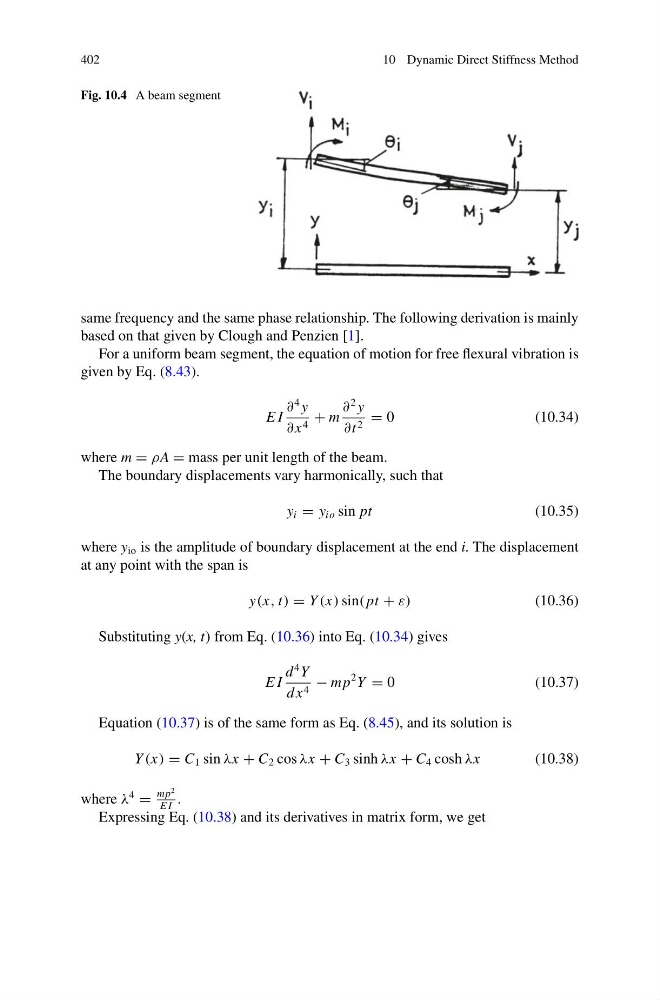
Fig. 10.4 A beam segment
same frequency and the same phase relationship. The following derivation is mainly
based on that given by Clough and Penzien [1].
For a uniform beam segment, the equation of motion for free flexural vibration is
given by Eq. (8.43).
E I
∂
4 y
∂ x 4 + m
∂
2 y
∂t 2 = 0
(10.34)
where m = ρA = mass per unit length of the beam.
The boundary displacements vary harmonically, such that
y i = y io sin pt
(10.35)
where y io is the amplitude of boundary displacement at the end i. The displacement
at any point with the span is
y(x, t) = Y (x) sin( pt + ε)
(10.36)
Substituting y(x, t) from Eq. (10.36) into Eq. (10.34) gives
E I
d
4 Y
dx 4 − mp
2 Y = 0
(10.37)
Equation (10.37) is of the same form as Eq. (8.45), and its solution is
Y (x) = C 1 sin λx + C 2 cos λx + C 3 sinh λx + C 4 cosh λx
(10.38)
where λ
4
=
mp
2
E I
.
Expressing Eq. (10.38) and its derivatives in matrix form, we get
10 Dynamic Direct Stiffness Method
Fig. 10.4 A beam segment
same frequency and the same phase relationship. The following derivation is mainly
based on that given by Clough and Penzien [1].
For a uniform beam segment, the equation of motion for free flexural vibration is
given by Eq. (8.43).
E I
∂
4 y
∂ x 4 + m
∂
2 y
∂t 2 = 0
(10.34)
where m = ρA = mass per unit length of the beam.
The boundary displacements vary harmonically, such that
y i = y io sin pt
(10.35)
where y io is the amplitude of boundary displacement at the end i. The displacement
at any point with the span is
y(x, t) = Y (x) sin( pt + ε)
(10.36)
Substituting y(x, t) from Eq. (10.36) into Eq. (10.34) gives
E I
d
4 Y
dx 4 − mp
2 Y = 0
(10.37)
Equation (10.37) is of the same form as Eq. (8.45), and its solution is
Y (x) = C 1 sin λx + C 2 cos λx + C 3 sinh λx + C 4 cosh λx
(10.38)
where λ
4
=
mp
2
E I
.
Expressing Eq. (10.38) and its derivatives in matrix form, we get