

396
10 Dynamic Direct Stiffness Method
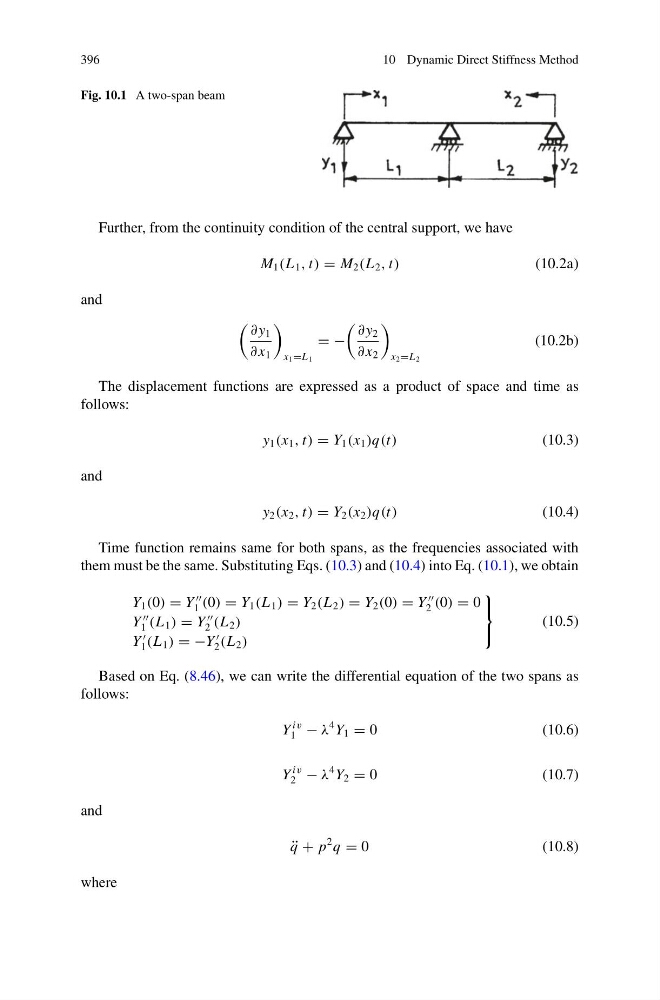
Fig. 10.1 A two-span beam
Further, from the continuity condition of the central support, we have
M 1 (L 1 , t) = M 2 (L 2 , t)
(10.2a)
and
∂ y 1
∂ x 1
x 1 =L 1
= −
∂ y 2
∂ x 2
x 2 =L 2
(10.2b)
The displacement functions are expressed as a product of space and time as
follows:
y 1 (x 1 , t) = Y 1 (x 1 )q(t)
(10.3)
and
y 2 (x 2 , t) = Y 2 (x 2 )q(t)
(10.4)
Time function remains same for both spans, as the frequencies associated with
them must be the same. Substituting Eqs. (10.3) and (10.4) into Eq. (10.1), we obtain
Y 1 (0) = Y
1 (0) = Y 1 (L 1 ) = Y 2 (L 2 ) = Y 2 (0) = Y
2 (0) = 0
Y
1 (L 1 ) = Y
2 (L 2 )
Y
1 (L 1 ) = −Y
2 (L 2 )
⎫
⎬
⎭
(10.5)
Based on Eq. (8.46), we can write the differential equation of the two spans as
follows:
Y
iv
1 − λ
4 Y 1 = 0
(10.6)
Y
iv
2 − λ
4 Y 2 = 0
(10.7)
and
¨
q + p
2 q = 0
(10.8)
where
10 Dynamic Direct Stiffness Method
Fig. 10.1 A two-span beam
Further, from the continuity condition of the central support, we have
M 1 (L 1 , t) = M 2 (L 2 , t)
(10.2a)
and
∂ y 1
∂ x 1
x 1 =L 1
= −
∂ y 2
∂ x 2
x 2 =L 2
(10.2b)
The displacement functions are expressed as a product of space and time as
follows:
y 1 (x 1 , t) = Y 1 (x 1 )q(t)
(10.3)
and
y 2 (x 2 , t) = Y 2 (x 2 )q(t)
(10.4)
Time function remains same for both spans, as the frequencies associated with
them must be the same. Substituting Eqs. (10.3) and (10.4) into Eq. (10.1), we obtain
Y 1 (0) = Y
1 (0) = Y 1 (L 1 ) = Y 2 (L 2 ) = Y 2 (0) = Y
2 (0) = 0
Y
1 (L 1 ) = Y
2 (L 2 )
Y
1 (L 1 ) = −Y
2 (L 2 )
⎫
⎬
⎭
(10.5)
Based on Eq. (8.46), we can write the differential equation of the two spans as
follows:
Y
iv
1 − λ
4 Y 1 = 0
(10.6)
Y
iv
2 − λ
4 Y 2 = 0
(10.7)
and
¨
q + p
2 q = 0
(10.8)
where