

374
9 Forced Vibration of Continuous Systems
a
2
=
E
ρ
(9.17)
Substituting a
2 for
E
ρ
in Eq. (9.16), we get
¨
ξ r +
(2r − 1)
2
π
2 a
2
4L 2
ξ r =
2P
ρ AL
sin
(2r − 1)
L
π
(9.18)
Using Duhamel’s integral, solution of Eq. (9.18) is
ξ r =
4P
(2r − 1)ρ Aπa
sin
(2r − 1)
2
π
t
0
sin
(2r − 1)πa
2L
(t − τ ) dτ
(9.19)
assuming the structure to be at rest at t = 0.
Therefore, the displacement u(x, t) is given by, after substituting U r from
Eq. (9.12) and ξ r from Eqs. (9.19) to (9.2)
u =
4P
ρ Aπa
1
(2r − 1) 2 sin
(2r − 1)
2
π sin
(2r − 1)π x
2L
×
t
0
sin
(2r − 1)πa
2L
(t − τ )dτ
(9.20)
If P is suddenly applied at the time t = 0, then Eq. (9.20) becomes
u =
8P L
π 2 a 2 ρ A
1
(2r − 1) 2 sin
(2r − 1)π
2
sin
(2r − 1) π x
2L
×
1 − cos
(2r − 1)πat
2L
(9.21)
Maximum displacement will occur at the end of the bar, where x = L and at time
t = 2L/a. Noting that
r =1, 2,3...
1
(2r − 1) 2 =
π
2
8
and substituting it in Eq. (9.21) for the maximum value, we get
(u) x=L =
2P L
AE
(9.22)
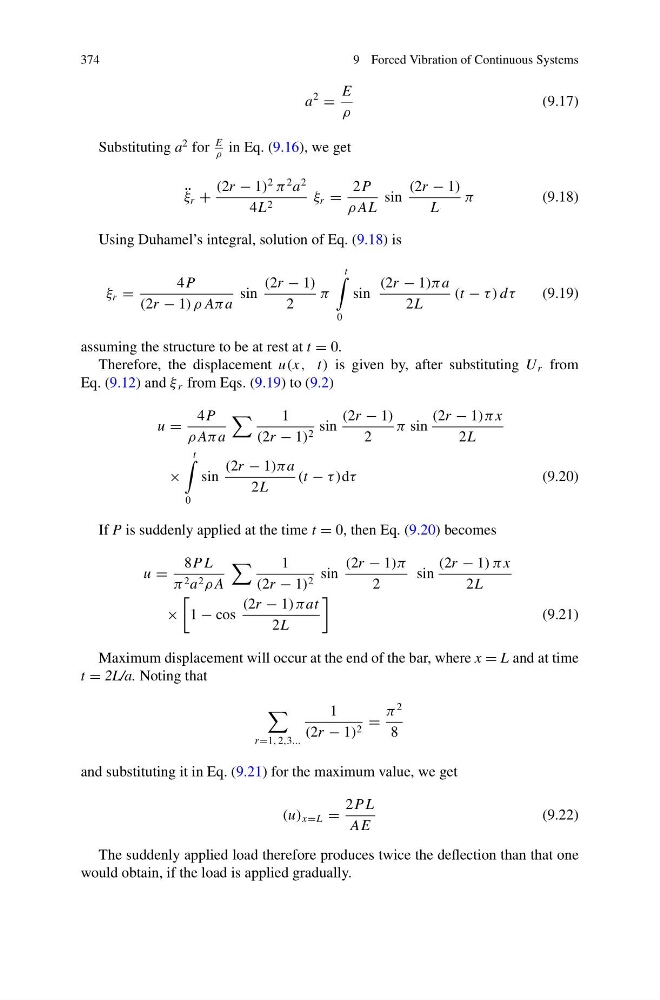
The suddenly applied load therefore produces twice the deflection than that one
would obtain, if the load is applied gradually.
9 Forced Vibration of Continuous Systems
a
2
=
E
ρ
(9.17)
Substituting a
2 for
E
ρ
in Eq. (9.16), we get
¨
ξ r +
(2r − 1)
2
π
2 a
2
4L 2
ξ r =
2P
ρ AL
sin
(2r − 1)
L
π
(9.18)
Using Duhamel’s integral, solution of Eq. (9.18) is
ξ r =
4P
(2r − 1)ρ Aπa
sin
(2r − 1)
2
π
t
0
sin
(2r − 1)πa
2L
(t − τ ) dτ
(9.19)
assuming the structure to be at rest at t = 0.
Therefore, the displacement u(x, t) is given by, after substituting U r from
Eq. (9.12) and ξ r from Eqs. (9.19) to (9.2)
u =
4P
ρ Aπa
1
(2r − 1) 2 sin
(2r − 1)
2
π sin
(2r − 1)π x
2L
×
t
0
sin
(2r − 1)πa
2L
(t − τ )dτ
(9.20)
If P is suddenly applied at the time t = 0, then Eq. (9.20) becomes
u =
8P L
π 2 a 2 ρ A
1
(2r − 1) 2 sin
(2r − 1)π
2
sin
(2r − 1) π x
2L
×
1 − cos
(2r − 1)πat
2L
(9.21)
Maximum displacement will occur at the end of the bar, where x = L and at time
t = 2L/a. Noting that
r =1, 2,3...
1
(2r − 1) 2 =
π
2
8
and substituting it in Eq. (9.21) for the maximum value, we get
(u) x=L =
2P L
AE
(9.22)
The suddenly applied load therefore produces twice the deflection than that one
would obtain, if the load is applied gradually.