

372
9 Forced Vibration of Continuous Systems
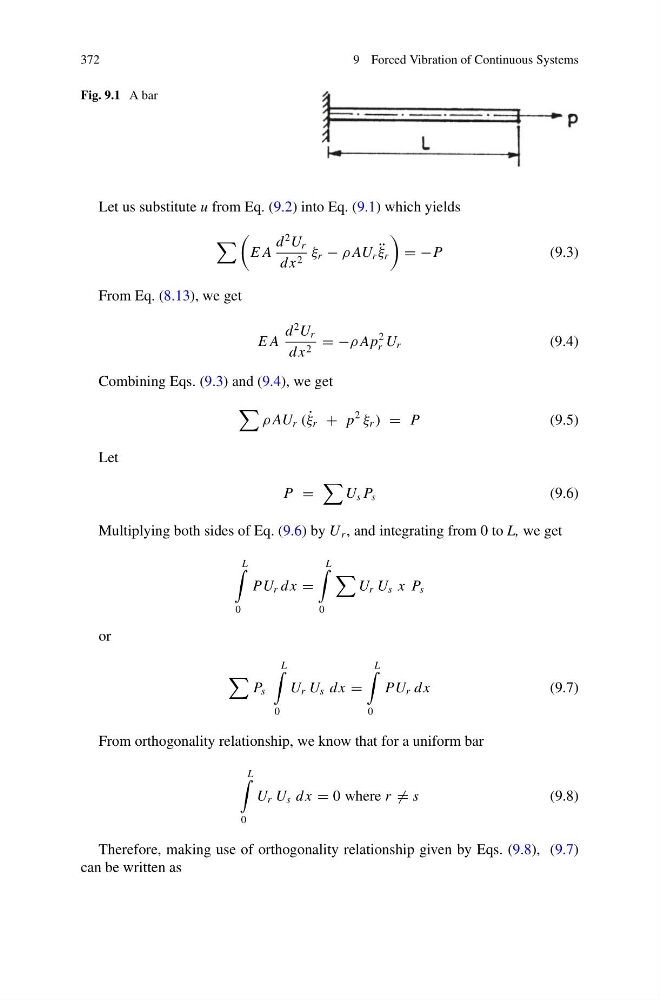
Fig. 9.1 A bar
Let us substitute u from Eq. (9.2) into Eq. (9.1) which yields
E A
d
2 U r
dx 2 ξ r − ρ AU r ¨
ξ r
= −P
(9.3)
From Eq. (8.13), we get
E A
d
2 U r
dx 2 = −ρ Ap
2
r U r
(9.4)
Combining Eqs. (9.3) and (9.4), we get
ρ AU r ( ˙
ξ r + p
2
ξ r ) = P
(9.5)
Let
P =
U s P s
(9.6)
Multiplying both sides of Eq. (9.6) by U r , and integrating from 0 to L, we get
L
0
PU r dx =
L
0
U r U s x P s
or
P s
L
0
U r U s dx =
L
0
PU r dx
(9.7)
From orthogonality relationship, we know that for a uniform bar
L
0
U r U s dx = 0 where r = s
(9.8)
Therefore, making use of orthogonality relationship given by Eqs. (9.8), (9.7)
can be written as
9 Forced Vibration of Continuous Systems
Fig. 9.1 A bar
Let us substitute u from Eq. (9.2) into Eq. (9.1) which yields
E A
d
2 U r
dx 2 ξ r − ρ AU r ¨
ξ r
= −P
(9.3)
From Eq. (8.13), we get
E A
d
2 U r
dx 2 = −ρ Ap
2
r U r
(9.4)
Combining Eqs. (9.3) and (9.4), we get
ρ AU r ( ˙
ξ r + p
2
ξ r ) = P
(9.5)
Let
P =
U s P s
(9.6)
Multiplying both sides of Eq. (9.6) by U r , and integrating from 0 to L, we get
L
0
PU r dx =
L
0
U r U s x P s
or
P s
L
0
U r U s dx =
L
0
PU r dx
(9.7)
From orthogonality relationship, we know that for a uniform bar
L
0
U r U s dx = 0 where r = s
(9.8)
Therefore, making use of orthogonality relationship given by Eqs. (9.8), (9.7)
can be written as