

22
2 Free Vibration of Single Degree of Freedom System
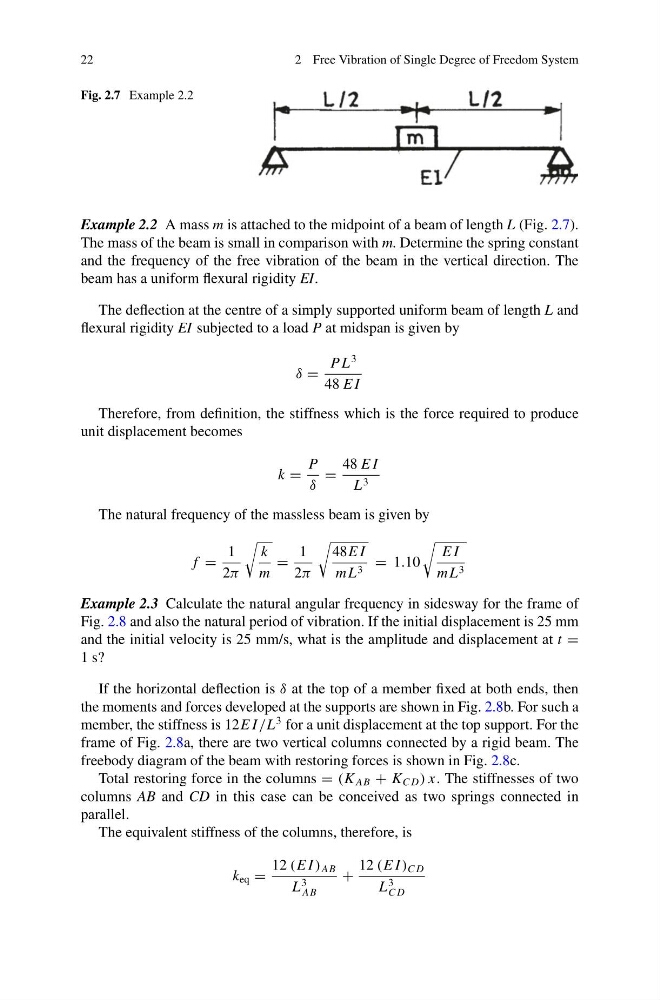
Fig. 2.7 Example 2.2
Example 2.2 A mass m is attached to the midpoint of a beam of length L (Fig. 2.7).
The mass of the beam is small in comparison with m. Determine the spring constant
and the frequency of the free vibration of the beam in the vertical direction. The
beam has a uniform flexural rigidity EI.
The deflection at the centre of a simply supported uniform beam of length L and
flexural rigidity EI subjected to a load P at midspan is given by
δ =
P L
3
48 E I
Therefore, from definition, the stiffness which is the force required to produce
unit displacement becomes
k =
P
δ
=
48 E I
L 3
The natural frequency of the massless beam is given by
f =
1
2π
k
m
=
1
2π
48E I
m L 3 = 1.10
E I
m L 3
Example 2.3 Calculate the natural angular frequency in sidesway for the frame of
Fig. 2.8 and also the natural period of vibration. If the initial displacement is 25 mm
and the initial velocity is 25 mm/s, what is the amplitude and displacement at t =
1 s?
If the horizontal deflection is δ at the top of a member fixed at both ends, then
the moments and forces developed at the supports are shown in Fig. 2.8b. For such a
member, the stiffness is 12E I /L
3 for a unit displacement at the top support. For the
frame of Fig. 2.8a, there are two vertical columns connected by a rigid beam. The
freebody diagram of the beam with restoring forces is shown in Fig. 2.8c.
Total restoring force in the columns = (K AB + K C D ) x. The stiffnesses of two
columns AB and CD in this case can be conceived as two springs connected in
parallel.
The equivalent stiffness of the columns, therefore, is
k eq =
12 (E I ) AB
L
3
AB
+
12 (E I ) C D
L
3
C D
2 Free Vibration of Single Degree of Freedom System
Fig. 2.7 Example 2.2
Example 2.2 A mass m is attached to the midpoint of a beam of length L (Fig. 2.7).
The mass of the beam is small in comparison with m. Determine the spring constant
and the frequency of the free vibration of the beam in the vertical direction. The
beam has a uniform flexural rigidity EI.
The deflection at the centre of a simply supported uniform beam of length L and
flexural rigidity EI subjected to a load P at midspan is given by
δ =
P L
3
48 E I
Therefore, from definition, the stiffness which is the force required to produce
unit displacement becomes
k =
P
δ
=
48 E I
L 3
The natural frequency of the massless beam is given by
f =
1
2π
k
m
=
1
2π
48E I
m L 3 = 1.10
E I
m L 3
Example 2.3 Calculate the natural angular frequency in sidesway for the frame of
Fig. 2.8 and also the natural period of vibration. If the initial displacement is 25 mm
and the initial velocity is 25 mm/s, what is the amplitude and displacement at t =
1 s?
If the horizontal deflection is δ at the top of a member fixed at both ends, then
the moments and forces developed at the supports are shown in Fig. 2.8b. For such a
member, the stiffness is 12E I /L
3 for a unit displacement at the top support. For the
frame of Fig. 2.8a, there are two vertical columns connected by a rigid beam. The
freebody diagram of the beam with restoring forces is shown in Fig. 2.8c.
Total restoring force in the columns = (K AB + K C D ) x. The stiffnesses of two
columns AB and CD in this case can be conceived as two springs connected in
parallel.
The equivalent stiffness of the columns, therefore, is
k eq =
12 (E I ) AB
L
3
AB
+
12 (E I ) C D
L
3
C D