

348
8 Free Vibration Analysis of Continuous Systems
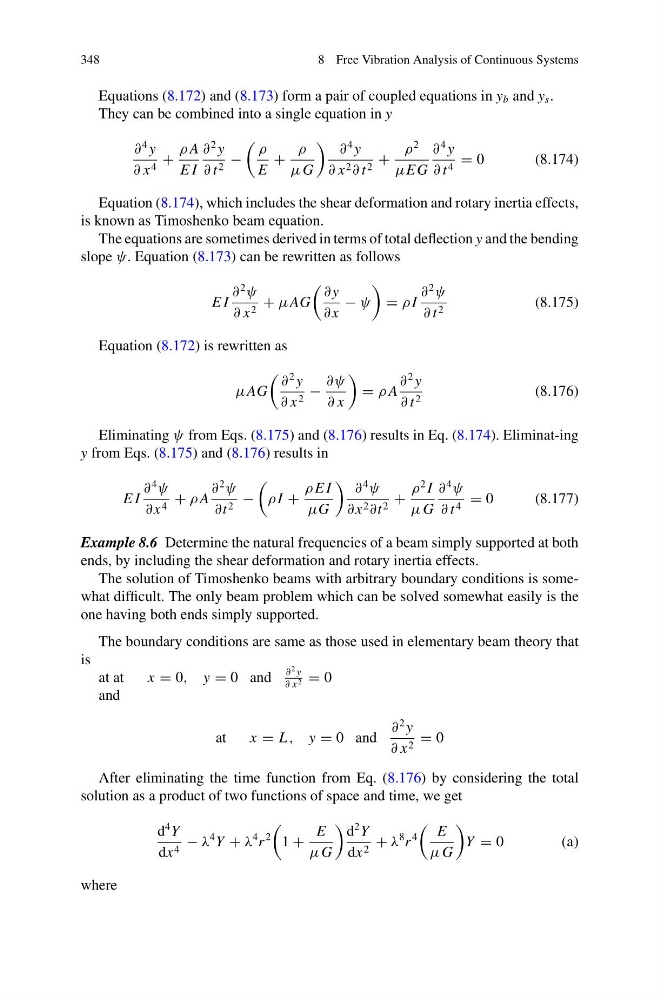
Equations (8.172) and (8.173) form a pair of coupled equations in y b and y s .
They can be combined into a single equation in y
∂
4 y
∂ x 4 +
ρ A
E I
∂
2 y
∂ t 2 −
ρ
E
+
ρ
μ G
∂
4 y
∂ x 2 ∂ t 2 +
ρ
2
μEG
∂
4 y
∂ t 4 = 0
(8.174)
Equation (8.174), which includes the shear deformation and rotary inertia effects,
is known as Timoshenko beam equation.
The equations are sometimes derived in terms of total deflection y and the bending
slope ψ. Equation (8.173) can be rewritten as follows
E I
∂
2
ψ
∂ x 2 + μAG
∂ y
∂ x
− ψ
= ρ I
∂
2
ψ
∂ t 2
(8.175)
Equation (8.172) is rewritten as
μAG
∂
2 y
∂ x 2 −
∂ψ
∂ x
= ρ A
∂
2 y
∂ t 2
(8.176)
Eliminating ψ from Eqs. (8.175) and (8.176) results in Eq. (8.174). Eliminat-ing
y from Eqs. (8.175) and (8.176) results in
E I
∂
4
ψ
∂ x 4 + ρ A
∂
2
ψ
∂t 2 −
ρ I +
ρ E I
μG
∂
4
ψ
∂ x 2 ∂t 2 +
ρ
2 I
μ G
∂
4
ψ
∂ t 4 = 0
(8.177)
Example 8.6 Determine the natural frequencies of a beam simply supported at both
ends, by including the shear deformation and rotary inertia effects.
The solution of Timoshenko beams with arbitrary boundary conditions is somewhat difficult. The only beam problem which can be solved somewhat easily is the
one having both ends simply supported.
The boundary conditions are same as those used in elementary beam theory that
is
at at
x = 0, y = 0 and
∂
2 y
∂ x 2 = 0
and
at
x = L , y = 0 and
∂
2 y
∂ x 2 = 0
After eliminating the time function from Eq. (8.176) by considering the total
solution as a product of two functions of space and time, we get
d
4 Y
dx 4 − λ
4 Y + λ
4 r
2
1 +
E
μ G
d
2 Y
dx 2 + λ
8 r
4
E
μ G
Y = 0
( a )
where
8 Free Vibration Analysis of Continuous Systems
Equations (8.172) and (8.173) form a pair of coupled equations in y b and y s .
They can be combined into a single equation in y
∂
4 y
∂ x 4 +
ρ A
E I
∂
2 y
∂ t 2 −
ρ
E
+
ρ
μ G
∂
4 y
∂ x 2 ∂ t 2 +
ρ
2
μEG
∂
4 y
∂ t 4 = 0
(8.174)
Equation (8.174), which includes the shear deformation and rotary inertia effects,
is known as Timoshenko beam equation.
The equations are sometimes derived in terms of total deflection y and the bending
slope ψ. Equation (8.173) can be rewritten as follows
E I
∂
2
ψ
∂ x 2 + μAG
∂ y
∂ x
− ψ
= ρ I
∂
2
ψ
∂ t 2
(8.175)
Equation (8.172) is rewritten as
μAG
∂
2 y
∂ x 2 −
∂ψ
∂ x
= ρ A
∂
2 y
∂ t 2
(8.176)
Eliminating ψ from Eqs. (8.175) and (8.176) results in Eq. (8.174). Eliminat-ing
y from Eqs. (8.175) and (8.176) results in
E I
∂
4
ψ
∂ x 4 + ρ A
∂
2
ψ
∂t 2 −
ρ I +
ρ E I
μG
∂
4
ψ
∂ x 2 ∂t 2 +
ρ
2 I
μ G
∂
4
ψ
∂ t 4 = 0
(8.177)
Example 8.6 Determine the natural frequencies of a beam simply supported at both
ends, by including the shear deformation and rotary inertia effects.
The solution of Timoshenko beams with arbitrary boundary conditions is somewhat difficult. The only beam problem which can be solved somewhat easily is the
one having both ends simply supported.
The boundary conditions are same as those used in elementary beam theory that
is
at at
x = 0, y = 0 and
∂
2 y
∂ x 2 = 0
and
at
x = L , y = 0 and
∂
2 y
∂ x 2 = 0
After eliminating the time function from Eq. (8.176) by considering the total
solution as a product of two functions of space and time, we get
d
4 Y
dx 4 − λ
4 Y + λ
4 r
2
1 +
E
μ G
d
2 Y
dx 2 + λ
8 r
4
E
μ G
Y = 0
( a )
where