

346
8 Free Vibration Analysis of Continuous Systems
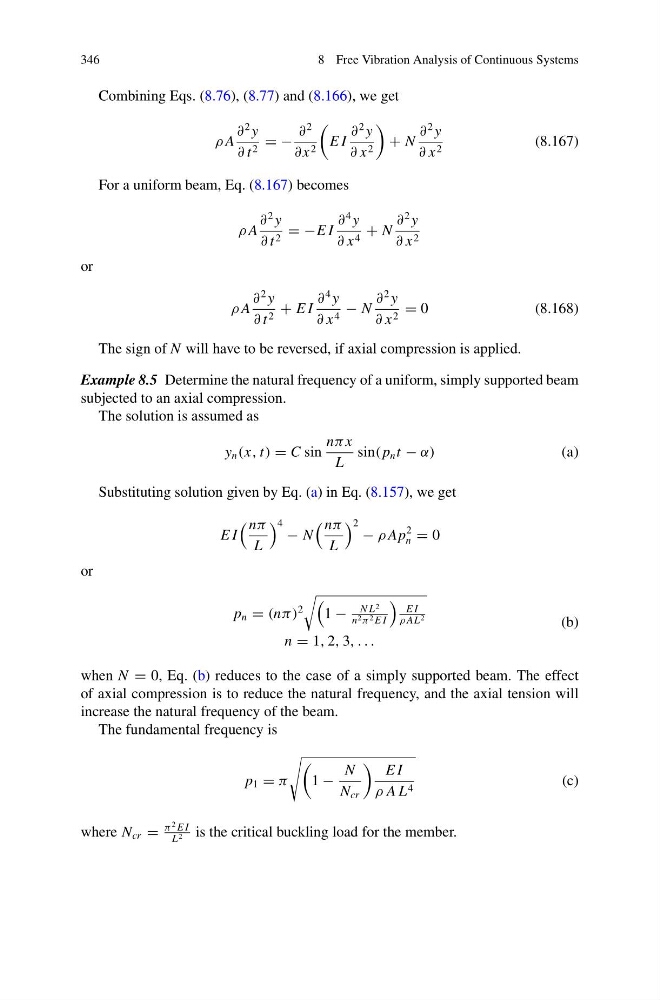
Combining Eqs. (8.76), (8.77) and (8.166), we get
ρ A
∂
2 y
∂ t 2 = −
∂
2
∂ x 2
E I
∂
2 y
∂ x 2
+ N
∂
2 y
∂ x 2
(8.167)
For a uniform beam, Eq. (8.167) becomes
ρ A
∂
2 y
∂ t 2 = −E I
∂
4 y
∂ x 4 + N
∂
2 y
∂ x 2
or
ρ A
∂
2 y
∂ t 2 + E I
∂
4 y
∂ x 4 − N
∂
2 y
∂ x 2 = 0
(8.168)
The sign of N will have to be reversed, if axial compression is applied.
Example 8.5 Determine the natural frequency of a uniform, simply supported beam
subjected to an axial compression.
The solution is assumed as
y n (x, t) = C sin
nπ x
L
sin( p n t − α)
(a)
Substituting solution given by Eq. (a) in Eq. (8.157), we get
E I
nπ
L
4 − N
nπ
L
2 − ρ Ap
2
n = 0
or
p n = (nπ)
2
1 −
N L 2
n 2 π 2 E I
E I
ρ AL 2
n = 1, 2, 3, . . .
(b)
when N = 0, Eq. (b) reduces to the case of a simply supported beam. The effect
of axial compression is to reduce the natural frequency, and the axial tension will
increase the natural frequency of the beam.
The fundamental frequency is
p 1 = π
1 −
N
N cr
E I
ρ A L 4
(c)
where N cr =
π
2 E I
L 2 is the critical buckling load for the member.
8 Free Vibration Analysis of Continuous Systems
Combining Eqs. (8.76), (8.77) and (8.166), we get
ρ A
∂
2 y
∂ t 2 = −
∂
2
∂ x 2
E I
∂
2 y
∂ x 2
+ N
∂
2 y
∂ x 2
(8.167)
For a uniform beam, Eq. (8.167) becomes
ρ A
∂
2 y
∂ t 2 = −E I
∂
4 y
∂ x 4 + N
∂
2 y
∂ x 2
or
ρ A
∂
2 y
∂ t 2 + E I
∂
4 y
∂ x 4 − N
∂
2 y
∂ x 2 = 0
(8.168)
The sign of N will have to be reversed, if axial compression is applied.
Example 8.5 Determine the natural frequency of a uniform, simply supported beam
subjected to an axial compression.
The solution is assumed as
y n (x, t) = C sin
nπ x
L
sin( p n t − α)
(a)
Substituting solution given by Eq. (a) in Eq. (8.157), we get
E I
nπ
L
4 − N
nπ
L
2 − ρ Ap
2
n = 0
or
p n = (nπ)
2
1 −
N L 2
n 2 π 2 E I
E I
ρ AL 2
n = 1, 2, 3, . . .
(b)
when N = 0, Eq. (b) reduces to the case of a simply supported beam. The effect
of axial compression is to reduce the natural frequency, and the axial tension will
increase the natural frequency of the beam.
The fundamental frequency is
p 1 = π
1 −
N
N cr
E I
ρ A L 4
(c)
where N cr =
π
2 E I
L 2 is the critical buckling load for the member.