

20
2 Free Vibration of Single Degree of Freedom System
x = A cos ( pt− ∈)
(2.12)
By squaring and adding the assumed values of x 0 and ˙
x 0 , it can be shown that
A =
x
2
0 +
˙
x
2
0
p 2
(2.13)
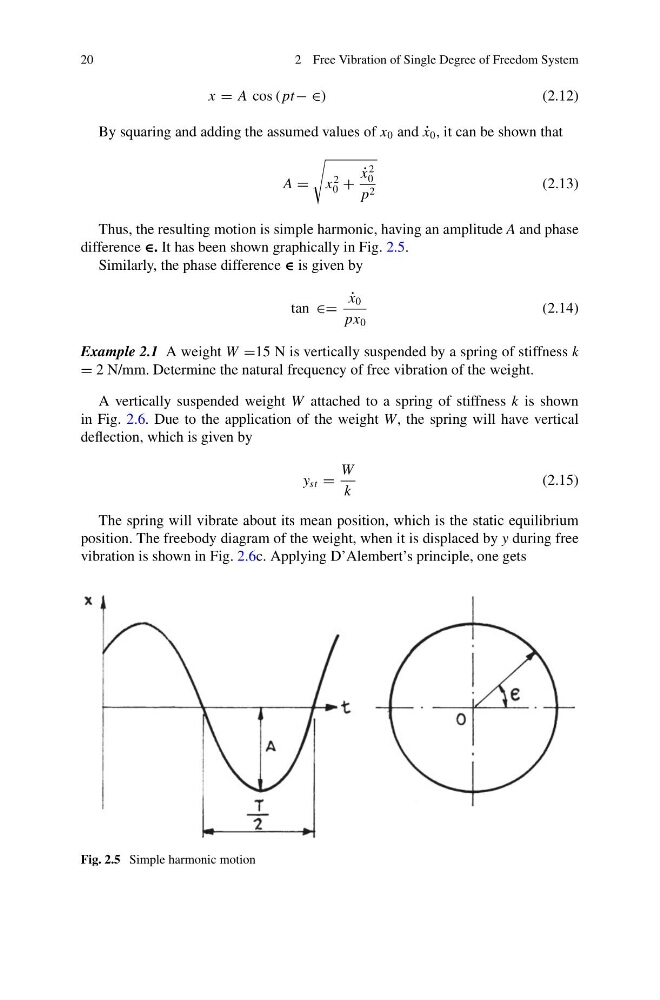
Thus, the resulting motion is simple harmonic, having an amplitude A and phase
difference ∈. It has been shown graphically in Fig. 2.5.
Similarly, the phase difference ∈ is given by
tan ∈=
˙
x 0
px 0
(2.14)
Example 2.1 A weight W =15 N is vertically suspended by a spring of stiffness k
= 2 N/mm. Determine the natural frequency of free vibration of the weight.
A vertically suspended weight W attached to a spring of stiffness k is shown
in Fig. 2.6. Due to the application of the weight W, the spring will have vertical
deflection, which is given by
y st =
W
k
(2.15)
The spring will vibrate about its mean position, which is the static equilibrium
position. The freebody diagram of the weight, when it is displaced by y during free
vibration is shown in Fig. 2.6c. Applying D’Alembert’s principle, one gets
Fig. 2.5 Simple harmonic motion
2 Free Vibration of Single Degree of Freedom System
x = A cos ( pt− ∈)
(2.12)
By squaring and adding the assumed values of x 0 and ˙
x 0 , it can be shown that
A =
x
2
0 +
˙
x
2
0
p 2
(2.13)
Thus, the resulting motion is simple harmonic, having an amplitude A and phase
difference ∈. It has been shown graphically in Fig. 2.5.
Similarly, the phase difference ∈ is given by
tan ∈=
˙
x 0
px 0
(2.14)
Example 2.1 A weight W =15 N is vertically suspended by a spring of stiffness k
= 2 N/mm. Determine the natural frequency of free vibration of the weight.
A vertically suspended weight W attached to a spring of stiffness k is shown
in Fig. 2.6. Due to the application of the weight W, the spring will have vertical
deflection, which is given by
y st =
W
k
(2.15)
The spring will vibrate about its mean position, which is the static equilibrium
position. The freebody diagram of the weight, when it is displaced by y during free
vibration is shown in Fig. 2.6c. Applying D’Alembert’s principle, one gets
Fig. 2.5 Simple harmonic motion