

326
8 Free Vibration Analysis of Continuous Systems
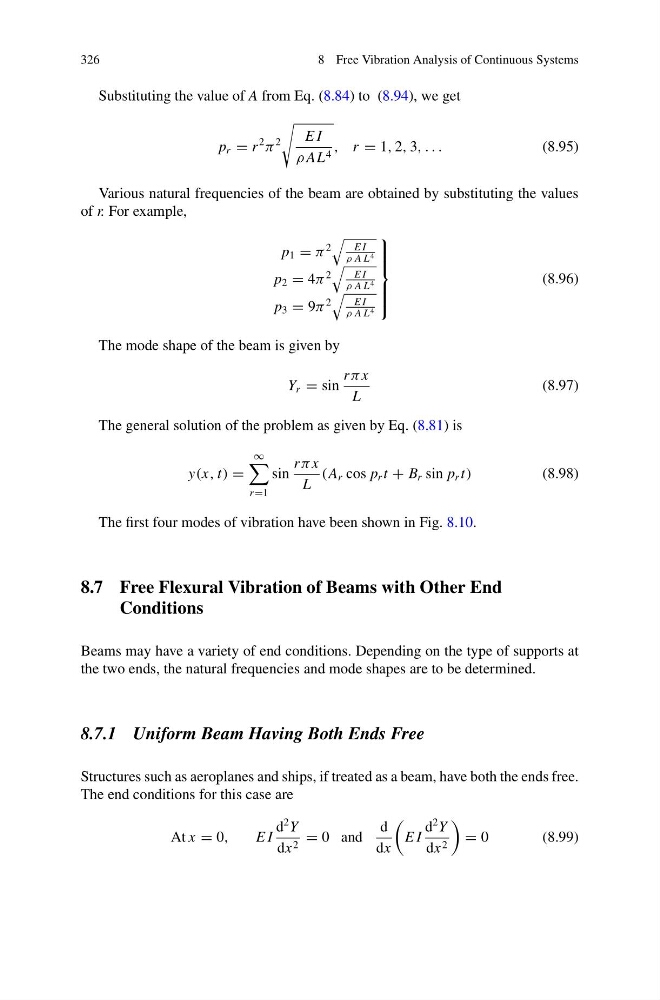
Substituting the value of A from Eq. (8.84) to (8.94), we get
p r = r
2
π
2
E I
ρ AL 4 , r = 1, 2, 3, . . .
(8.95)
Various natural frequencies of the beam are obtained by substituting the values
of r. For example,
p 1 = π
2
E I
ρ A L 4
p 2 = 4π
2
E I
ρ A L 4
p 3 = 9π
2
E I
ρ A L 4
⎫
⎪ ⎪ ⎪ ⎬
⎪ ⎪ ⎪ ⎭
(8.96)
The mode shape of the beam is given by
Y r = sin
r π x
L
(8.97)
The general solution of the problem as given by Eq. (8.81) is
y(x, t) =
∞
r =1
sin
r π x
L
(A r cos p r t + B r sin p r t)
(8.98)
The first four modes of vibration have been shown in Fig. 8.10.
8.7 Free Flexural Vibration of Beams with Other End
Conditions
Beams may have a variety of end conditions. Depending on the type of supports at
the two ends, the natural frequencies and mode shapes are to be determined.
8.7.1 Uniform Beam Having Both Ends Free
Structures such as aeroplanes and ships, if treated as a beam, have both the ends free.
The end conditions for this case are
At x = 0,
E I
d
2 Y
dx 2 = 0 and
d
dx
E I
d
2 Y
dx 2
= 0
(8.99)
8 Free Vibration Analysis of Continuous Systems
Substituting the value of A from Eq. (8.84) to (8.94), we get
p r = r
2
π
2
E I
ρ AL 4 , r = 1, 2, 3, . . .
(8.95)
Various natural frequencies of the beam are obtained by substituting the values
of r. For example,
p 1 = π
2
E I
ρ A L 4
p 2 = 4π
2
E I
ρ A L 4
p 3 = 9π
2
E I
ρ A L 4
⎫
⎪ ⎪ ⎪ ⎬
⎪ ⎪ ⎪ ⎭
(8.96)
The mode shape of the beam is given by
Y r = sin
r π x
L
(8.97)
The general solution of the problem as given by Eq. (8.81) is
y(x, t) =
∞
r =1
sin
r π x
L
(A r cos p r t + B r sin p r t)
(8.98)
The first four modes of vibration have been shown in Fig. 8.10.
8.7 Free Flexural Vibration of Beams with Other End
Conditions
Beams may have a variety of end conditions. Depending on the type of supports at
the two ends, the natural frequencies and mode shapes are to be determined.
8.7.1 Uniform Beam Having Both Ends Free
Structures such as aeroplanes and ships, if treated as a beam, have both the ends free.
The end conditions for this case are
At x = 0,
E I
d
2 Y
dx 2 = 0 and
d
dx
E I
d
2 Y
dx 2
= 0
(8.99)