

18
2 Free Vibration of Single Degree of Freedom System
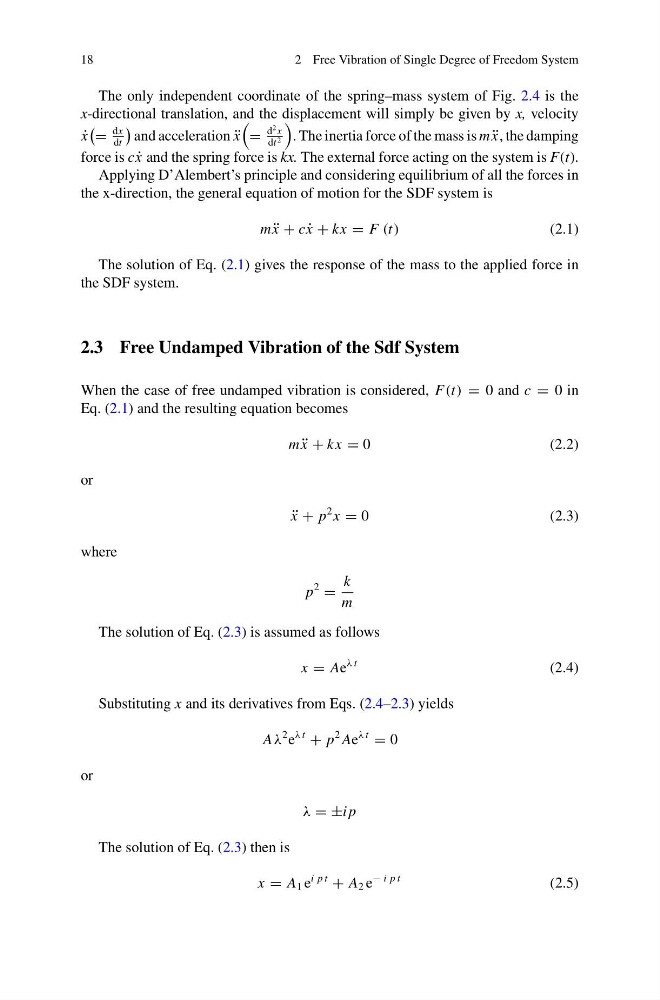
The only independent coordinate of the spring–mass system of Fig. 2.4 is the
x-directional translation, and the displacement will simply be given by x, velocity
˙
x
=
dx
dt
and acceleration ¨
x
=
d
2 x
dt 2
. The inertia force of the mass is m ¨
x, the damping
force is c ˙
x and the spring force is kx. The external force acting on the system is F(t).
Applying D’Alembert’s principle and considering equilibrium of all the forces in
the x-direction, the general equation of motion for the SDF system is
m ¨
x + c ˙
x + kx = F (t)
(2.1)
The solution of Eq. (2.1) gives the response of the mass to the applied force in
the SDF system.
2.3 Free Undamped Vibration of the Sdf System
When the case of free undamped vibration is considered, F(t) = 0 and c = 0 in
Eq. (2.1) and the resulting equation becomes
m ¨
x + kx = 0
( 2 . 2 )
or
¨
x + p
2 x = 0
(2.3)
where
p
2
=
k
m
The solution of Eq. (2.3) is assumed as follows
x = Ae
λ t
(2.4)
Substituting x and its derivatives from Eqs. (2.4–2.3) yields
A λ
2 e
λ t
+ p
2 Ae
λ t
= 0
or
λ = ±i p
The solution of Eq. (2.3) then is
x = A 1 e
i p t
+ A 2 e
− i p t
(2.5)
2 Free Vibration of Single Degree of Freedom System
The only independent coordinate of the spring–mass system of Fig. 2.4 is the
x-directional translation, and the displacement will simply be given by x, velocity
˙
x
=
dx
dt
and acceleration ¨
x
=
d
2 x
dt 2
. The inertia force of the mass is m ¨
x, the damping
force is c ˙
x and the spring force is kx. The external force acting on the system is F(t).
Applying D’Alembert’s principle and considering equilibrium of all the forces in
the x-direction, the general equation of motion for the SDF system is
m ¨
x + c ˙
x + kx = F (t)
(2.1)
The solution of Eq. (2.1) gives the response of the mass to the applied force in
the SDF system.
2.3 Free Undamped Vibration of the Sdf System
When the case of free undamped vibration is considered, F(t) = 0 and c = 0 in
Eq. (2.1) and the resulting equation becomes
m ¨
x + kx = 0
( 2 . 2 )
or
¨
x + p
2 x = 0
(2.3)
where
p
2
=
k
m
The solution of Eq. (2.3) is assumed as follows
x = Ae
λ t
(2.4)
Substituting x and its derivatives from Eqs. (2.4–2.3) yields
A λ
2 e
λ t
+ p
2 Ae
λ t
= 0
or
λ = ±i p
The solution of Eq. (2.3) then is
x = A 1 e
i p t
+ A 2 e
− i p t
(2.5)