

7.10 Complex Matrix Inversion Method …
297
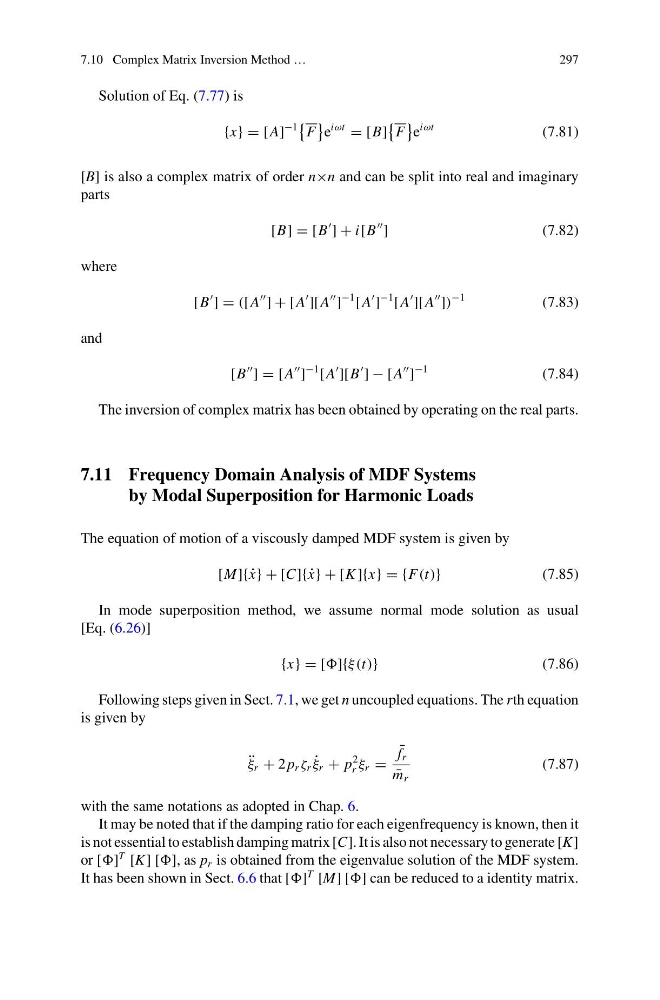
Solution of Eq. (7.77) is
{x} = [A]
−1
F
e
iωt
= [B]
F
e
iωt
(7.81)
[B] is also a complex matrix of order n×n and can be split into real and imaginary
parts
[B] = [B
] + i[B
]
(7.82)
where
[B
] = ([A
] + [A
][A
]
−1
[A
]
−1
[A
][A
])
−1
(7.83)
and
[B
] = [A
]
−1
[A
][B
] − [A
]
−1
(7.84)
The inversion of complex matrix has been obtained by operating on the real parts.
7.11 Frequency Domain Analysis of MDF Systems
by Modal Superposition for Harmonic Loads
The equation of motion of a viscously damped MDF system is given by
[M]{ ˙
x} + [C]{ ˙
x} + [K ]{x} = {F(t)}
(7.85)
In mode superposition method, we assume normal mode solution as usual
[Eq. (6.26)]
{x} = []{ξ (t)}
(7.86)
Following steps given in Sect. 7.1, we get n uncoupled equations. The rth equation
is given by
¨
ξ r + 2 p r ζ r ˙
ξ r + p
2
r ξ r =
¯
f r
¯
m r
(7.87)
with the same notations as adopted in Chap. 6.
It may be noted that if the damping ratio for each eigenfrequency is known, then it
is not essential to establish damping matrix [C]. It is also not necessary to generate [K]
or []
T [K] [], as p r is obtained from the eigenvalue solution of the MDF system.
It has been shown in Sect. 6.6 that []
T [M] [] can be reduced to a identity matrix.
297
Solution of Eq. (7.77) is
{x} = [A]
−1
F
e
iωt
= [B]
F
e
iωt
(7.81)
[B] is also a complex matrix of order n×n and can be split into real and imaginary
parts
[B] = [B
] + i[B
]
(7.82)
where
[B
] = ([A
] + [A
][A
]
−1
[A
]
−1
[A
][A
])
−1
(7.83)
and
[B
] = [A
]
−1
[A
][B
] − [A
]
−1
(7.84)
The inversion of complex matrix has been obtained by operating on the real parts.
7.11 Frequency Domain Analysis of MDF Systems
by Modal Superposition for Harmonic Loads
The equation of motion of a viscously damped MDF system is given by
[M]{ ˙
x} + [C]{ ˙
x} + [K ]{x} = {F(t)}
(7.85)
In mode superposition method, we assume normal mode solution as usual
[Eq. (6.26)]
{x} = []{ξ (t)}
(7.86)
Following steps given in Sect. 7.1, we get n uncoupled equations. The rth equation
is given by
¨
ξ r + 2 p r ζ r ˙
ξ r + p
2
r ξ r =
¯
f r
¯
m r
(7.87)
with the same notations as adopted in Chap. 6.
It may be noted that if the damping ratio for each eigenfrequency is known, then it
is not essential to establish damping matrix [C]. It is also not necessary to generate [K]
or []
T [K] [], as p r is obtained from the eigenvalue solution of the MDF system.
It has been shown in Sect. 6.6 that []
T [M] [] can be reduced to a identity matrix.