

7.2 Mode Superposition Method …
263
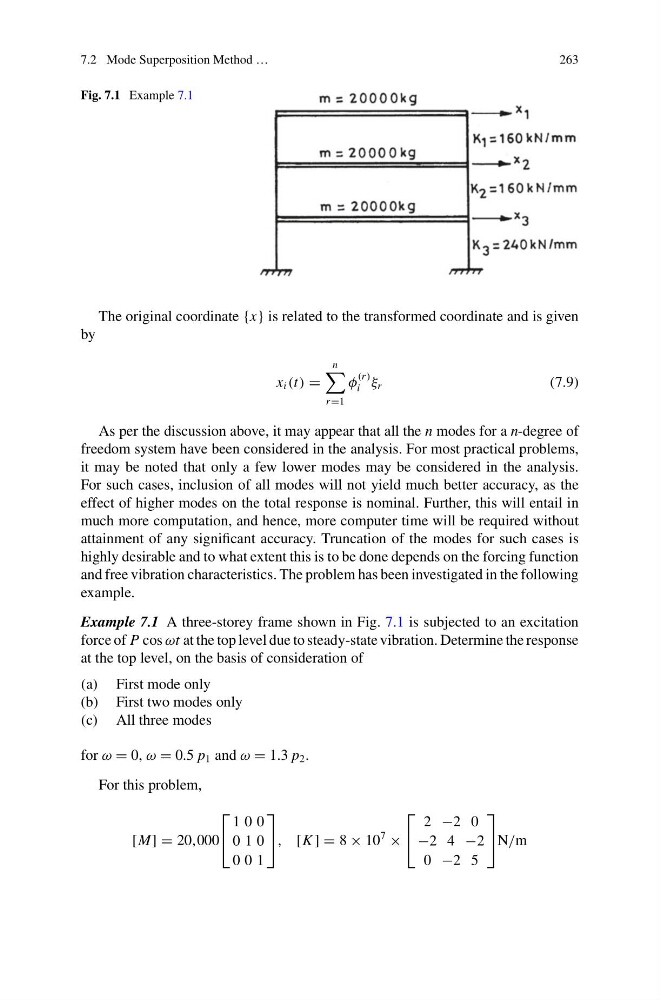
Fig. 7.1 Example 7.1
The original coordinate {x} is related to the transformed coordinate and is given
by
x i (t) =
n
r =1
φ
(r )
i ξ r
(7.9)
As per the discussion above, it may appear that all the n modes for a n-degree of
freedom system have been considered in the analysis. For most practical problems,
it may be noted that only a few lower modes may be considered in the analysis.
For such cases, inclusion of all modes will not yield much better accuracy, as the
effect of higher modes on the total response is nominal. Further, this will entail in
much more computation, and hence, more computer time will be required without
attainment of any significant accuracy. Truncation of the modes for such cases is
highly desirable and to what extent this is to be done depends on the forcing function
and free vibration characteristics. The problem has been investigated in the following
example.
Example 7.1 A three-storey frame shown in Fig. 7.1 is subjected to an excitation
force of P cos ωt at the top level due to steady-state vibration. Determine the response
at the top level, on the basis of consideration of
(a) First mode only
(b) First two modes only
(c) All three modes
for ω = 0, ω = 0.5 p 1 and ω = 1.3 p 2 .
For this problem,
[M] = 20,000
⎡
⎣
1 0 0
0 1 0
0 0 1
⎤
⎦ , [K ] = 8 × 10
7
×
⎡
⎣
2 −2 0
−2 4 −2
0 −2 5
⎤
⎦ N/m
263
Fig. 7.1 Example 7.1
The original coordinate {x} is related to the transformed coordinate and is given
by
x i (t) =
n
r =1
φ
(r )
i ξ r
(7.9)
As per the discussion above, it may appear that all the n modes for a n-degree of
freedom system have been considered in the analysis. For most practical problems,
it may be noted that only a few lower modes may be considered in the analysis.
For such cases, inclusion of all modes will not yield much better accuracy, as the
effect of higher modes on the total response is nominal. Further, this will entail in
much more computation, and hence, more computer time will be required without
attainment of any significant accuracy. Truncation of the modes for such cases is
highly desirable and to what extent this is to be done depends on the forcing function
and free vibration characteristics. The problem has been investigated in the following
example.
Example 7.1 A three-storey frame shown in Fig. 7.1 is subjected to an excitation
force of P cos ωt at the top level due to steady-state vibration. Determine the response
at the top level, on the basis of consideration of
(a) First mode only
(b) First two modes only
(c) All three modes
for ω = 0, ω = 0.5 p 1 and ω = 1.3 p 2 .
For this problem,
[M] = 20,000
⎡
⎣
1 0 0
0 1 0
0 0 1
⎤
⎦ , [K ] = 8 × 10
7
×
⎡
⎣
2 −2 0
−2 4 −2
0 −2 5
⎤
⎦ N/m