

6.21 Component Mode Synthesis Method
247
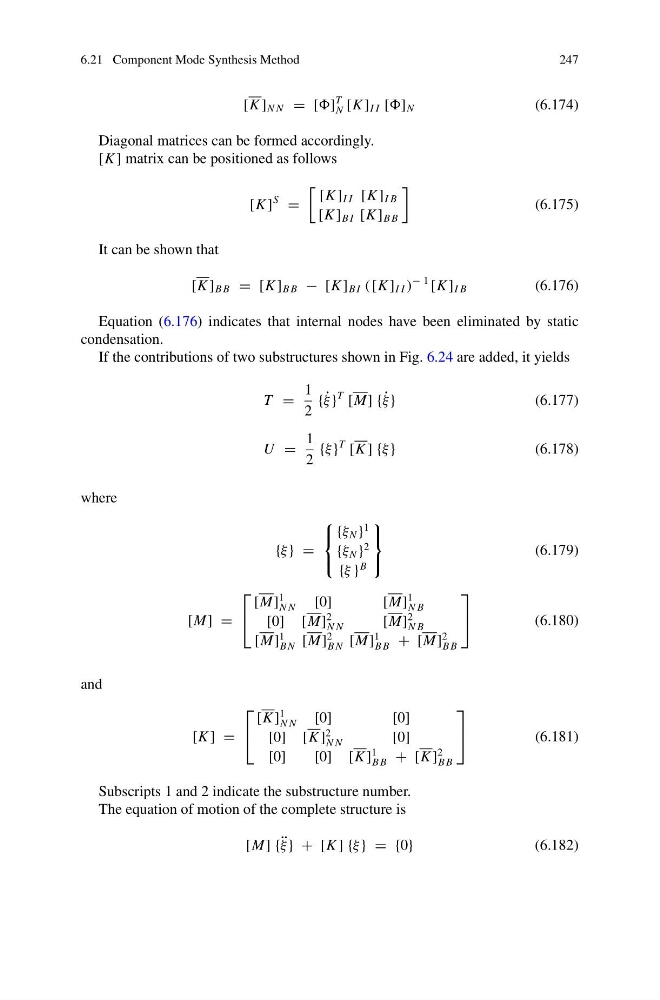
[K ] N N = []
T
N [K ] I I [] N
(6.174)
Diagonal matrices can be formed accordingly.
[K ] matrix can be positioned as follows
[K ]
S
=
[K ] I I [K ] I B
[K ] B I [K ] B B
(6.175)
It can be shown that
[K ] B B = [K ] B B − [K ] B I ( [K ] I I )
− 1
[K ] I B
(6.176)
Equation (6.176) indicates that internal nodes have been eliminated by static
condensation.
If the contributions of two substructures shown in Fig. 6.24 are added, it yields
T =
1
2
{ ˙
ξ }
T
[M] { ˙
ξ }
(6.177)
U =
1
2
{ξ }
T
[K ] {ξ }
(6.178)
where
{ξ } =
⎧
⎨
⎩
{ξ N }
1
{ξ N }
2
{ξ }
B
⎫
⎬
⎭
(6.179)
[M] =
⎡
⎣
[M]
1
N N
[0]
[M]
1
N B
[0] [M]
2
N N
[M]
2
N B
[M]
1
B N [M]
2
B N [M]
1
B B + [M]
2
B B
⎤
⎦
(6.180)
and
[K ] =
⎡
⎣
[K ]
1
N N
[0]
[ 0]
[0] [K ]
2
N N
[0]
[0]
[0] [K ]
1
B B + [K ]
2
B B
⎤
⎦
(6.181)
Subscripts 1 and 2 indicate the substructure number.
The equation of motion of the complete structure is
[M] { ¨
ξ } + [K ] {ξ } = {0}
(6.182)
247
[K ] N N = []
T
N [K ] I I [] N
(6.174)
Diagonal matrices can be formed accordingly.
[K ] matrix can be positioned as follows
[K ]
S
=
[K ] I I [K ] I B
[K ] B I [K ] B B
(6.175)
It can be shown that
[K ] B B = [K ] B B − [K ] B I ( [K ] I I )
− 1
[K ] I B
(6.176)
Equation (6.176) indicates that internal nodes have been eliminated by static
condensation.
If the contributions of two substructures shown in Fig. 6.24 are added, it yields
T =
1
2
{ ˙
ξ }
T
[M] { ˙
ξ }
(6.177)
U =
1
2
{ξ }
T
[K ] {ξ }
(6.178)
where
{ξ } =
⎧
⎨
⎩
{ξ N }
1
{ξ N }
2
{ξ }
B
⎫
⎬
⎭
(6.179)
[M] =
⎡
⎣
[M]
1
N N
[0]
[M]
1
N B
[0] [M]
2
N N
[M]
2
N B
[M]
1
B N [M]
2
B N [M]
1
B B + [M]
2
B B
⎤
⎦
(6.180)
and
[K ] =
⎡
⎣
[K ]
1
N N
[0]
[ 0]
[0] [K ]
2
N N
[0]
[0]
[0] [K ]
1
B B + [K ]
2
B B
⎤
⎦
(6.181)
Subscripts 1 and 2 indicate the substructure number.
The equation of motion of the complete structure is
[M] { ¨
ξ } + [K ] {ξ } = {0}
(6.182)