

1.6 Dynamic Loading
11
are having a much longer tenure. Due to the characteristics of these loadings, the
mathematical treatment is different for different cases.
1.7 Finite Element Discretization
One of the initial steps to be followed in the finite element analysis is the discretization
of the model. For framed structure, the discretization is obvious, as one member is
considered at a time which is the discrete element. However, for the sake of analysis,
the joint may be artificially created by considering a joint at any point of the member.
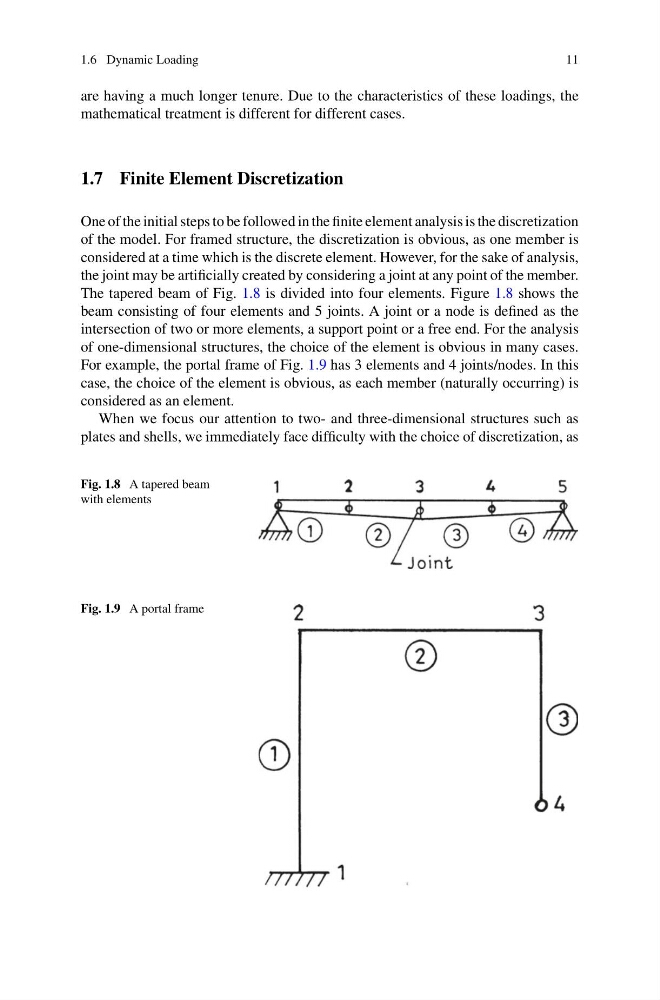
The tapered beam of Fig. 1.8 is divided into four elements. Figure 1.8 shows the
beam consisting of four elements and 5 joints. A joint or a node is defined as the
intersection of two or more elements, a support point or a free end. For the analysis
of one-dimensional structures, the choice of the element is obvious in many cases.
For example, the portal frame of Fig. 1.9 has 3 elements and 4 joints/nodes. In this
case, the choice of the element is obvious, as each member (naturally occurring) is
considered as an element.
When we focus our attention to two- and three-dimensional structures such as
plates and shells, we immediately face difficulty with the choice of discretization, as
Fig. 1.8 A tapered beam
with elements
Fig. 1.9 A portal frame
11
are having a much longer tenure. Due to the characteristics of these loadings, the
mathematical treatment is different for different cases.
1.7 Finite Element Discretization
One of the initial steps to be followed in the finite element analysis is the discretization
of the model. For framed structure, the discretization is obvious, as one member is
considered at a time which is the discrete element. However, for the sake of analysis,
the joint may be artificially created by considering a joint at any point of the member.
The tapered beam of Fig. 1.8 is divided into four elements. Figure 1.8 shows the
beam consisting of four elements and 5 joints. A joint or a node is defined as the
intersection of two or more elements, a support point or a free end. For the analysis
of one-dimensional structures, the choice of the element is obvious in many cases.
For example, the portal frame of Fig. 1.9 has 3 elements and 4 joints/nodes. In this
case, the choice of the element is obvious, as each member (naturally occurring) is
considered as an element.
When we focus our attention to two- and three-dimensional structures such as
plates and shells, we immediately face difficulty with the choice of discretization, as
Fig. 1.8 A tapered beam
with elements
Fig. 1.9 A portal frame