

6.12 Stodola’s Method
223
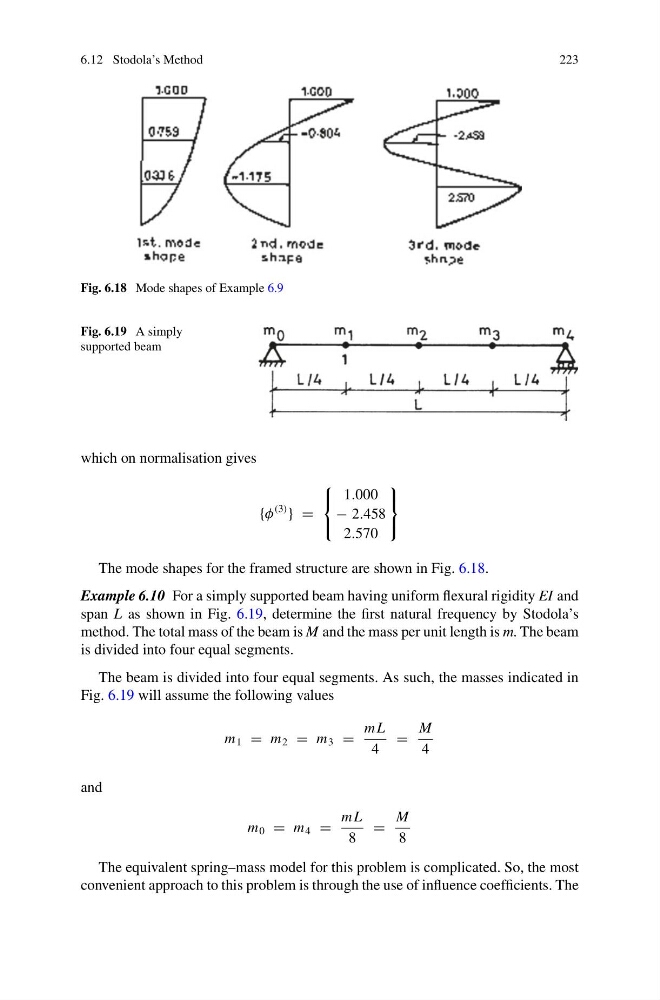
Fig. 6.18 Mode shapes of Example 6.9
Fig. 6.19 A simply
supported beam
which on normalisation gives
{φ
(3)
} =
⎧
⎨
⎩
1.000
− 2.458
2.570
⎫
⎬
⎭
The mode shapes for the framed structure are shown in Fig. 6.18.
Example 6.10 For a simply supported beam having uniform flexural rigidity EI and
span L as shown in Fig. 6.19, determine the first natural frequency by Stodola’s
method. The total mass of the beam is M and the mass per unit length is m. The beam
is divided into four equal segments.
The beam is divided into four equal segments. As such, the masses indicated in
Fig. 6.19 will assume the following values
m 1 = m 2 = m 3 =
m L
4
=
M
4
and
m 0 = m 4 =
m L
8
=
M
8
The equivalent spring–mass model for this problem is complicated. So, the most
convenient approach to this problem is through the use of influence coefficients. The
223
Fig. 6.18 Mode shapes of Example 6.9
Fig. 6.19 A simply
supported beam
which on normalisation gives
{φ
(3)
} =
⎧
⎨
⎩
1.000
− 2.458
2.570
⎫
⎬
⎭
The mode shapes for the framed structure are shown in Fig. 6.18.
Example 6.10 For a simply supported beam having uniform flexural rigidity EI and
span L as shown in Fig. 6.19, determine the first natural frequency by Stodola’s
method. The total mass of the beam is M and the mass per unit length is m. The beam
is divided into four equal segments.
The beam is divided into four equal segments. As such, the masses indicated in
Fig. 6.19 will assume the following values
m 1 = m 2 = m 3 =
m L
4
=
M
4
and
m 0 = m 4 =
m L
8
=
M
8
The equivalent spring–mass model for this problem is complicated. So, the most
convenient approach to this problem is through the use of influence coefficients. The