

6.12 Stodola’s Method
217
6.12 Stodola’s Method
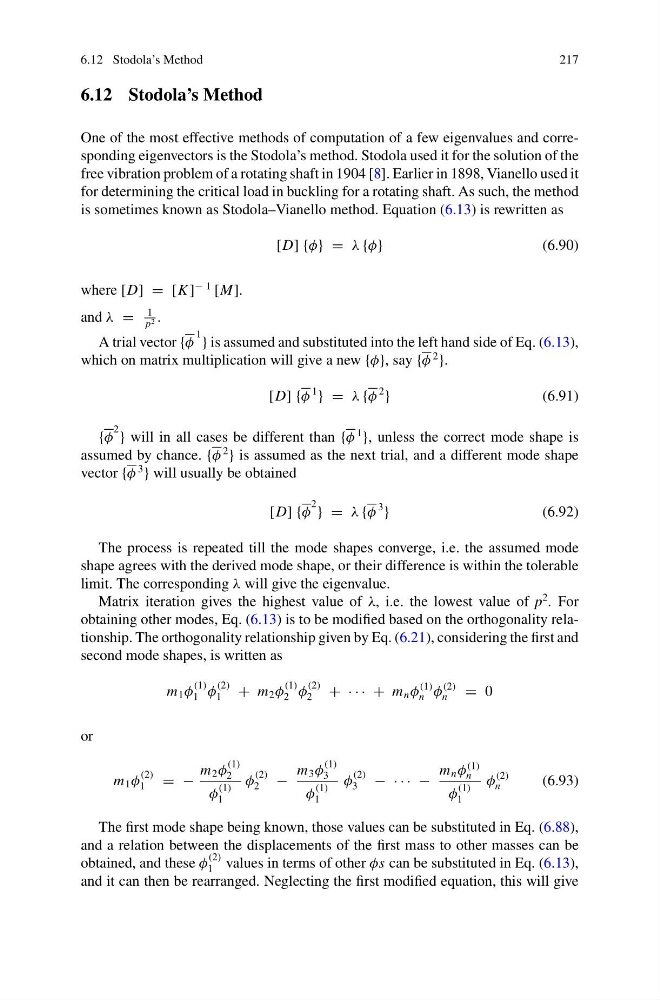
One of the most effective methods of computation of a few eigenvalues and corresponding eigenvectors is the Stodola’s method. Stodola used it for the solution of the
free vibration problem of a rotating shaft in 1904 [8]. Earlier in 1898, Vianello used it
for determining the critical load in buckling for a rotating shaft. As such, the method
is sometimes known as Stodola–Vianello method. Equation (6.13) is rewritten as
[D] {φ} = λ {φ}
(6.90)
where [D] = [K ]
− 1
[M].
and λ =
1
p 2 .
A trial vector {φ
1 } is assumed and substituted into the left hand side of Eq. (6.13),
which on matrix multiplication will give a new {φ}, say {φ
2
}.
[D] {φ
1
} = λ {φ
2
}
(6.91)
{φ
2 } will in all cases be different than {φ
1
}, unless the correct mode shape is
assumed by chance. {φ
2
} is assumed as the next trial, and a different mode shape
vector {φ
3
} will usually be obtained
[D] {φ
2 } = λ {φ
3
}
(6.92)
The process is repeated till the mode shapes converge, i.e. the assumed mode
shape agrees with the derived mode shape, or their difference is within the tolerable
limit. The corresponding λ will give the eigenvalue.
Matrix iteration gives the highest value of λ, i.e. the lowest value of p
2 . For
obtaining other modes, Eq. (6.13) is to be modified based on the orthogonality relationship. The orthogonality relationship given by Eq. (6.21), considering the first and
second mode shapes, is written as
m 1 φ
(1)
1 φ
(2)
1
+ m 2 φ
(1)
2 φ
(2)
2
+ · · · + m n φ
(1)
n φ
(2)
n
= 0
or
m 1 φ
(2)
1
= −
m 2 φ
(1)
2
φ
(1)
1
φ
(2)
2
−
m 3 φ
(1)
3
φ
(1)
1
φ
(2)
3
− · · · −
m n φ
(1)
n
φ
(1)
1
φ
(2)
n
(6.93)
The first mode shape being known, those values can be substituted in Eq. (6.88),
and a relation between the displacements of the first mass to other masses can be
obtained, and these φ
(2)
1 values in terms of other φs can be substituted in Eq. (6.13),
and it can then be rearranged. Neglecting the first modified equation, this will give
217
6.12 Stodola’s Method
One of the most effective methods of computation of a few eigenvalues and corresponding eigenvectors is the Stodola’s method. Stodola used it for the solution of the
free vibration problem of a rotating shaft in 1904 [8]. Earlier in 1898, Vianello used it
for determining the critical load in buckling for a rotating shaft. As such, the method
is sometimes known as Stodola–Vianello method. Equation (6.13) is rewritten as
[D] {φ} = λ {φ}
(6.90)
where [D] = [K ]
− 1
[M].
and λ =
1
p 2 .
A trial vector {φ
1 } is assumed and substituted into the left hand side of Eq. (6.13),
which on matrix multiplication will give a new {φ}, say {φ
2
}.
[D] {φ
1
} = λ {φ
2
}
(6.91)
{φ
2 } will in all cases be different than {φ
1
}, unless the correct mode shape is
assumed by chance. {φ
2
} is assumed as the next trial, and a different mode shape
vector {φ
3
} will usually be obtained
[D] {φ
2 } = λ {φ
3
}
(6.92)
The process is repeated till the mode shapes converge, i.e. the assumed mode
shape agrees with the derived mode shape, or their difference is within the tolerable
limit. The corresponding λ will give the eigenvalue.
Matrix iteration gives the highest value of λ, i.e. the lowest value of p
2 . For
obtaining other modes, Eq. (6.13) is to be modified based on the orthogonality relationship. The orthogonality relationship given by Eq. (6.21), considering the first and
second mode shapes, is written as
m 1 φ
(1)
1 φ
(2)
1
+ m 2 φ
(1)
2 φ
(2)
2
+ · · · + m n φ
(1)
n φ
(2)
n
= 0
or
m 1 φ
(2)
1
= −
m 2 φ
(1)
2
φ
(1)
1
φ
(2)
2
−
m 3 φ
(1)
3
φ
(1)
1
φ
(2)
3
− · · · −
m n φ
(1)
n
φ
(1)
1
φ
(2)
n
(6.93)
The first mode shape being known, those values can be substituted in Eq. (6.88),
and a relation between the displacements of the first mass to other masses can be
obtained, and these φ
(2)
1 values in terms of other φs can be substituted in Eq. (6.13),
and it can then be rearranged. Neglecting the first modified equation, this will give