

1.5 Some Basic Definitions
7
F 0 = c ˙
x
(1.3)
where ˙
x = velocity =
dx
dt
and c is the damping constant.
Coulomb damping, also known as dry friction, occurs when the motion of the
body is on a dry surface. The damping force is given by
F 0 = µ N
(1.4)
where µ is the coefficient of kinematic friction and N is the normal pressure of the
moving body on the surface.
Negative damping is a very special case, when the system is such that damping
adds energy to the system instead of it being dissipated. As such, amplitude increases
progressively in such cases. It occurs in the wires of transmission line tower.
In this book, damping will be considered throughout to be of viscous type unless
otherwise specified.
1.5.5 Degrees of Freedom
Any mass can undergo six possible displacements in space—three translations and
three rotations (about an orthogonal axis system). However, it happens with most
systems that they are allowed to move in certain directions, while their movements
in other directions are constrained. The minimum number of coordinate systems
required to indicate the position of the mass at any instant of time is referred to as
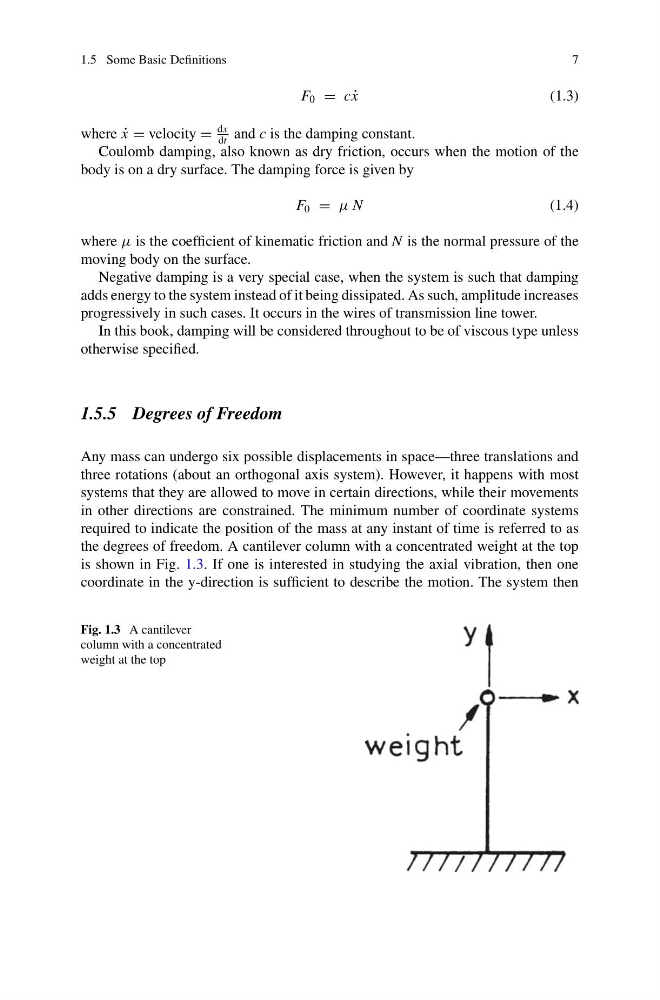
the degrees of freedom. A cantilever column with a concentrated weight at the top
is shown in Fig. 1.3. If one is interested in studying the axial vibration, then one
coordinate in the y-direction is sufficient to describe the motion. The system then
Fig. 1.3 A cantilever
column with a concentrated
weight at the top
7
F 0 = c ˙
x
(1.3)
where ˙
x = velocity =
dx
dt
and c is the damping constant.
Coulomb damping, also known as dry friction, occurs when the motion of the
body is on a dry surface. The damping force is given by
F 0 = µ N
(1.4)
where µ is the coefficient of kinematic friction and N is the normal pressure of the
moving body on the surface.
Negative damping is a very special case, when the system is such that damping
adds energy to the system instead of it being dissipated. As such, amplitude increases
progressively in such cases. It occurs in the wires of transmission line tower.
In this book, damping will be considered throughout to be of viscous type unless
otherwise specified.
1.5.5 Degrees of Freedom
Any mass can undergo six possible displacements in space—three translations and
three rotations (about an orthogonal axis system). However, it happens with most
systems that they are allowed to move in certain directions, while their movements
in other directions are constrained. The minimum number of coordinate systems
required to indicate the position of the mass at any instant of time is referred to as
the degrees of freedom. A cantilever column with a concentrated weight at the top
is shown in Fig. 1.3. If one is interested in studying the axial vibration, then one
coordinate in the y-direction is sufficient to describe the motion. The system then
Fig. 1.3 A cantilever
column with a concentrated
weight at the top