

6.8 Dunkerley’s Equation
199
1
p
2
1
∼ = d 11 + d 22 + · · · + d nn =
n
i = 1
d ii
(6.51)
Dunkerley’s equation gives a lower bound to the fundamental frequency.
From Eq. (6.13), it is seen that
d ii = f ii m i
(6.52)
for a lumped mass system, where f ii is the influence coefficient, that is, it denotes
the deflection at i due to a unit force applied at i. The quantity d ii can be given a
physical meaning. If we set all the masses of the system to zero except m i , the system
becomes a single degree of freedom system, having a natural frequency given by
1
p
2
ii
= f ii m i
(6.53)
Substituting Eqs. (6.52) and (6.53) into Eq. (6.51), Dunkerley’s equation is
expressed as follows:
1
p
2
1
∼ =
1
p
2
11
+
1
p
2
22
+ · · · +
1
p 2
n n
(6.54)
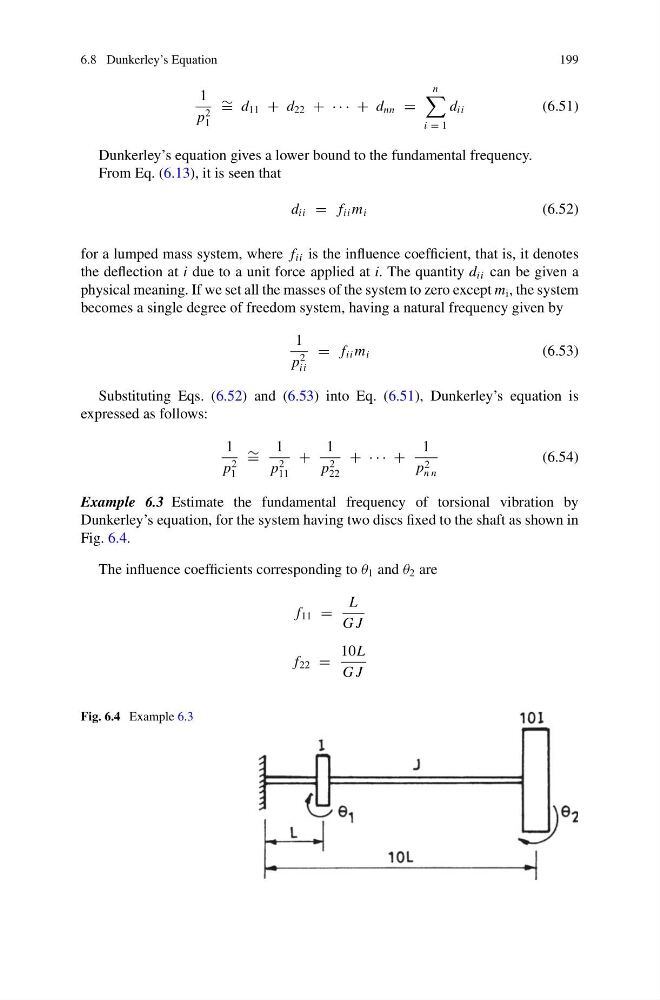
Example 6.3 Estimate the fundamental frequency of torsional vibration by
Dunkerley’s equation, for the system having two discs fixed to the shaft as shown in
Fig. 6.4.
The influence coefficients corresponding to θ 1 and θ 2 are
f 11 =
L
G J
f 22 =
10L
G J
Fig. 6.4 Example 6.3
199
1
p
2
1
∼ = d 11 + d 22 + · · · + d nn =
n
i = 1
d ii
(6.51)
Dunkerley’s equation gives a lower bound to the fundamental frequency.
From Eq. (6.13), it is seen that
d ii = f ii m i
(6.52)
for a lumped mass system, where f ii is the influence coefficient, that is, it denotes
the deflection at i due to a unit force applied at i. The quantity d ii can be given a
physical meaning. If we set all the masses of the system to zero except m i , the system
becomes a single degree of freedom system, having a natural frequency given by
1
p
2
ii
= f ii m i
(6.53)
Substituting Eqs. (6.52) and (6.53) into Eq. (6.51), Dunkerley’s equation is
expressed as follows:
1
p
2
1
∼ =
1
p
2
11
+
1
p
2
22
+ · · · +
1
p 2
n n
(6.54)
Example 6.3 Estimate the fundamental frequency of torsional vibration by
Dunkerley’s equation, for the system having two discs fixed to the shaft as shown in
Fig. 6.4.
The influence coefficients corresponding to θ 1 and θ 2 are
f 11 =
L
G J
f 22 =
10L
G J
Fig. 6.4 Example 6.3