

5.8 Free Vibration of Damped Two Degrees of Freedom System
179
Given that at t = 0, x = 10, θ = 0, ˙
x = 5 and ˙
θ = 2, determine the
resultant motion of the system.
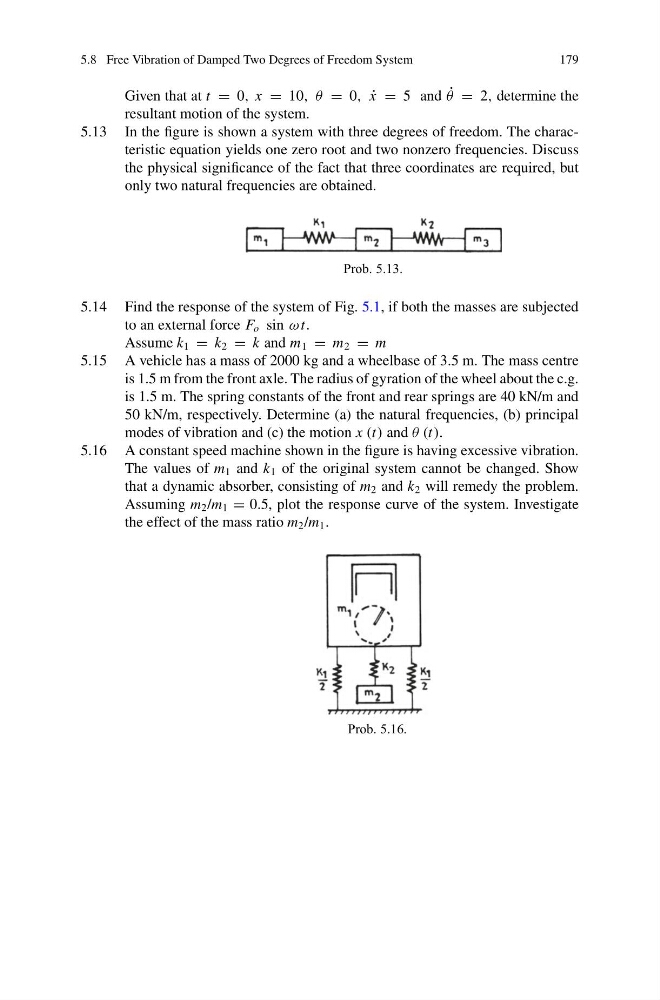
5.13 In the figure is shown a system with three degrees of freedom. The characteristic equation yields one zero root and two nonzero frequencies. Discuss
the physical significance of the fact that three coordinates are required, but
only two natural frequencies are obtained.
Prob. 5.13.
5.14 Find the response of the system of Fig. 5.1, if both the masses are subjected
to an external force F o sin ω t.
Assume k 1 = k 2 = k and m 1 = m 2 = m
5.15 A vehicle has a mass of 2000 kg and a wheelbase of 3.5 m. The mass centre
is 1.5 m from the front axle. The radius of gyration of the wheel about the c.g.
is 1.5 m. The spring constants of the front and rear springs are 40 kN/m and
50 kN/m, respectively. Determine (a) the natural frequencies, (b) principal
modes of vibration and (c) the motion x (t) and θ (t).
5.16 A constant speed machine shown in the figure is having excessive vibration.
The values of m 1 and k 1 of the original system cannot be changed. Show
that a dynamic absorber, consisting of m 2 and k 2 will remedy the problem.
Assuming m 2 /m 1 = 0.5, plot the response curve of the system. Investigate
the effect of the mass ratio m 2 /m 1 .
Prob. 5.16.
179
Given that at t = 0, x = 10, θ = 0, ˙
x = 5 and ˙
θ = 2, determine the
resultant motion of the system.
5.13 In the figure is shown a system with three degrees of freedom. The characteristic equation yields one zero root and two nonzero frequencies. Discuss
the physical significance of the fact that three coordinates are required, but
only two natural frequencies are obtained.
Prob. 5.13.
5.14 Find the response of the system of Fig. 5.1, if both the masses are subjected
to an external force F o sin ω t.
Assume k 1 = k 2 = k and m 1 = m 2 = m
5.15 A vehicle has a mass of 2000 kg and a wheelbase of 3.5 m. The mass centre
is 1.5 m from the front axle. The radius of gyration of the wheel about the c.g.
is 1.5 m. The spring constants of the front and rear springs are 40 kN/m and
50 kN/m, respectively. Determine (a) the natural frequencies, (b) principal
modes of vibration and (c) the motion x (t) and θ (t).
5.16 A constant speed machine shown in the figure is having excessive vibration.
The values of m 1 and k 1 of the original system cannot be changed. Show
that a dynamic absorber, consisting of m 2 and k 2 will remedy the problem.
Assuming m 2 /m 1 = 0.5, plot the response curve of the system. Investigate
the effect of the mass ratio m 2 /m 1 .
Prob. 5.16.