

174
5 Vibration of Two Degrees of Freedom System
where
B 1 =
C
2
1 + C
2
2 ,
B 2 =
C
2
3 + C
2
4
B
1 = B 1
α
2
1 + β
2
1 ,
B
2 = B 2
α
2
2 + β
2
2
(5.56)
ϕ d 1 = tan
− 1
C 2
C 1
,
ϕ d 2 = tan
− 1
C 4
C 3
ϕ
d 1
= tan
− 1
γ
1 C 2
γ 1 C 1
, ϕ
d 2
= tan
− 1
γ
2 C 4
γ 2 C 3
(5.57)
Natural modes that exist have a phase relationship, that is, they are out of phase.
Some simplifications are possible for the case of small viscous damping where it
is approximated as follows:
p d 1 = p 1 , γ
1 = γ 1
p d 2 = p 2 , γ
2 = γ 2
(5.58)
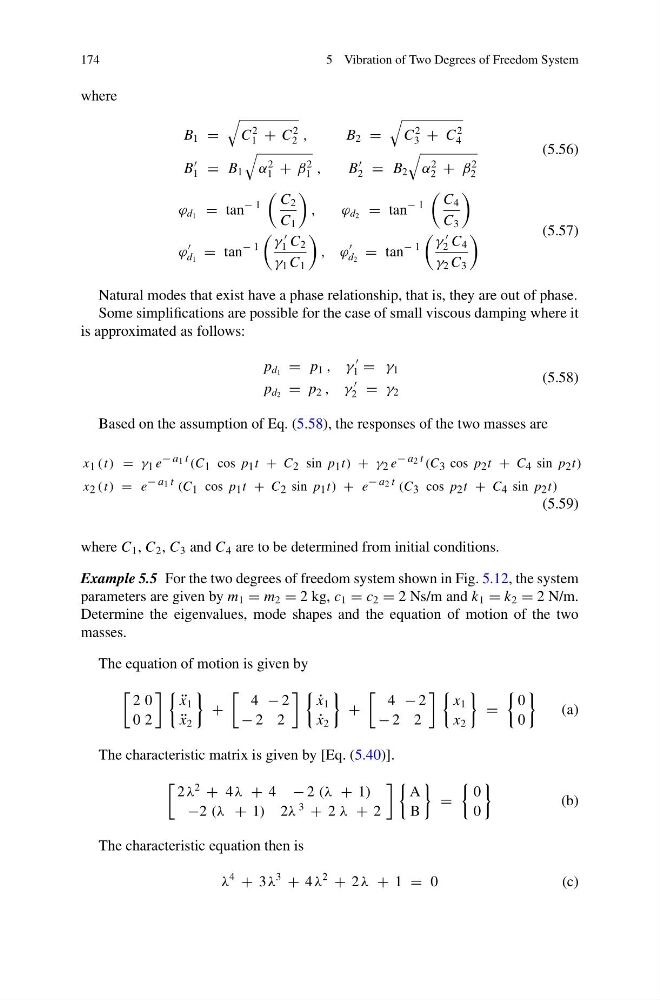
Based on the assumption of Eq. (5.58), the responses of the two masses are
x 1 ( t) = γ 1 e − a 1 t (C 1 cos p 1 t + C 2 sin p 1 t) + γ 2 e − a 2 t (C 3 cos p 2 t + C 4 sin p 2 t)
x 2 ( t) = e − a 1 t (C 1 cos p 1 t + C 2 sin p 1 t) + e − a 2 t (C 3 cos p 2 t + C 4 sin p 2 t)
(5.59)
where C 1 , C 2 , C 3 and C 4 are to be determined from initial conditions.
Example 5.5 For the two degrees of freedom system shown in Fig. 5.12, the system
parameters are given by m 1 = m 2 = 2 kg, c 1 = c 2 = 2 Ns/m and k 1 = k 2 = 2 N/m.
Determine the eigenvalues, mode shapes and the equation of motion of the two
masses.
The equation of motion is given by
2 0
0 2
¨
x 1
¨
x 2
+
4 − 2
− 2 2
˙
x 1
˙
x 2
+
4 − 2
− 2 2
x 1
x 2
=
0
0
(a)
The characteristic matrix is given by [Eq. (5.40)].
2 λ
2
+ 4 λ + 4 − 2 (λ + 1)
−2 (λ + 1) 2λ
3
+ 2 λ + 2
A
B
=
0
0
(b)
The characteristic equation then is
λ
4
+ 3λ
3
+ 4 λ
2
+ 2 λ + 1 = 0
( c )
5 Vibration of Two Degrees of Freedom System
where
B 1 =
C
2
1 + C
2
2 ,
B 2 =
C
2
3 + C
2
4
B
1 = B 1
α
2
1 + β
2
1 ,
B
2 = B 2
α
2
2 + β
2
2
(5.56)
ϕ d 1 = tan
− 1
C 2
C 1
,
ϕ d 2 = tan
− 1
C 4
C 3
ϕ
d 1
= tan
− 1
γ
1 C 2
γ 1 C 1
, ϕ
d 2
= tan
− 1
γ
2 C 4
γ 2 C 3
(5.57)
Natural modes that exist have a phase relationship, that is, they are out of phase.
Some simplifications are possible for the case of small viscous damping where it
is approximated as follows:
p d 1 = p 1 , γ
1 = γ 1
p d 2 = p 2 , γ
2 = γ 2
(5.58)
Based on the assumption of Eq. (5.58), the responses of the two masses are
x 1 ( t) = γ 1 e − a 1 t (C 1 cos p 1 t + C 2 sin p 1 t) + γ 2 e − a 2 t (C 3 cos p 2 t + C 4 sin p 2 t)
x 2 ( t) = e − a 1 t (C 1 cos p 1 t + C 2 sin p 1 t) + e − a 2 t (C 3 cos p 2 t + C 4 sin p 2 t)
(5.59)
where C 1 , C 2 , C 3 and C 4 are to be determined from initial conditions.
Example 5.5 For the two degrees of freedom system shown in Fig. 5.12, the system
parameters are given by m 1 = m 2 = 2 kg, c 1 = c 2 = 2 Ns/m and k 1 = k 2 = 2 N/m.
Determine the eigenvalues, mode shapes and the equation of motion of the two
masses.
The equation of motion is given by
2 0
0 2
¨
x 1
¨
x 2
+
4 − 2
− 2 2
˙
x 1
˙
x 2
+
4 − 2
− 2 2
x 1
x 2
=
0
0
(a)
The characteristic matrix is given by [Eq. (5.40)].
2 λ
2
+ 4 λ + 4 − 2 (λ + 1)
−2 (λ + 1) 2λ
3
+ 2 λ + 2
A
B
=
0
0
(b)
The characteristic equation then is
λ
4
+ 3λ
3
+ 4 λ
2
+ 2 λ + 1 = 0
( c )