

124
3 Forced Vibration of Single Degree of Freedom System
G = shear modulus of the shaft = 0.8 × 10
11 N/m
2
3.27 A vibrating system with a moving base has a mass of 400 kg, a spring of
stiffness 50,000 N/m and a damper whose damping constant is not known. It
has been found that when the amplitude of support vibration is 3 mm at the
natural frequency of the supported system, the amplitude of the vibration of
the mass is 12 mm. Determine (1) the damping constant of the system, (2)
the dynamic force amplitude at the base and (3) the amplitude of the mass
relative to the base.
3.28 The radial clearance between the stator and the rotor of a variable-speed
electric motor is 1 mm. The mass of the rotor is 30 kg and its unbalance (me)
is 7.5 kg–mm. The rotor is centrally placed between the two bearings, that
is, the bearings are 1 m on either side of the rotor. The operating speed of the
machine varies between 600 and 6000 rpm. Assuming negligible damping,
determine the shaft diameter so that the rotor is always clear of the stator at
operating condition.
3.29 An accelerometer can measure vibrations in the range of 0–50 Hz. The
maximum error that is likely to occur in the measurement is 1%. The
suspended mass m is 0.1 kg. Find the spring stiffness and damping coefficient
of the accelerometer.
3.30 A velometer has a damping ratio ζ = 0.5 and a natural frequency of 25 Hz.
Determine the lowest frequency of vibration of the vibrating body so that the
error of measurement of velocity is 1%.
3.31 A spring–mass system has a spring constant 4000 N/m. It is subjected to a
harmonic force of amplitude 50 N and frequency 4 Hz. The amplitude of the
forced vibration of the mass is 20 mm. Find the value of m.
3.32 Determine the ratio of the maximum amplitude to resonant amplitude for a
viscously damped system when it is subjected to steady-state vibration in
harmonic force.
3.33 A machine weighing 30,000 N exerts a harmonic force of 3000 N amplitude,
at 10 Hz at its supports. After installing the machine on a spring-type isolator,
the force exerted on the support is reduced to 300 N. Determine the spring
stiffness k.
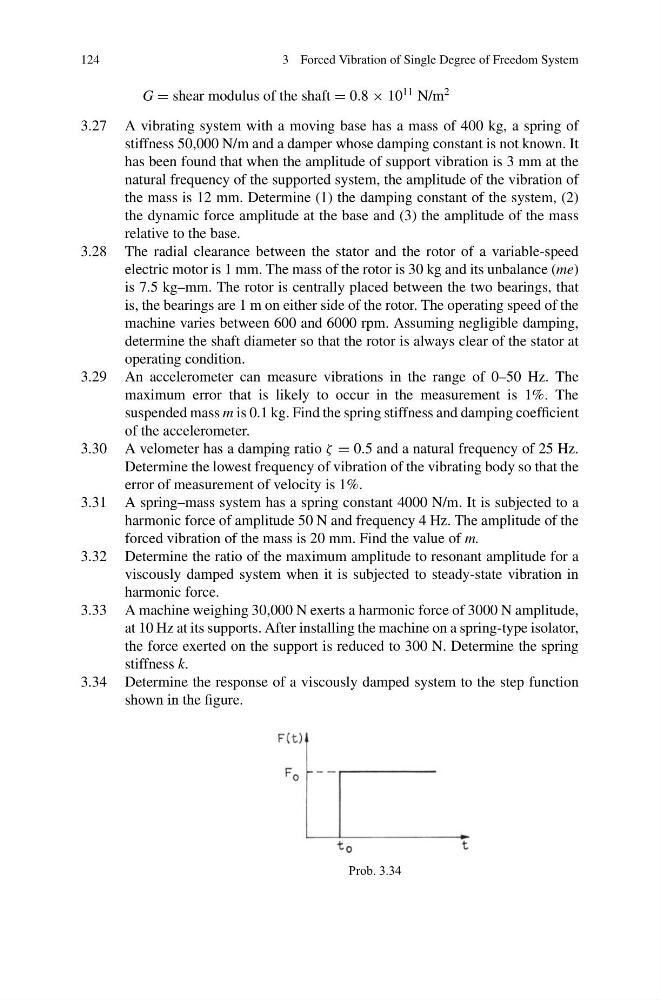
3.34 Determine the response of a viscously damped system to the step function
shown in the figure.
Prob. 3.34
3 Forced Vibration of Single Degree of Freedom System
G = shear modulus of the shaft = 0.8 × 10
11 N/m
2
3.27 A vibrating system with a moving base has a mass of 400 kg, a spring of
stiffness 50,000 N/m and a damper whose damping constant is not known. It
has been found that when the amplitude of support vibration is 3 mm at the
natural frequency of the supported system, the amplitude of the vibration of
the mass is 12 mm. Determine (1) the damping constant of the system, (2)
the dynamic force amplitude at the base and (3) the amplitude of the mass
relative to the base.
3.28 The radial clearance between the stator and the rotor of a variable-speed
electric motor is 1 mm. The mass of the rotor is 30 kg and its unbalance (me)
is 7.5 kg–mm. The rotor is centrally placed between the two bearings, that
is, the bearings are 1 m on either side of the rotor. The operating speed of the
machine varies between 600 and 6000 rpm. Assuming negligible damping,
determine the shaft diameter so that the rotor is always clear of the stator at
operating condition.
3.29 An accelerometer can measure vibrations in the range of 0–50 Hz. The
maximum error that is likely to occur in the measurement is 1%. The
suspended mass m is 0.1 kg. Find the spring stiffness and damping coefficient
of the accelerometer.
3.30 A velometer has a damping ratio ζ = 0.5 and a natural frequency of 25 Hz.
Determine the lowest frequency of vibration of the vibrating body so that the
error of measurement of velocity is 1%.
3.31 A spring–mass system has a spring constant 4000 N/m. It is subjected to a
harmonic force of amplitude 50 N and frequency 4 Hz. The amplitude of the
forced vibration of the mass is 20 mm. Find the value of m.
3.32 Determine the ratio of the maximum amplitude to resonant amplitude for a
viscously damped system when it is subjected to steady-state vibration in
harmonic force.
3.33 A machine weighing 30,000 N exerts a harmonic force of 3000 N amplitude,
at 10 Hz at its supports. After installing the machine on a spring-type isolator,
the force exerted on the support is reduced to 300 N. Determine the spring
stiffness k.
3.34 Determine the response of a viscously damped system to the step function
shown in the figure.
Prob. 3.34