

122
3 Forced Vibration of Single Degree of Freedom System
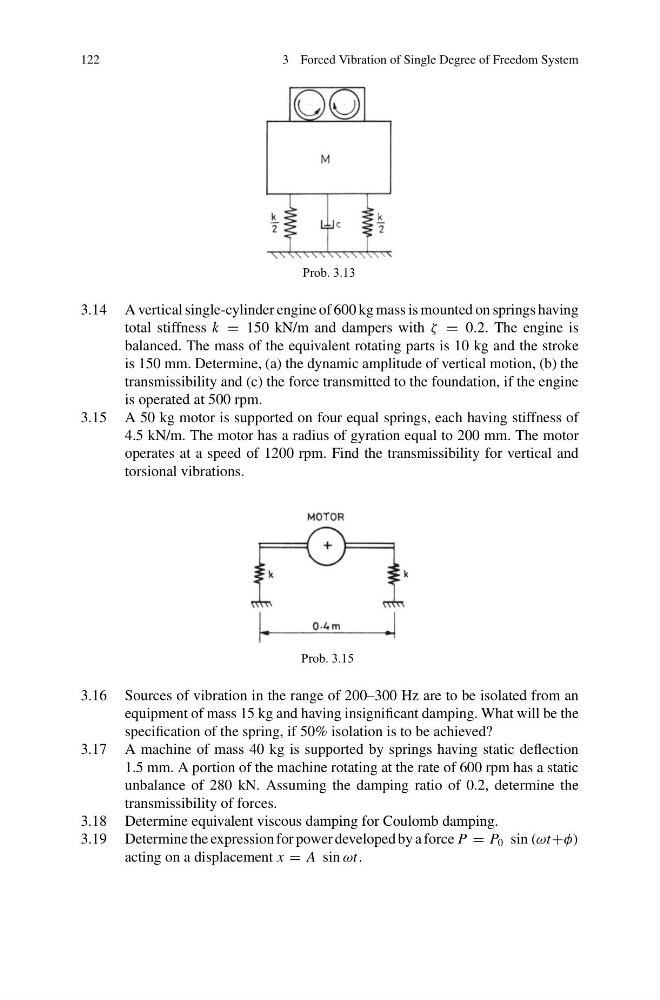
Prob. 3.13
3.14 A vertical single-cylinder engine of 600 kg mass is mounted on springs having
total stiffness k = 150 kN/m and dampers with ζ = 0.2. The engine is
balanced. The mass of the equivalent rotating parts is 10 kg and the stroke
is 150 mm. Determine, (a) the dynamic amplitude of vertical motion, (b) the
transmissibility and (c) the force transmitted to the foundation, if the engine
is operated at 500 rpm.
3.15 A 50 kg motor is supported on four equal springs, each having stiffness of
4.5 kN/m. The motor has a radius of gyration equal to 200 mm. The motor
operates at a speed of 1200 rpm. Find the transmissibility for vertical and
torsional vibrations.
Prob. 3.15
3.16 Sources of vibration in the range of 200–300 Hz are to be isolated from an
equipment of mass 15 kg and having insignificant damping. What will be the
specification of the spring, if 50% isolation is to be achieved?
3.17 A machine of mass 40 kg is supported by springs having static deflection
1.5 mm. A portion of the machine rotating at the rate of 600 rpm has a static
unbalance of 280 kN. Assuming the damping ratio of 0.2, determine the
transmissibility of forces.
3.18 Determine equivalent viscous damping for Coulomb damping.
3.19 Determine the expression for power developed by a force P = P 0 sin (ωt+φ)
acting on a displacement x = A sin ωt.
3 Forced Vibration of Single Degree of Freedom System
Prob. 3.13
3.14 A vertical single-cylinder engine of 600 kg mass is mounted on springs having
total stiffness k = 150 kN/m and dampers with ζ = 0.2. The engine is
balanced. The mass of the equivalent rotating parts is 10 kg and the stroke
is 150 mm. Determine, (a) the dynamic amplitude of vertical motion, (b) the
transmissibility and (c) the force transmitted to the foundation, if the engine
is operated at 500 rpm.
3.15 A 50 kg motor is supported on four equal springs, each having stiffness of
4.5 kN/m. The motor has a radius of gyration equal to 200 mm. The motor
operates at a speed of 1200 rpm. Find the transmissibility for vertical and
torsional vibrations.
Prob. 3.15
3.16 Sources of vibration in the range of 200–300 Hz are to be isolated from an
equipment of mass 15 kg and having insignificant damping. What will be the
specification of the spring, if 50% isolation is to be achieved?
3.17 A machine of mass 40 kg is supported by springs having static deflection
1.5 mm. A portion of the machine rotating at the rate of 600 rpm has a static
unbalance of 280 kN. Assuming the damping ratio of 0.2, determine the
transmissibility of forces.
3.18 Determine equivalent viscous damping for Coulomb damping.
3.19 Determine the expression for power developed by a force P = P 0 sin (ωt+φ)
acting on a displacement x = A sin ωt.