

108
3 Forced Vibration of Single Degree of Freedom System
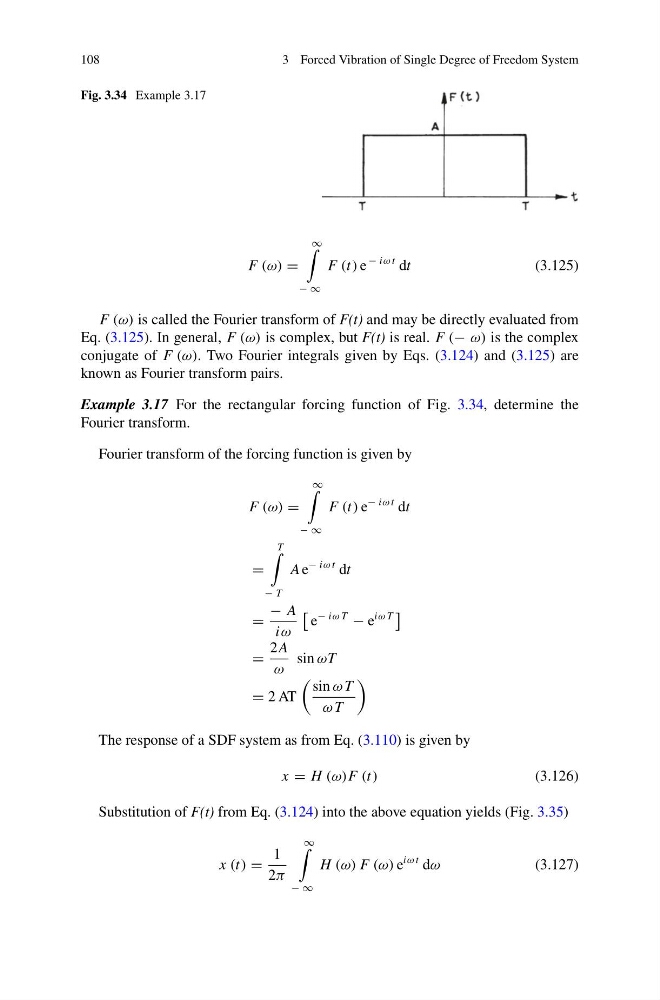
Fig. 3.34 Example 3.17
F (ω) =
∞
− ∞
F (t) e
− iω t dt
(3.125)
F (ω) is called the Fourier transform of F(t) and may be directly evaluated from
Eq. (3.125). In general, F (ω) is complex, but F(t) is real. F (− ω) is the complex
conjugate of F (ω). Two Fourier integrals given by Eqs. (3.124) and (3.125) are
known as Fourier transform pairs.
Example 3.17 For the rectangular forcing function of Fig. 3.34, determine the
Fourier transform.
Fourier transform of the forcing function is given by
F (ω) =
∞
− ∞
F (t) e
− iω t dt
=
T
− T
A e
− iω t dt
=
− A
iω
e
− iω T
− e
iω T
=
2 A
ω
sin ωT
= 2 AT
sin ω T
ω T
The response of a SDF system as from Eq. (3.110) is given by
x = H (ω)F (t)
(3.126)
Substitution of F(t) from Eq. (3.124) into the above equation yields (Fig. 3.35)
x (t) =
1
2π
∞
− ∞
H (ω) F (ω) e
iω t dω
(3.127)
3 Forced Vibration of Single Degree of Freedom System
Fig. 3.34 Example 3.17
F (ω) =
∞
− ∞
F (t) e
− iω t dt
(3.125)
F (ω) is called the Fourier transform of F(t) and may be directly evaluated from
Eq. (3.125). In general, F (ω) is complex, but F(t) is real. F (− ω) is the complex
conjugate of F (ω). Two Fourier integrals given by Eqs. (3.124) and (3.125) are
known as Fourier transform pairs.
Example 3.17 For the rectangular forcing function of Fig. 3.34, determine the
Fourier transform.
Fourier transform of the forcing function is given by
F (ω) =
∞
− ∞
F (t) e
− iω t dt
=
T
− T
A e
− iω t dt
=
− A
iω
e
− iω T
− e
iω T
=
2 A
ω
sin ωT
= 2 AT
sin ω T
ω T
The response of a SDF system as from Eq. (3.110) is given by
x = H (ω)F (t)
(3.126)
Substitution of F(t) from Eq. (3.124) into the above equation yields (Fig. 3.35)
x (t) =
1
2π
∞
− ∞
H (ω) F (ω) e
iω t dω
(3.127)