

3.14 Response Due to Periodic Forces
99
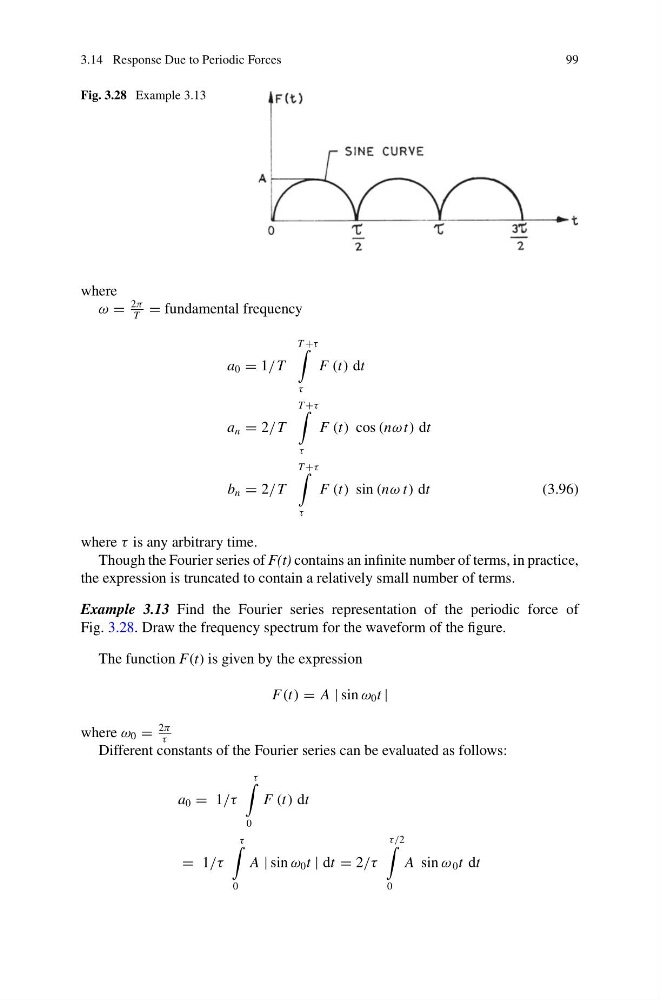
Fig. 3.28 Example 3.13
where
ω =
2π
T
= fundamental frequency
a 0 = 1/T
T +τ
τ
F (t) dt
a n = 2/T
T +τ
τ
F (t) cos (nω t) dt
b n = 2/T
T +τ
τ
F (t) sin (nω t) dt
(3.96)
where τ is any arbitrary time.
Though the Fourier series of F(t) contains an infinite number of terms, in practice,
the expression is truncated to contain a relatively small number of terms.
Example 3.13 Find the Fourier series representation of the periodic force of
Fig. 3.28. Draw the frequency spectrum for the waveform of the figure.
The function F(t) is given by the expression
F(t) = A | sin ω 0 t |
where ω 0 =
2π
τ
Different constants of the Fourier series can be evaluated as follows:
a 0 = 1/τ
τ
0
F (t) dt
= 1/τ
τ
0
A | sin ω 0 t | dt = 2/τ
τ/2
0
A sin ω 0 t dt
99
Fig. 3.28 Example 3.13
where
ω =
2π
T
= fundamental frequency
a 0 = 1/T
T +τ
τ
F (t) dt
a n = 2/T
T +τ
τ
F (t) cos (nω t) dt
b n = 2/T
T +τ
τ
F (t) sin (nω t) dt
(3.96)
where τ is any arbitrary time.
Though the Fourier series of F(t) contains an infinite number of terms, in practice,
the expression is truncated to contain a relatively small number of terms.
Example 3.13 Find the Fourier series representation of the periodic force of
Fig. 3.28. Draw the frequency spectrum for the waveform of the figure.
The function F(t) is given by the expression
F(t) = A | sin ω 0 t |
where ω 0 =
2π
τ
Different constants of the Fourier series can be evaluated as follows:
a 0 = 1/τ
τ
0
F (t) dt
= 1/τ
τ
0
A | sin ω 0 t | dt = 2/τ
τ/2
0
A sin ω 0 t dt