

86
3 Forced Vibration of Single Degree of Freedom System
3.10 Vibration Measuring Seismic Instruments
An engineer may be interested to measure any one or all the three quantities of
interest in the motion of a vibrating body. They are the displacement, the velocity
and the acceleration. Suitable instruments have been developed to measure each of
the above quantities. Principles associated with the instrument are essentially based
on the spring–mass system.
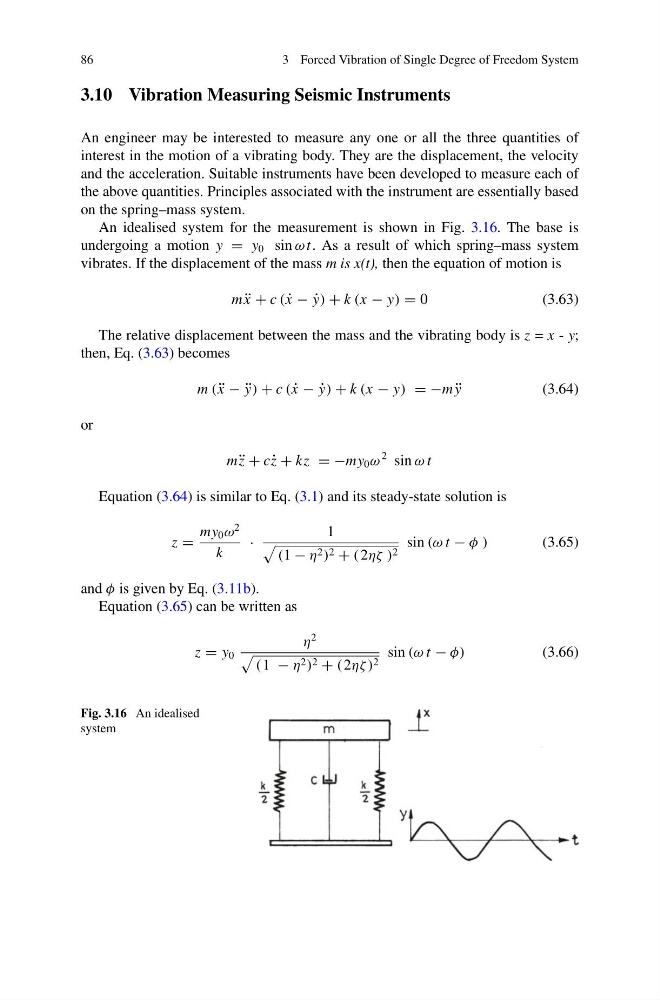
An idealised system for the measurement is shown in Fig. 3.16. The base is
undergoing a motion y = y 0 sin ω t. As a result of which spring–mass system
vibrates. If the displacement of the mass m is x(t), then the equation of motion is
m ¨
x + c ( ˙
x − ˙
y) + k (x − y) = 0
(3.63)
The relative displacement between the mass and the vibrating body is z = x - y;
then, Eq. (3.63) becomes
m ( ¨
x − ¨
y) + c ( ˙
x − ˙
y) + k (x − y) = −m ¨
y
(3.64)
or
m ¨
z + c˙ z + kz = −my 0 ω
2 sin ω t
Equation (3.64) is similar to Eq. (3.1) and its steady-state solution is
z =
my 0 ω
2
k
·
1
(1 − η 2 ) 2 + ( 2ηζ ) 2
sin (ω t − φ )
(3.65)
and φ is given by Eq. (3.11b).
Equation (3.65) can be written as
z = y 0
η
2
( 1 − η 2 ) 2 + ( 2ηζ ) 2
sin (ω t − φ)
(3.66)
Fig. 3.16 An idealised
system
3 Forced Vibration of Single Degree of Freedom System
3.10 Vibration Measuring Seismic Instruments
An engineer may be interested to measure any one or all the three quantities of
interest in the motion of a vibrating body. They are the displacement, the velocity
and the acceleration. Suitable instruments have been developed to measure each of
the above quantities. Principles associated with the instrument are essentially based
on the spring–mass system.
An idealised system for the measurement is shown in Fig. 3.16. The base is
undergoing a motion y = y 0 sin ω t. As a result of which spring–mass system
vibrates. If the displacement of the mass m is x(t), then the equation of motion is
m ¨
x + c ( ˙
x − ˙
y) + k (x − y) = 0
(3.63)
The relative displacement between the mass and the vibrating body is z = x - y;
then, Eq. (3.63) becomes
m ( ¨
x − ¨
y) + c ( ˙
x − ˙
y) + k (x − y) = −m ¨
y
(3.64)
or
m ¨
z + c˙ z + kz = −my 0 ω
2 sin ω t
Equation (3.64) is similar to Eq. (3.1) and its steady-state solution is
z =
my 0 ω
2
k
·
1
(1 − η 2 ) 2 + ( 2ηζ ) 2
sin (ω t − φ )
(3.65)
and φ is given by Eq. (3.11b).
Equation (3.65) can be written as
z = y 0
η
2
( 1 − η 2 ) 2 + ( 2ηζ ) 2
sin (ω t − φ)
(3.66)
Fig. 3.16 An idealised
system