

4 Running Kinetic Simulations: A Brief Tutorial
Once we have a candidate model for the reaction mechanisms and the DFT energy
values (Gibbs energy barriers), the next task is to simulate the experiments. If the
simulation agrees with the experimental data, then the proposed scheme is a plausible mechanism, although this agreement by itself does not rule out other possible
mechanisms.
The reaction kinetics simulations presented here have been carried out with the
biochemical system simulator COPASI [15] that generates and solves numerically
the set of differential equations corresponding to the kinetic reactions to obtain the
concentration over time data of each species A(t), B(t). . . starting from the initial
concentrations. The temperature can be different for each experiment (run) and can
also be defined as a function of time. Like other similar programs, COPASI has a
user-friendly graphical interface, online Support Manual and is available free of
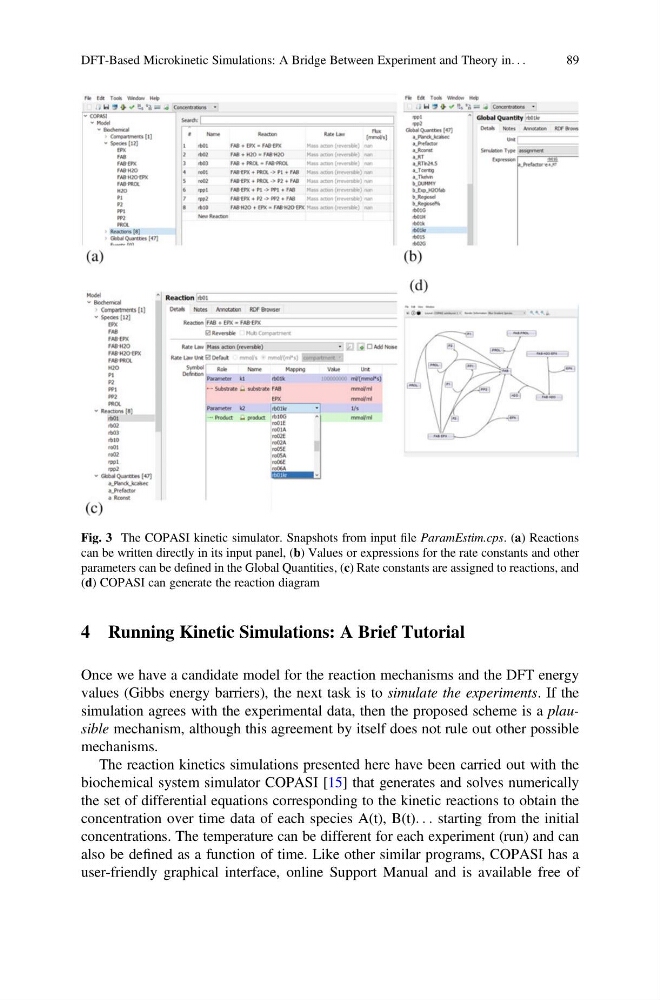
Fig. 3 The COPASI kinetic simulator. Snapshots from input file ParamEstim.cps. (a) Reactions
can be written directly in its input panel, (b) Values or expressions for the rate constants and other
parameters can be defined in the Global Quantities, (c) Rate constants are assigned to reactions, and
(d) COPASI can generate the reaction diagram
DFT-Based Microkinetic Simulations: A Bridge Between Experiment and Theory in. . .
89
Once we have a candidate model for the reaction mechanisms and the DFT energy
values (Gibbs energy barriers), the next task is to simulate the experiments. If the
simulation agrees with the experimental data, then the proposed scheme is a plausible mechanism, although this agreement by itself does not rule out other possible
mechanisms.
The reaction kinetics simulations presented here have been carried out with the
biochemical system simulator COPASI [15] that generates and solves numerically
the set of differential equations corresponding to the kinetic reactions to obtain the
concentration over time data of each species A(t), B(t). . . starting from the initial
concentrations. The temperature can be different for each experiment (run) and can
also be defined as a function of time. Like other similar programs, COPASI has a
user-friendly graphical interface, online Support Manual and is available free of
Fig. 3 The COPASI kinetic simulator. Snapshots from input file ParamEstim.cps. (a) Reactions
can be written directly in its input panel, (b) Values or expressions for the rate constants and other
parameters can be defined in the Global Quantities, (c) Rate constants are assigned to reactions, and
(d) COPASI can generate the reaction diagram
DFT-Based Microkinetic Simulations: A Bridge Between Experiment and Theory in. . .
89