

reaction kinetics models based on empirical laws. On the contrary, in research it is
worth to go deeper into the details of elementary reactions (microkinetic modeling)
to be able to envisage and design new, groundbreaking synthetic routes that, in the
long term, will pay off for the additional time and cost. For further reading on
microkinetic modeling, see a recent review [1] and references thereof as well as Refs.
[2–10].
Instead of assembling yet another review, the goal of this chapter is to enable the
reader to carry out microkinetic modeling and simulation studies of synthetic
chemistry problems, assuming the availability of a set of DFT energy values for
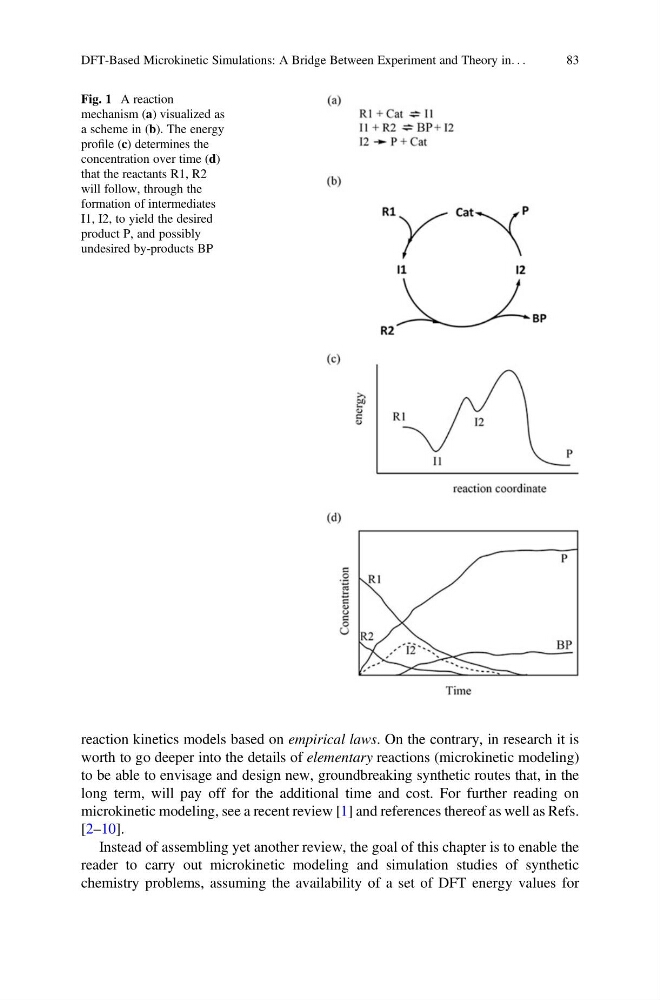
Fig. 1 A reaction
mechanism (a) visualized as
a scheme in (b). The energy
profile (c) determines the
concentration over time (d)
that the reactants R1, R2
will follow, through the
formation of intermediates
I1, I2, to yield the desired
product P, and possibly
undesired by-products BP
DFT-Based Microkinetic Simulations: A Bridge Between Experiment and Theory in. . .
83
worth to go deeper into the details of elementary reactions (microkinetic modeling)
to be able to envisage and design new, groundbreaking synthetic routes that, in the
long term, will pay off for the additional time and cost. For further reading on
microkinetic modeling, see a recent review [1] and references thereof as well as Refs.
[2–10].
Instead of assembling yet another review, the goal of this chapter is to enable the
reader to carry out microkinetic modeling and simulation studies of synthetic
chemistry problems, assuming the availability of a set of DFT energy values for
Fig. 1 A reaction
mechanism (a) visualized as
a scheme in (b). The energy
profile (c) determines the
concentration over time (d)
that the reactants R1, R2
will follow, through the
formation of intermediates
I1, I2, to yield the desired
product P, and possibly
undesired by-products BP
DFT-Based Microkinetic Simulations: A Bridge Between Experiment and Theory in. . .
83